Swiss Replica Movement Guide — Every Clone Caliber Explained (2026)
The Complete Technical Reference to 1:1 Clone Calibers for Rolex, AP, Patek, Omega & IWC
Clone movements have changed everything in the replica watch industry. Five years ago, most replicas ran on generic Asian movements with fake engravings slapped on top. That era is over. Today’s best clone calibers replicate the architecture, gear trains, and even the winding characteristics of genuine Swiss movements.
This guide is a complete technical reference to every major clone caliber in production. We’ve disassembled, tested, and compared hundreds of clone movements across every major brand. This isn’t marketing copy — it’s built from hands-on experience with every caliber worth discussing. If you’re new to the superclone market, start with our complete superclone watches buying guide for an overview of materials, factories, and QC standards.
What You’ll Learn in This Guide:
- Rolex calibers (3235, 3285, 3255, 4130) — how each clone movement compares to the genuine, spec-by-spec, with tables and red flags to watch for
- Audemars Piguet (3120, 4401) — why AP clones are as much about finishing as function, and what the display caseback reveals
- Patek Philippe (324 SC, 240) — the challenge of replicating ultra-thin movements and micro-rotors at a fraction of the thickness
- Omega (8800/8900, 3861) — the truth about co-axial escapement clones and what actually makes it inside the case
- IWC & Vacheron Constantin — why ETA-based clones are sometimes the smarter choice, and how decoration quality varies
- Maintenance schedules — service intervals by caliber type, daily care tips, magnetization prevention
- Our QC process — how we test, regulate, and verify every movement before shipping
Whether you’re choosing your first superclone or comparing factories for a specific reference, this guide gives you the technical knowledge to make an informed decision.
In This Guide
01. Rolex Clone Movements — 3235, 3285, 3255, 4130
02. Audemars Piguet — 3120, 4401 flyback
03. Patek Philippe — 324 SC, 240 micro-rotor
04. Omega — co-axial clones, Speedmaster
05. IWC & Vacheron — ETA-based & finishing
06. Maintenance Guide — service intervals & care
07. QC Process — how we verify movements
08. FAQ — common questions answered
What Makes a Clone Movement “1:1” — And Why Most Aren’t
The term “1:1 clone movement” gets thrown around carelessly. Sellers label anything with the right number of jewels as “1:1.” That’s misleading. A true 1:1 clone replicates these specific elements:
- Bridge layout and screw positions — identical to genuine, not approximated
- Gear train architecture — correct wheel counts, ratios, and placement
- Balance wheel diameter and frequency — matching 28,800 vph with proper inertia
- Rotor weight distribution — correct winding efficiency and direction
- Power reserve — actual hours, not inflated specs
- Hand stack height — determines how hands sit relative to the dial
Most mid-tier replicas fail on at least two of these points. The bridge layout might look right in photos, but screw positions are off by fractions of a millimeter. The power reserve is claimed at 72 hours but dies at 40. These details matter because they affect daily wearability — not just aesthetics.
Rolex Clone Movements — The Gold Standard of Replication
No brand has received more engineering attention from clone movement manufacturers than Rolex. The demand is massive, and the competition between factories has pushed quality to remarkable levels. Here’s every major Rolex caliber currently cloned.
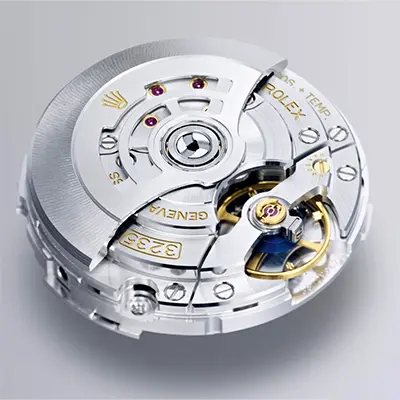
Clone Caliber 3235 — The Workhorse
The 3235 sits inside more Rolex models than any other movement: Submariner 126610, Datejust 126234, Explorer 124270, Sea-Dweller 126600, and Oyster Perpetual 126000 among others. It’s the most refined clone movement in production today.
| Specification | Genuine Rolex 3235 | Best Clone 3235 |
|---|---|---|
| Frequency | 28,800 vph | 28,800 vph |
| Power Reserve | 70 hours | 68–72 hours |
| Jewels | 31 | 31 |
| Rotor Type | Chromalight bidirectional | Bidirectional, correct weight |
| Accuracy (regulated) | ±2 sec/day (COSC) | ±5–10 sec/day |
| Hacking | Yes | Yes |
| Hand-wind | Yes | Yes |
What sets the best 3235 clones apart is the Chronergy escapement replication. The genuine uses a nickel-phosphorus pallet fork with optimized geometry. Top clone versions achieve similar energy efficiency — that’s why the 70-hour power reserve is real, not faked with a weaker mainspring.
Date change behavior is another tell. Genuine 3235 uses an instantaneous date change around midnight. The best clones replicate this with a snap that completes in under one second. Cheaper versions use semi-instant mechanisms where the date “drags” for 10–15 minutes.
Technical Note: The 3235 replaced the legendary 3135 in most models starting 2020. Some factories still produce 3135 clones for vintage-style references, but the 3235 is now the standard for modern Rolex replicas.
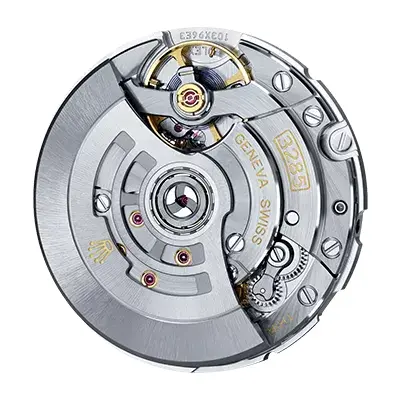
Clone Caliber 3285 — The True GMT
The 3285 was a breakthrough moment for clone manufacturing. Previous GMT clones used modified movements where the hour hand couldn’t jump independently — you’d have to rotate the bezel to track a second timezone. The 3285 clone fixed that.
In the genuine caliber, an independent hour hand mechanism uses a 24-hour wheel connected through a clutch system. The clone replicates this architecture. Pull the crown to position 1, and the local hour hand jumps in one-hour increments while minutes and seconds continue running. That’s the behavior GMT owners expect.
This movement powers the GMT-Master II 126710 (Pepsi, Batman, Sprite, and Root Beer bezels). Factory selection matters here more than with any other Rolex clone, because the GMT complication adds mechanical complexity that cheaper builders can’t handle reliably.
Clone Caliber 3255 — Day-Date Precision
Day-Date models require two calendar complications: day and date. The 3255 clone handles both with correct switching behavior. The day disc rotates through a 7-position star wheel, changing semi-instantly around midnight. The date operates through a similar instantaneous mechanism.
Weight distribution in Day-Date clones deserves attention. These watches use precious metal cases (gold or platinum in genuine), so the movement’s mass relative to the case affects wrist feel. Top 3255 clones account for this with correctly weighted rotors.
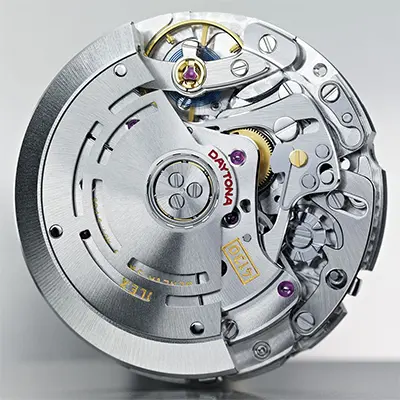
Clone Caliber 4130 — The Daytona Challenge
The 4130 is the most technically demanding Rolex caliber to clone. It’s an integrated chronograph — meaning the chronograph mechanism is built into the base movement, not added as a module on top. This design requires precise engineering of the vertical clutch, column wheel, and chronograph gear train.
| 4130 Feature | What to Check | Red Flag |
|---|---|---|
| Pusher action | Smooth start/stop, no hesitation | Sticky or gritty pushers |
| Chronograph seconds | Smooth sweep, instant reset to 12 | Stuttering or slow reset |
| Sub-dial spacing | Matches genuine dial layout exactly | Sub-dials too close or misaligned |
| Running seconds | Continuous sweep at 6 o’clock | Ticking or irregular sweep |
| Power reserve | 72 hours (chronograph off) | Dies under 48 hours |
The vertical clutch is what makes a great 4130 clone feel right. When you start the chronograph, the seconds hand should begin moving with zero stutter — no “jump” to catch up. This requires the driving wheel and chronograph wheel to engage through a friction-fit coupling that transfers torque smoothly. Cheap 4130 clones use a horizontal clutch instead, which produces a visible jump at startup.
Hands-On Insight: We test every Daytona clone by running the chronograph for 24 continuous hours. A well-built 4130 clone should show no timing deviation between chronograph-on and chronograph-off states beyond ±3 seconds.
Audemars Piguet Clone Movements — Where Decoration Meets Function
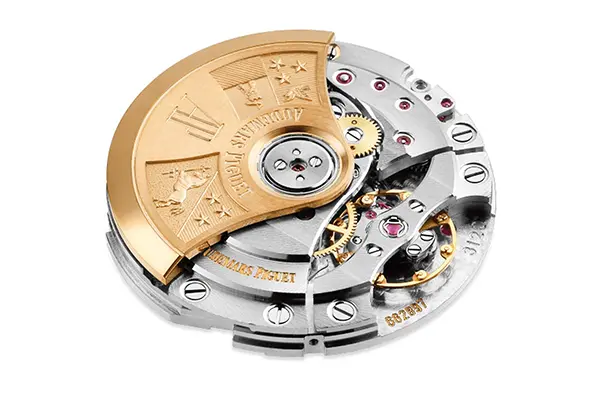
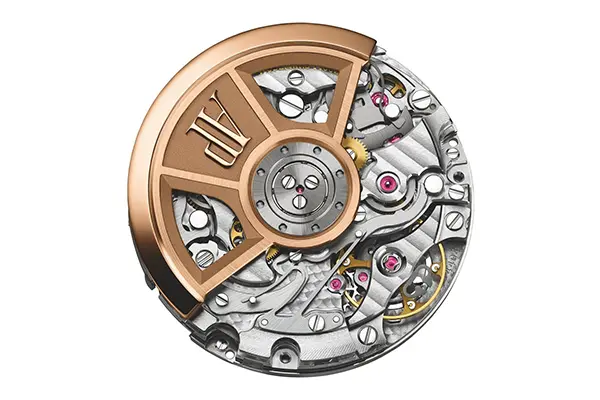
AP replicas face a unique challenge. The Royal Oak’s display caseback means the movement is always visible. Every bridge edge, every screw slot, every rotor engraving is on display. This makes AP clone movements as much about finishing as function.
Clone Caliber 3120 — Royal Oak Foundation
The 3120 powers the Royal Oak 15500 and 15202 (Jumbo). It’s a time-only automatic with date. The genuine movement features the AP signature Geneva stripes, perlage on the base plate, and a 22k gold rotor with the AP monogram.
Top-tier 3120 clones replicate the decoration hierarchy correctly: Geneva stripes run in the right direction, perlage dots have consistent diameter, and the rotor’s brushed finish matches the genuine’s texture. The balance wheel oscillates at 28,800 vph with a power reserve around 60 hours.
One critical detail — the 3120’s date quickset mechanism. In the genuine, pulling the crown to the first position and turning clockwise advances the date. The best clones replicate this detent feel. Cheaper versions have a mushy crown pull with no clear position feedback.
Clone Caliber 4401 — Royal Oak Chronograph
The 4401 is AP’s integrated flyback chronograph. “Flyback” means you can reset and restart the chronograph in a single pusher press — no need to stop, reset, then restart. It’s a complication that requires precise mechanical sequencing.
This caliber powers the Royal Oak Chronograph 26240. The clone version replicates the column wheel, vertical clutch, and flyback mechanism. Pusher resistance should feel firm but not stiff — genuine pushers operate with approximately 1.5–2 kg of force. The chronograph sub-dials at 6 and 12 o’clock (minutes and hours) must be perfectly aligned with the dial printing.
The 4401 clone is not a watch for rough use. AP chronograph movements have tighter tolerances than Rolex equivalents, and the clone versions reflect this. Regular service intervals — we recommend every 3–4 years — keep these movements running within spec.
Patek Philippe Clone Movements — Engineering Subtlety
Patek clones operate on different principles. Where Rolex emphasizes robustness and AP focuses on visual drama, Patek movements are about refinement and thinness. The winding should feel like silk. The rotor should spin with barely audible momentum. These are quiet machines.
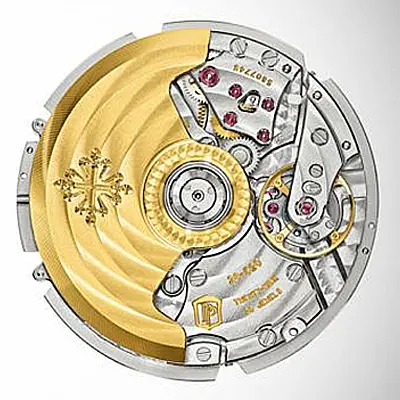
Clone Caliber 324 SC — Nautilus and Aquanaut Standard
The 324 SC powers the Nautilus 5711, 5712, and Aquanaut 5167 — the most sought-after Patek references in both genuine and replica markets. “SC” stands for Seconde Centrale (center seconds).
| 324 SC Feature | Genuine | Best Clone |
|---|---|---|
| Thickness | 3.30 mm | 3.5–3.8 mm |
| Power Reserve | 45 hours | 42–48 hours |
| Frequency | 28,800 vph | 28,800 vph |
| Rotor | 21k gold, Gyromax | Decorated, correct shape |
| Finishing | Geneva Seal level | High-grade Geneva stripes |
Thickness is the primary challenge. The genuine 324 SC is 3.30 mm thin. Clone versions typically add 0.2–0.5 mm due to slightly thicker bridges and base plates. This difference affects case profile — and experienced collectors will notice if a “Nautilus” sits too tall on the wrist. The best factories keep this gap under 0.3 mm.
The Gyromax balance is another distinction. Genuine Patek uses a free-sprung balance with inertia-adjusting weights. Top clones replicate the visual appearance but use a regulated balance with a standard regulator. Functionally, this has minimal impact on daily accuracy, but it’s visible under magnification.
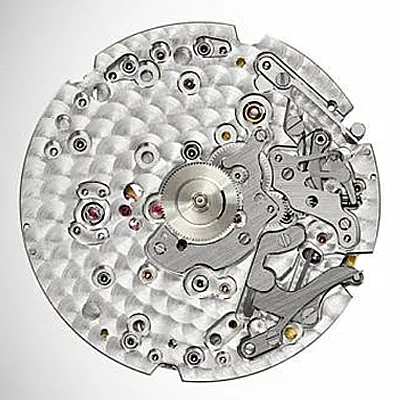
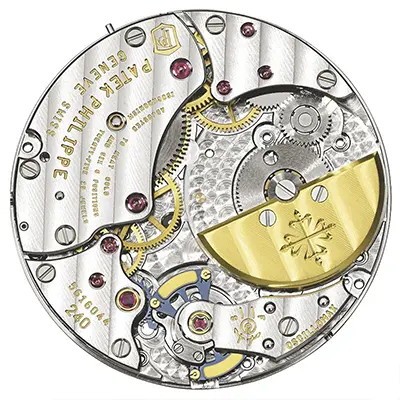
Clone Caliber 240 — Ultra-Thin Micro-Rotor
The 240 is Patek’s ultra-thin masterpiece. At just 2.53 mm thick in genuine form, it uses a micro-rotor — a small, off-center winding weight integrated into the movement rather than sitting on top. This design allows the movement to be dramatically thinner.
Cloning the 240 is extremely difficult. The micro-rotor requires precise mass distribution in a tiny footprint. The mainspring barrel must be flat enough to maintain the slim profile. Only a handful of factories produce acceptable 240 clones, and even the best versions measure 2.8–3.0 mm — slightly thicker than genuine.
These movements power the Calatrava 5227 and some limited Nautilus variants. They reward gentle wear. Heavy activity generates less winding energy due to the smaller rotor mass, so daily wearing is important to maintain power.
Ownership Tip: If your Patek clone with a 240 movement stops overnight, it likely isn’t defective — the micro-rotor simply didn’t accumulate enough energy. Hand-wind it 20–25 turns before wearing and the problem disappears.
Omega Clone Movements — Co-Axial Architecture
Omega’s genuine movements use a co-axial escapement — a fundamentally different design from the standard Swiss lever escapement. The co-axial reduces friction at the escapement, theoretically extending service intervals and improving long-term accuracy.
Fully replicating the co-axial architecture in a clone is rare. Most Omega clones use a modified standard escapement with a co-axial-style visual appearance. The bridges, rotor, and plates look correct, but the escapement mechanism uses traditional pallet fork geometry.
Seamaster Clone Movements
Seamaster 300M and Planet Ocean clones typically use clone 8800 or 8900 calibers. These movements deliver correct hand behavior, date function, and power reserve (55–60 hours in the best versions). The movements feature the distinctive Omega arabesque Geneva waves visible through the display caseback.
For Seamaster Diver 300M (the “Bond” model), the helium escape valve is decorative in replicas but the movement itself performs well as a daily wearer. Water resistance ratings on replicas should never be tested beyond splash resistance, regardless of the case markings.
Speedmaster Clone Movements
The Speedmaster Moonwatch uses a hand-wound chronograph movement (caliber 3861 in modern genuine versions). Clone versions replicate the manual winding feel and chronograph function. The column wheel and horizontal clutch architecture is maintained, giving correct pusher feel and sub-dial operation.
One detail unique to Speedmaster clones: the running seconds sub-dial at 9 o’clock. In genuine calibers, this sweeps smoothly. In clones, slight stepping may be visible under magnification. At normal viewing distance, the behavior appears identical.
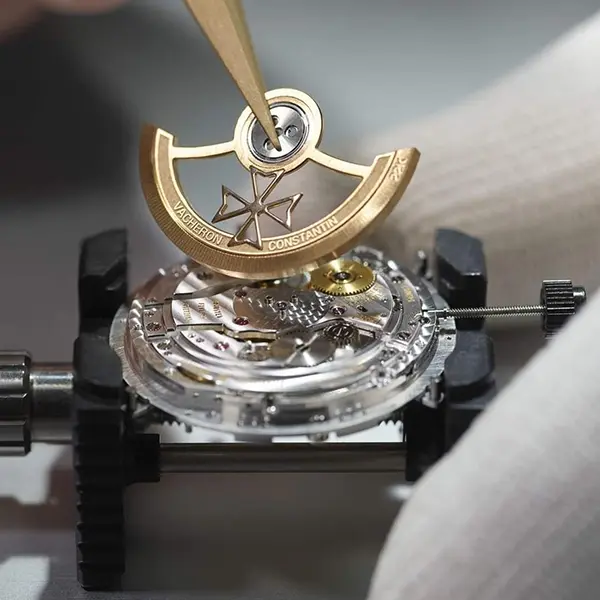
IWC and Vacheron Constantin Clone Movements
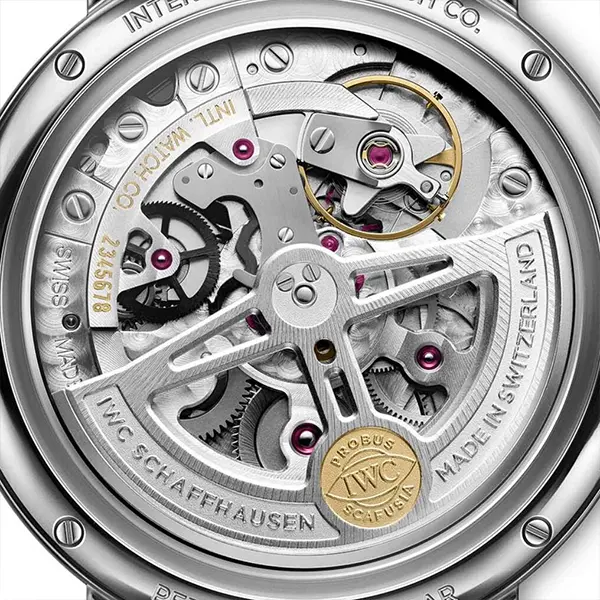
IWC — ETA-Based Reliability
IWC replicas take a different approach. Rather than cloning IWC’s proprietary calibers, most use high-grade decorated ETA clones. The Big Pilot IW501001 uses an ETA 2892-A2 base with IWC-style decoration. The Portugieser Chronograph uses a clone of the 7750 with correct sub-dial layout.
This approach has a significant advantage: serviceability. ETA-based movements have standardized parts, meaning any experienced watchmaker can service them. Finding parts for a clone 3235 or 4130 is much harder.
| IWC Model | Clone Movement Base | Power Reserve | Serviceability |
|---|---|---|---|
| Big Pilot | ETA 2892-A2 clone | 42 hours | Excellent — standard parts |
| Portugieser Chrono | ETA 7750 clone | 44 hours | Excellent — standard parts |
| Portugieser Annual | Modified ETA base | 40 hours | Good — mostly standard |
| Mark XVIII | Miyota 9015 decorated | 42 hours | Excellent — widely available |
Service Advantage: IWC clone watches are among the easiest high-end replicas to maintain. Any watchmaker familiar with ETA/Miyota movements can perform routine cleaning, oiling, and regulation without specialized tools.
Vacheron Constantin — Finishing Focus
Vacheron replicas, particularly the Overseas collection, emphasize movement decoration above all else. The genuine caliber 5100 features a Geneva Seal finish with hand-beveled bridges and mirror-polished screw heads. Clone versions vary enormously in finishing quality.
The best Vacheron clones use decorated automatic movements with correct bridge shapes and rotor engravings. The focus is cosmetic because the display caseback is the selling point of any Vacheron. Mechanical performance is adequate — 40–42 hours power reserve, ±8–12 seconds per day — but collectors buying Vacheron clones prioritize how the movement looks, not how it performs on a timing machine.
Movement Maintenance — What Every Clone Owner Should Know
Clone movements require maintenance, just like genuine Swiss calibers. The materials and lubricants used in clones are different from Swiss-grade equivalents, which affects service intervals and long-term behavior.
Service Intervals by Caliber Type
| Movement Type | Recommended Service | Signs of Needed Service |
|---|---|---|
| Rolex 3235/3285 clone | Every 3–4 years | Power reserve drops below 55 hours, accuracy exceeds ±15 sec/day |
| Rolex 4130 clone | Every 2–3 years | Chronograph hesitation, sticky pushers, reset misalignment |
| AP 3120 clone | Every 3–4 years | Rotor noise, date change sluggish, crown feel changes |
| AP 4401 clone | Every 2–3 years | Flyback malfunction, chronograph drift |
| Patek 324 clone | Every 3–5 years | Winding feels gritty, stops overnight despite full wind |
| Patek 240 clone | Every 2–3 years | Won’t maintain charge, hand-wind resistance |
| ETA/Miyota base | Every 4–5 years | Accuracy drift, winding stiffness |
Daily Care Tips
Winding: For automatic movements, wearing the watch daily is the best maintenance. If you rotate between multiple watches, hand-wind your clone 20–30 turns before putting it on. This ensures adequate mainspring tension from the start.
Magnetization: Clone movements are more susceptible to magnetic fields than genuine Swiss calibers because the balance springs use different alloys. Keep watches away from phone speakers, laptop hinges, and magnetic clasps. If your watch suddenly gains 30+ seconds per day, magnetization is the likely cause — a demagnetizer costs under $20 and fixes the issue in seconds.
Storage: Store watches crown-up or dial-up. Avoid leaving a mechanical watch face-down, as this puts pressure on the crystal and movement simultaneously. A watch box with individual cushions is ideal.
Water exposure: Regardless of case markings (300m, 100m, etc.), treat every clone watch as splash-proof only. The gaskets and crown tube threading in replicas are not tested to genuine pressure standards. Rain and hand-washing are fine. Swimming, showering, and diving are not.
How We Select and Verify Movements
We don’t sell watches based on factory marketing materials — and our customer reviews reflect that approach. Every piece goes through a verification process before it ships:
- Visual inspection — Bridge layout, decoration quality, rotor engraving accuracy, screw slot alignment
- Timing test — 6-position regulation check (dial up, dial down, crown up, crown down, crown left, crown right)
- Power reserve test — Full wind to complete stop, measured in hours
- Function test — Date change, day change, GMT hand, chronograph operation (model-dependent)
- Winding test — Crown feel, hand-wind smoothness, rotor spin duration
QC videos and photos are provided before shipping — see our quality control video gallery for examples. You see exactly what you’re getting — the specific watch, not a sample or stock photo. This process catches the 5–10% of units that pass factory QC but don’t meet our standards.
Every clone movement has a story. Our job is making sure that story doesn’t end with disappointment. Ready to order? Check our payment methods and order process guide.
Frequently Asked Questions
What is the difference between a clone movement and a replica movement?
A clone movement replicates the genuine caliber’s architecture — bridge layout, gear train, and complications — as closely as possible. A generic replica movement is a standard Asian automatic (often Miyota or Sea-Gull based) with cosmetic plates added to look like the genuine caliber. Clone movements cost more to produce but deliver better accuracy, correct hand behavior, and authentic winding feel.
Can a watchmaker service a clone movement?
Yes, but the watchmaker needs experience with clone calibers specifically. Standard ETA and Miyota-based clone movements use widely available parts. Proprietary clones (3235, 4130, 3120, 324) require specialized knowledge and sometimes factory-specific parts. We can recommend experienced service providers upon request. For delivery details, see our shipping policy.
How long do clone movements last?
With proper maintenance (regular service every 3–5 years depending on caliber), a quality clone movement can last 10+ years. The primary wear points are the same as genuine movements: escapement components, mainspring, and pivot jewels. Regular cleaning and oiling prevents premature wear.
Is a more expensive clone movement always better?
Not always. Price reflects complexity and finishing, not necessarily reliability. An ETA-based IWC clone at a lower price point may outlast a more expensive Patek 240 clone simply because the ETA platform is more robust and easier to service. Match the movement to your usage — daily beaters benefit from simpler architectures.
Why does my clone watch run fast after buying?
New clone movements often run slightly fast (+10–15 sec/day) because factories regulate for speed rather than accuracy. After 2–4 weeks of daily wear, the mainspring settles and accuracy typically improves to ±5–10 sec/day. If it still runs significantly fast after a month, magnetization or regulation adjustment may be needed.
What is a vertical clutch and why does it matter for chronographs?
A vertical clutch is the coupling mechanism between the movement’s gear train and the chronograph wheel. When you press the start button, a vertical clutch engages by pressing two friction surfaces together (like a car clutch). This creates instant, smooth engagement — the chronograph hand starts moving without any jump. Horizontal clutches use a lateral engagement that creates a visible “snap” at startup. All genuine Rolex Daytonas and modern AP chronographs use vertical clutches, so the best clones replicate this.
Do I need a watch winder for my clone watch?
Watch winders are optional. They keep automatic watches running when not worn, but they also keep the movement constantly active — which means lubricants are consumed continuously. If you wear your watch at least 3–4 days per week, a winder is unnecessary. For rotation collections where watches sit unworn for weeks, a quality winder set to 650–800 TPD (turns per day) in bidirectional mode works for most Rolex and AP clones.