Patek Philippe Complications Replica — Annual Calendar 5726, Nautilus Chrono 5980, World Time 5131, and What Actually Works
Last updated: March 2026 • 21-minute read • Complications functionality tested across 5 references
Patek Philippe complications replica watches push into territory where the super clone industry meets its most fascinating challenge: replicating not just the appearance but the mechanical function of advanced watchmaking. The Nautilus Annual Calendar (5726), the Nautilus Chronograph Travel Time (5990), and the World Time (5131) each pack genuine complications into Patek’s iconic designs — and super clone factories have developed creative solutions to replicate both their visual and functional aspects. This guide is brutally honest about what works, what’s cosmetic, what’s functional, and what you need to know before choosing a complication Patek over a simple time-only model.
Table of Contents
- 01 Patek Complications — The Hierarchy
- 02 5726A — Nautilus Annual Calendar
- 03 5990A — Nautilus Chrono Travel Time
- 04 5131 — World Time
- 05 Functionality Matrix — What Actually Works
- 06 Factory Rankings for Complications
- 07 Simple vs Complication — The Smart Choice
- 08 QC for Complication Models
- 09 FAQ — 15 Complication Questions
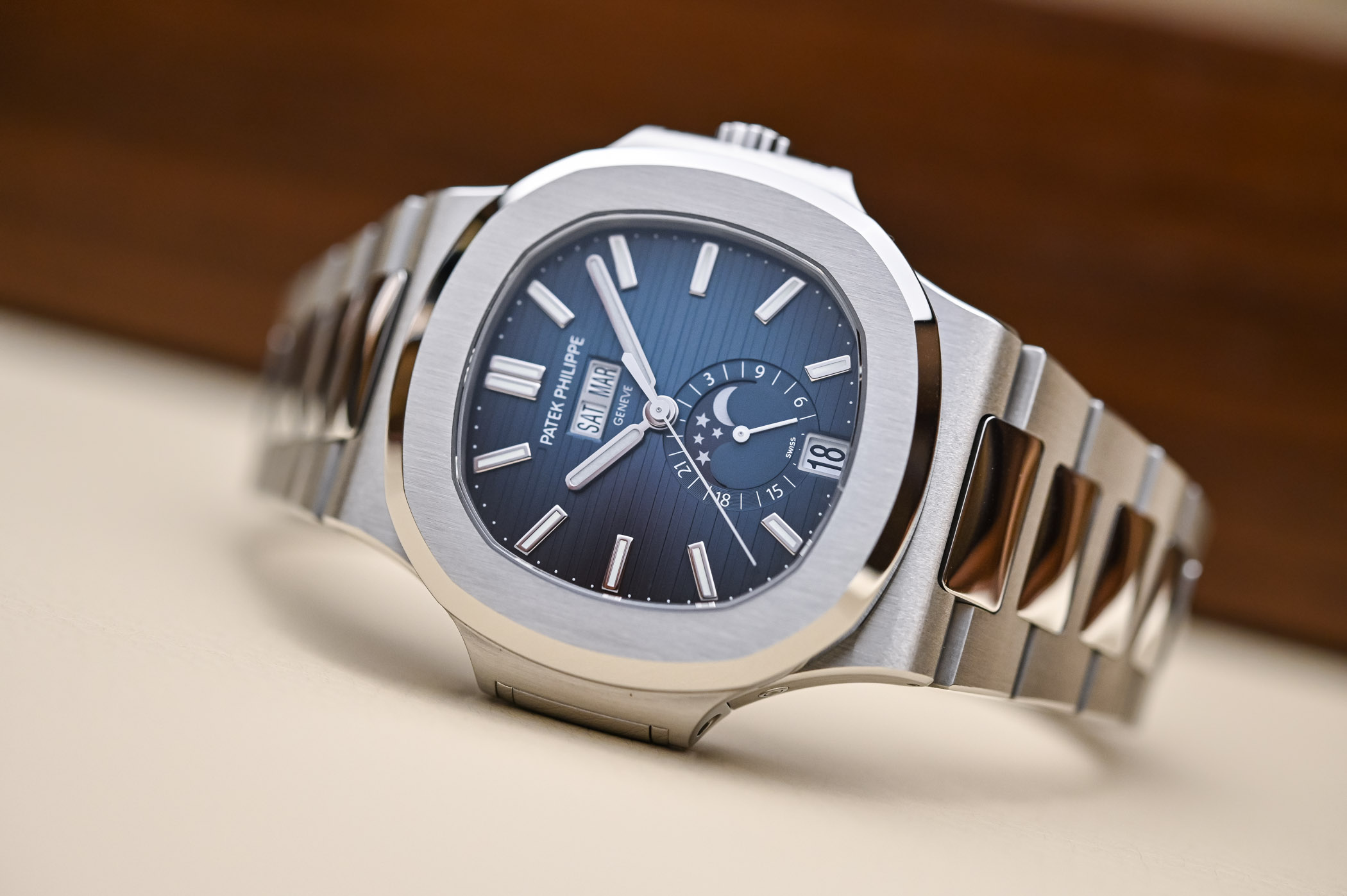
Patek Complications — The Hierarchy
Patek Philippe organizes their collections into a clear hierarchy: Calatrava (time-only dress), Nautilus/Aquanaut (sports), Complications, and Grand Complications. Each step up adds mechanical sophistication — and in the super clone world, each step up also adds complexity to what factories must replicate. Understanding this hierarchy helps you set realistic expectations.
Annual Calendar — knows which months have 30 or 31 days, requiring only one manual correction per year (end of February). Less complex than a perpetual calendar but more useful than a simple date. Patek’s Annual Calendar was the first in the industry when launched in 1996.
Chronograph — elapsed time measurement with start, stop, reset functions. Patek’s chronographs use proprietary calibers with column-wheel construction — the most refined chronograph mechanism available. The Travel Time variant adds a second time zone.
World Time — displays all 24 time zones simultaneously on a single dial. The city ring rotates, the 24-hour ring follows, and you can read any time zone at a glance. Mechanically, it’s a module on top of a base movement — elegant but complex.
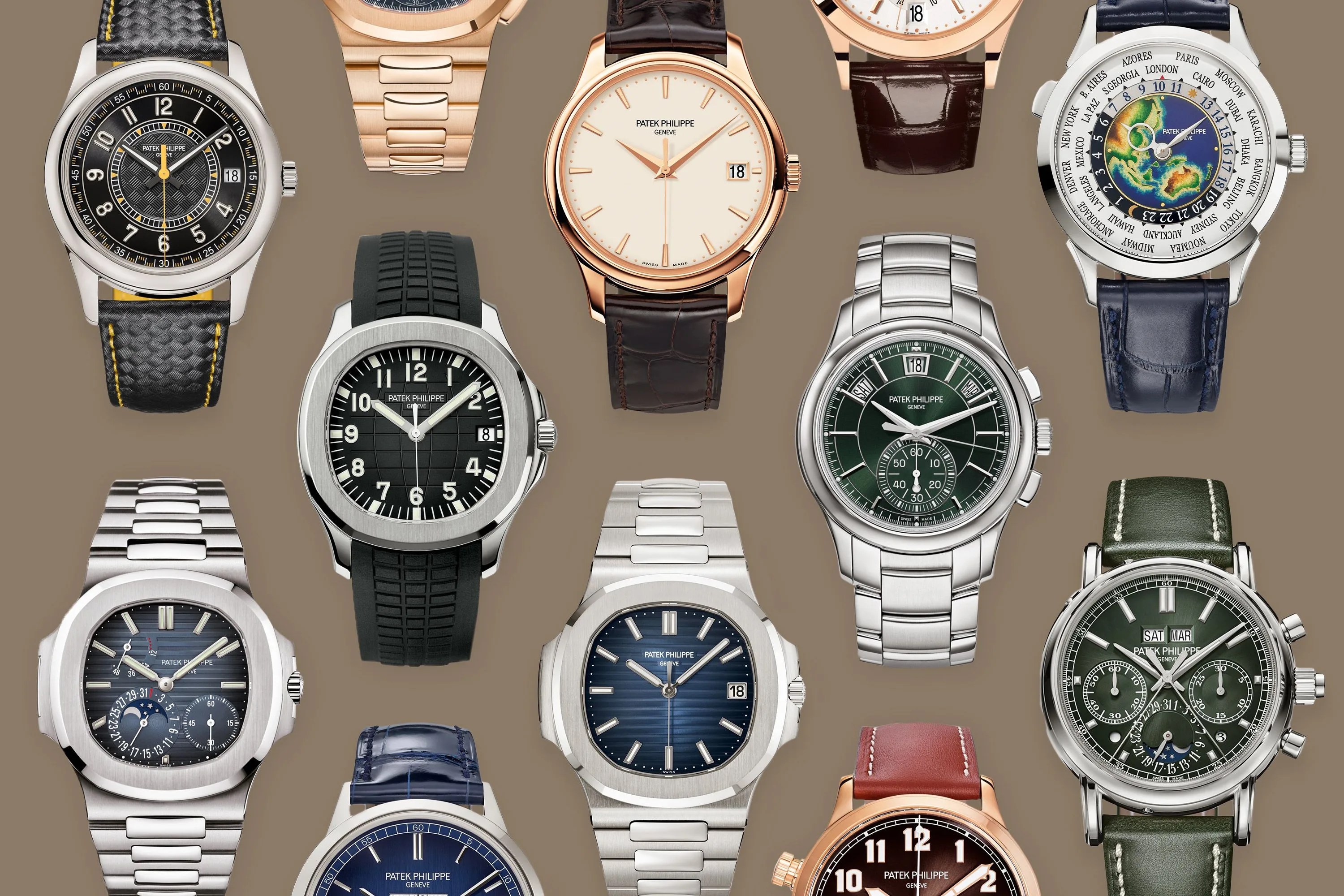
In super clone form, each complication presents a different challenge. The chronograph is the most functionally accurate — factories have decades of experience with 7750-based chronograph movements. The annual calendar is partially functional. The world time is primarily visual with limited mechanical function. Let me break down each reference. The annual calendars, chronographs and Travel Time models we stock are in our Patek complications super clone collection, while the Nautilus-cased 5726 and 5990 sit with the Nautilus 5726 and 5990 replicas.
5726A — Nautilus Annual Calendar
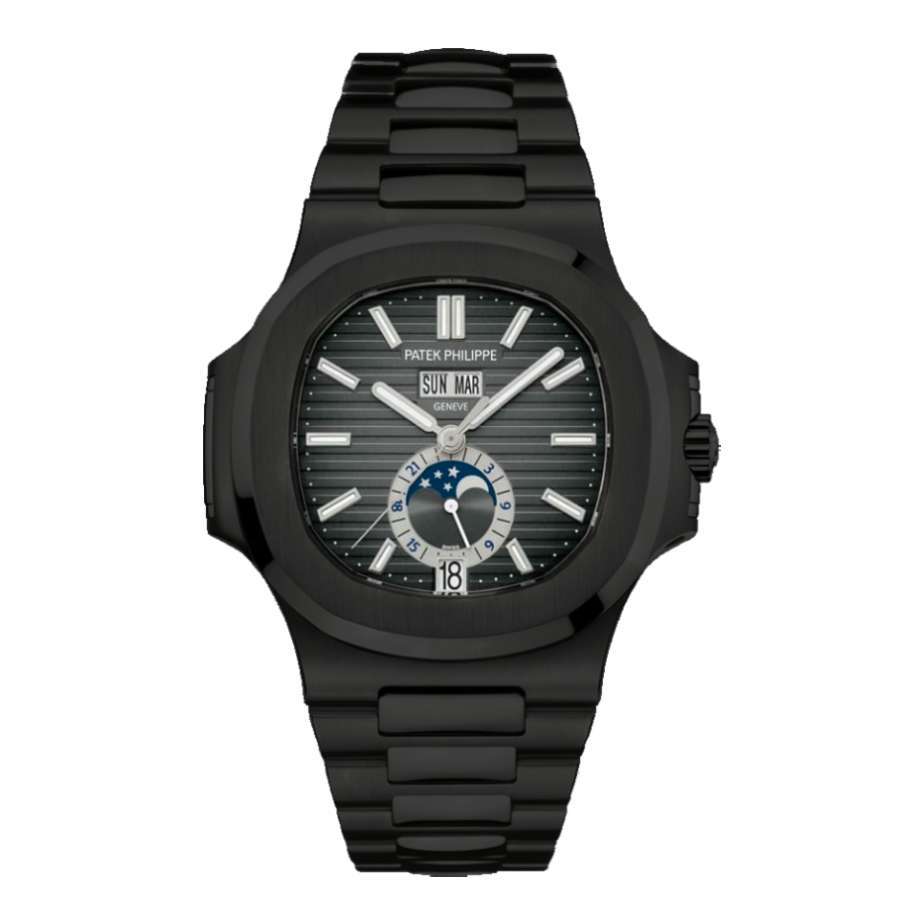
The Nautilus Annual Calendar 5726A-001 is arguably the most desirable Nautilus variant — it combines the Nautilus’s iconic case and dial with day, date, month, and moon phase displays. The result is a Nautilus that shows more information than the basic 5711 while maintaining the collection’s sporty elegance. The case is 40.5mm (slightly larger than the 5711’s 40mm) and 11.3mm thick (vs 8.3mm) to accommodate the calendar module.
The dial layout places three windows at 10:30 (day), 12 (month), and 1:30 (date) positions, with a moon phase aperture between 4 and 5 o’clock. The horizontal embossing continues across the dial surface around these displays, maintaining the Nautilus visual identity. The date uses a pointer hand on a subdial rather than a window — a design choice that adds visual interest and allows the date to occupy less dial real estate than a window would.
What works on the super clone: The moon phase is fully functional — driven by the standard 59-tooth gear, it tracks the lunar cycle accurately. The date advances automatically at midnight. The day and month displays are set via correctors and advance manually — they don’t automatically track like a genuine annual calendar does. This means you’ll correct the day and month manually, treating it similarly to how you’d treat a perpetual calendar super clone.
What doesn’t work: The annual calendar mechanism itself — the gear train that knows February is shorter than March, that April has 30 days while May has 31 — is not present in the super clone. This is a programmed cam mechanism that requires precision watchmaking beyond current clone factory capabilities. The visual presentation is complete; the automated month-length intelligence is not.
5990A — Nautilus Chrono Travel Time
The Nautilus 5990/1A is a flyback chronograph with a second time zone — two legitimate complications in one Nautilus. The 40.5mm case has pushers at 2, 4, 8, and 10 o’clock: the standard chronograph pushers at 2/4, and the Travel Time pushers at 8/10 that advance the local time hour hand forward or backward. The dial has two subdials (30 minutes at 6, 12 hours at 12), a date window at 3, and a day/night indicator at 9.
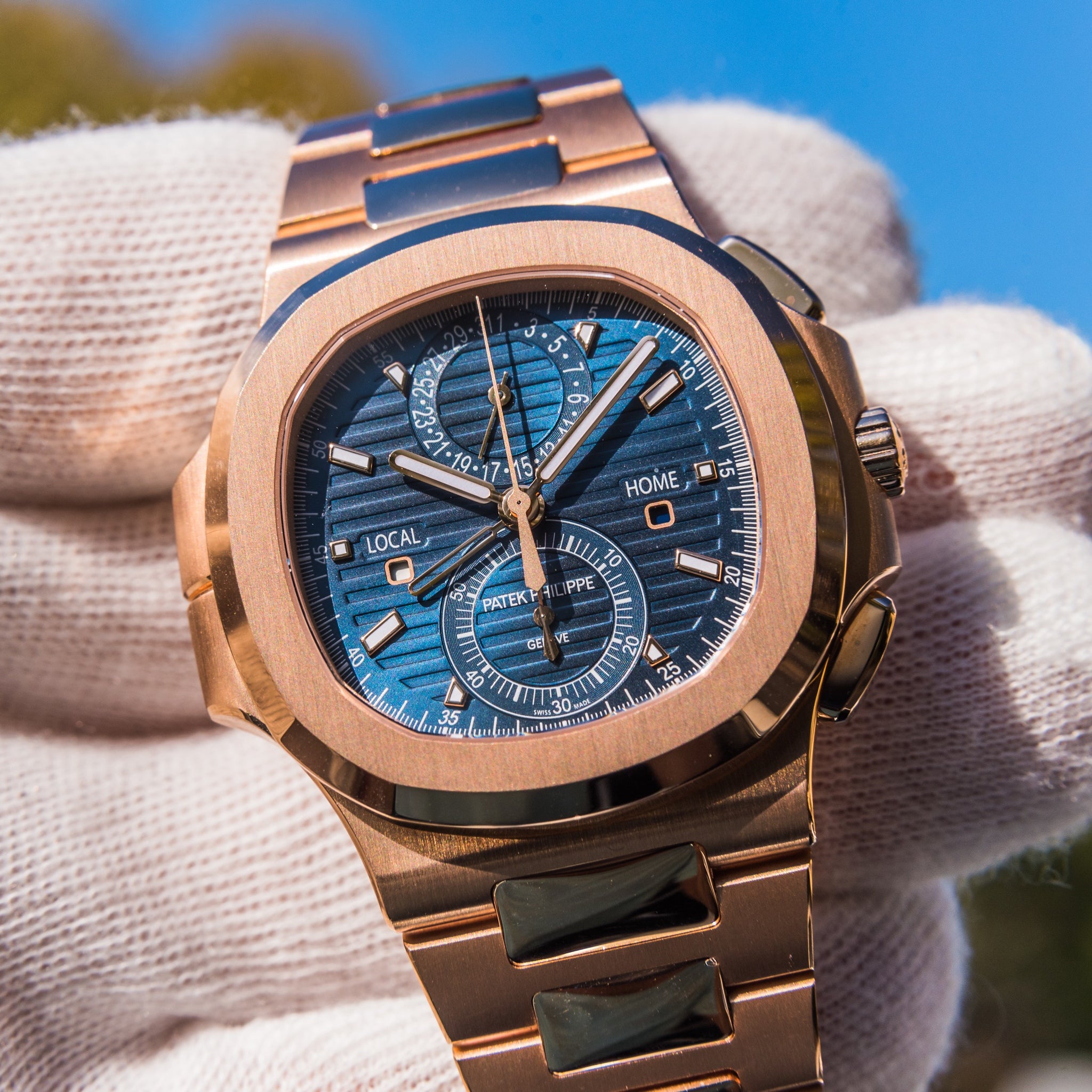
The super clone 5990 uses a modified Asian 7750 movement — the same reliable base used in countless chronograph replicas. The chronograph functions work correctly: start, stop, reset. The 30-minute and 12-hour subdials function. The central chronograph seconds hand sweeps. This is well-established territory for clone factories — the 7750 has been producing working chronographs for decades.
The Travel Time function is partially replicated. The pushers at 8 and 10 o’clock are present and spring-loaded, but the dual-hour-hand mechanism (genuine has two superimposed hour hands, one for home time and one for local time) is simplified in the super clone. Some versions have a functional GMT hand that can be set independently; others have the second hour hand as decorative. Clarify with your dealer which version is current from the factory you’re ordering.
The 5990 is the most visually complex Nautilus variant. The dial is dense with information — subdials, date, day/night indicator, tachymeter scale — all presented over the horizontal embossing. 3KF handles this complexity well: the subdial printing is sharp, the hands are correctly proportioned, and the overall dial balance reads as organized rather than cluttered. The chronograph pushers have correct rubber accents matching the Nautilus’s design language.
5131 — World Time
The World Time 5131 is Patek’s most visually dramatic complication — a 39.5mm watch that displays all 24 time zones simultaneously. The outermost ring lists 24 cities representing each time zone. Inside that, a 24-hour ring rotates continuously. The center of the dial features a hand-painted or cloisonné enamel map. Reading it: find your city, look at the hour number aligned with it on the 24-hour ring — that’s the current time in that zone.
The super clone 5131 is primarily a visual experience. The city ring and 24-hour ring are present and correctly labeled. The 24-hour ring rotates with the movement, tracking the passage of time. Changing time zones (which on genuine involves pressing a button at 10 o’clock to advance the city ring) has simplified functionality on the super clone — it works but may require more deliberate pressure than genuine’s refined pusher mechanism.
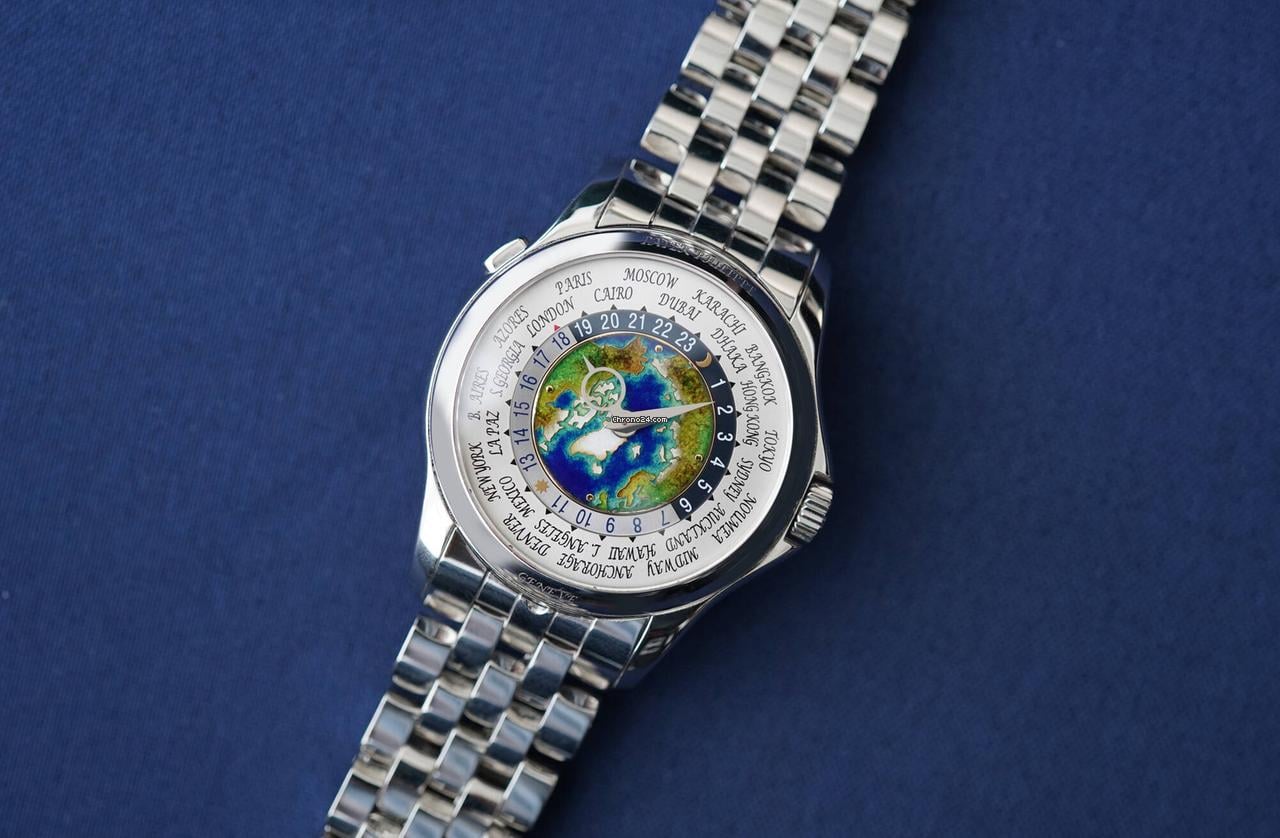
The center enamel map is the most impressive visual element. Genuine Patek uses hand-painted cloisonné enamel — thin gold wire forming the outlines of continents, with colored enamel fired into each section. This is one of the rarest artisan techniques in watchmaking. The super clone uses printed map art — visually similar at arm’s length but lacking the dimensional quality of genuine enamel. Under magnification, printed art is flat while genuine cloisonné has raised gold wire boundaries between color zones.
Despite the functional limitations, the World Time super clone delivers a visual experience that few other watches match. The rotating 24-hour ring creates constant movement on the dial. The city names add an international, worldly character. The map centerpiece is a conversation piece regardless of its production method. For collectors who appreciate the World Time for its design concept rather than its practical utility, the super clone captures that design effectively.
Functionality Matrix — What Actually Works
This is the reference table. Bookmark it. Print it. Before buying any Patek complication super clone, check this matrix to understand exactly what functions are mechanical (real) versus cosmetic (display-only):
Green = fully functional | Yellow = manual or partial | Red = not present | — = not applicable
Factory Rankings for Complications
3KF leads for the 5726 Annual Calendar and 5990 Chronograph. Their Nautilus case and dial work is the industry benchmark, and the complication implementations — while simplified — are executed cleanly. 3KF’s chronograph movement in the 5990 is smooth and reliable.
PPF produces competitive versions of these references with slightly lower dial quality but sometimes better complication functionality — their 5990 Travel Time mechanism reportedly has better dual-time-zone operation on some batches. Worth considering if Travel Time function matters to you.
ZF produces the best World Time 5131 — their focus on dial artistry and case finishing serves this reference well. The printed enamel map on ZF’s version is sharper than other factories’ attempts, and the city ring text is more legible.
Simple vs Complication — The Smart Choice
Here’s the honest advice that most guides won’t give you: for most buyers, a simple time-only Patek super clone (5711 or 5167A) is a smarter purchase than a complication model. Here’s why:
Higher accuracy: The 5711 and 5167A have fewer components, which means fewer potential failure points. The Miyota 9015 in time-only mode is at its most reliable — no chronograph gears to wear, no calendar mechanism to jam, no complications to misalign.
Better QC consistency: 3KF produces far more 5711 units than 5726 or 5990 units. Higher production volume means more refined tooling, better-trained assembly, and more consistent quality control. The 5711 has been through more production iterations than any complication model.
Lower maintenance: Time-only watches need basic service every 3-5 years. Chronographs need more frequent service because the chronograph mechanism has additional wear points. Calendar complications have correctors that can wear. Each added complication is an added maintenance item.
The exception: If you specifically want the visual presentation of a complication Patek — the busy dial of the 5726, the sporty pushers of the 5990, the international character of the 5131 — and you understand that some functions are simplified, then the complication model delivers an experience the 5711 doesn’t match. The chronograph 5990 is particularly compelling because the chronograph function is fully operational.
My recommendation: Buy a 5711 first. If you fall in love with the Nautilus platform and want a second piece, the 5990 Chronograph adds a genuinely functional complication (working chrono) while maintaining the Nautilus design language. The 5726 Annual Calendar is third — beautiful dial, but the annual calendar function isn’t replicated mechanically.
QC for Complication Models
Complication-Specific QC Checklist:
- All subdial hands: Centered and aligned with their scales
- Pusher operation: Confirm with dealer that all pushers click and function
- Chronograph reset: All chrono hands should return to zero cleanly
- Moon phase disc: Clear printing, no smudges, correct position
- Window displays: Day/month text legible, centered in windows
- Dial printing: All text sharp, no bleeding or misalignment
- Standard Nautilus checks: Case shape, embossing, bracelet, gradient
- Request function video: See the chronograph start/stop or correctors advance
FAQ — 15 Complication Questions
Does the annual calendar actually work on the 5726 super clone?
Partially. Time, date, and moon phase work mechanically. The annual calendar intelligence — knowing month lengths automatically — is not present. Day and month are set via correctors. You’ll adjust manually at the end of short months.
Does the chronograph work on the 5990?
Yes. The chronograph — start, stop, reset — is fully functional. It uses a modified Asian 7750, a proven chronograph movement. The elapsed time measurement is accurate for everyday use. Subdials function correctly.
Does the Travel Time work on the 5990?
Varies by production batch. Some 3KF versions have a functional GMT hand adjustable via the pushers at 8/10. Others have the second hour hand as decorative. Ask your dealer about the current factory batch before ordering.
Is the World Time 5131 functional?
The 24-hour ring rotates automatically with the movement — it tracks time progression correctly. The city ring can be advanced via the button at 10 o’clock, though the action may be stiffer than genuine. The enamel map is printed rather than genuine cloisonné.
Which complication Patek is the best super clone purchase?
The 5990 Nautilus Chronograph. The chronograph is fully functional (unlike the annual calendar or world time mechanisms), the Nautilus design language is maintained, and 3KF’s execution is strong. You get a genuine working complication, not just a visual simulation.
Should I buy a complication or a simple 5711?
For most buyers, the 5711. It’s more refined, more reliable, and 3KF’s quality is most consistent on this reference. Only choose a complication if you specifically want the additional dial complexity or the chronograph function. The 5711 is the safer, higher-quality purchase.
Are complication super clones harder to service?
Yes, slightly. The chronograph 5990 uses a 7750-based movement — any experienced watchmaker handles these. The calendar complications have additional correctors and display mechanisms that add service complexity. Budget for slightly more expensive servicing compared to time-only models.
How thick are the complication models?
The 5726 is approximately 11.5mm (vs 5711’s 8.5mm). The 5990 is approximately 12.5mm. Both are noticeably thicker than the time-only 5711 — they won’t slip under shirt cuffs as easily. This thickness is consistent with genuine specifications; the complications need more vertical space.
Which factory makes the best 5726?
3KF. Their Nautilus case and dial quality carry over to the 5726, and the calendar displays are cleanly integrated into the dial layout. The moon phase disc quality is excellent — gold on deep blue, properly sized.
Is the 5131 World Time worth buying?
As a visual/collector piece — yes, if you appreciate the world time concept and the enamel map aesthetic. As a functional travel watch — no, a simple GMT offers better time zone utility. The 5131 is bought for its design, not its practicality.
Do the correctors on the 5726 feel solid?
On 3KF — yes. The correctors (recessed pushers in the case side) click positively and advance the displays by one increment per press. Use a wooden toothpick or corrector tool; never metal. The corrector feel is slightly stiffer than genuine but functional.
Can I use the 5990 chronograph for timing?
Yes. The chronograph measures elapsed time accurately — suitable for timing laps, cooking, meetings, parking meters. It’s not COSC-certified chronograph precision, but for everyday timing tasks it’s completely functional and reliable.
What’s the power reserve on complication models?
The 5726 (Miyota base): ~42 hours. The 5990 (7750 base): ~46 hours. The 5131: ~42 hours. All handle overnight off the wrist. The 7750 in the 5990 actually has slightly better power reserve than the Miyota-based models.
Are complication models on bracelet or strap?
The 5726 and 5990 come on integrated Nautilus bracelets — same steel bracelet as the 5711. The 5131 World Time comes on a leather strap (round case, not Nautilus). 3KF’s bracelet quality is the same across all Nautilus models.
Is the enamel map on the 5131 convincing?
At arm’s length — yes, the continent outlines and color zones read correctly. Under magnification — no, printed art lacks the dimensional quality of genuine cloisonné enamel (raised gold wire, fired enamel in individual cells). This is the most significant visual difference on the 5131 super clone.
Final Word
Patek Philippe complications in super clone form require honest expectations and informed choices. The 5990 Chronograph is the strongest buy — a fully functional chronograph in the Nautilus case. The 5726 Annual Calendar delivers beautiful visual complexity with a working moon phase, though the annual calendar intelligence is absent. The 5131 World Time is a visual masterpiece with limited functional depth. Know what you’re buying, understand the functionality matrix, and choose based on what matters most to you: if it’s function, get the 5990. If it’s visual impact, get the 5726 or 5131. If it’s pure Patek quality, get the 5711 and save complications for your second purchase.
Related guides: Nautilus Replica Guide • Aquanaut Replica Guide • Calatrava Replica Guide • QC Photos Masterclass • Browse Patek Collection