Jaeger-LeCoultre Reverso Replica — The Art Deco Icon That Flips the Script on Luxury Watch Design
No other luxury watch does what the Reverso does. You take it off, you flip the case over, and there’s a completely different face waiting underneath. A second dial. A blank canvas for engraving. A solid caseback that protects the crystal during polo matches. Born in 1931 for British officers in India who kept smashing their watch crystals during sports, the Reverso became something far more significant — the definitive Art Deco wristwatch, and arguably the most innovative case design in horological history.
- Born from Polo — The 1931 Story
- Anatomy of the Flip — How the Case Works
- Reverso Classic — The Pure Original
- Reverso Tribute — The Collector’s Choice
- Reverso Duo/Duoface — Two Time Zones
- Reverso Hybris Mechanica — Ultra-Complication
- Super Clone Guide — The Flip Test
- How to Wear a Rectangular Watch
- Reverso vs Cartier Tank vs Cartier Santos
- FAQ — 15 Questions Answered
I remember the first time I handled a Reverso. I was at a Basel press event in the mid-1990s, and a JLC representative handed me a Reverso Duo in rose gold. I flipped the case, heard that satisfying click as it locked into position, and saw the second dial emerge — a different time zone, a different design, the same watch. That mechanical ingenuity, packed into a case designed 60 years earlier, hooked me permanently. Thirty years later, I’ve owned four Reversos (two genuine, two super clones) and examined hundreds. This is everything I know.
Born from Polo — The 1931 Story
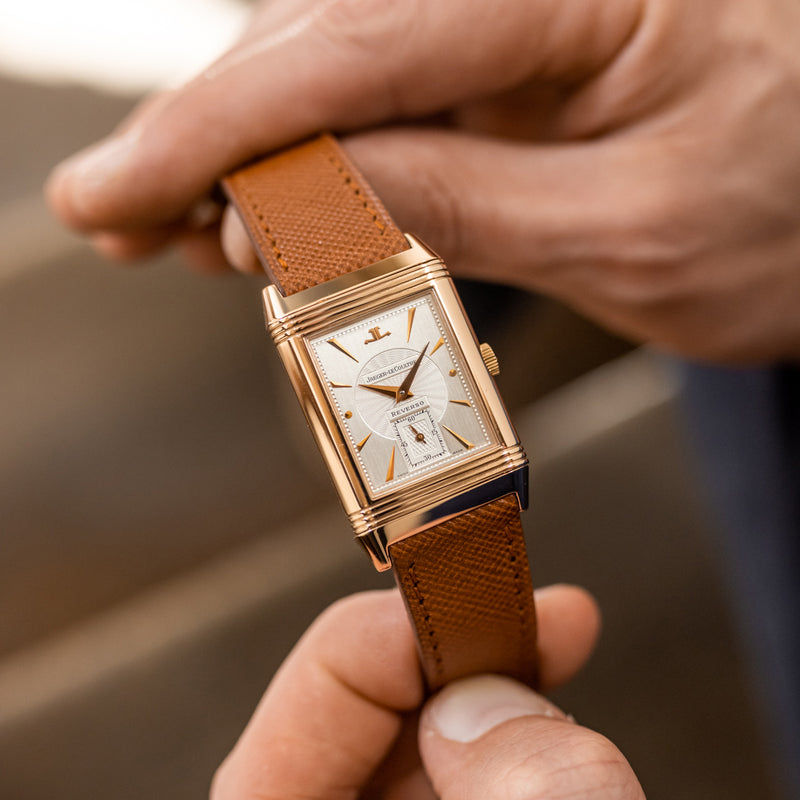
The year was 1931. British colonial officers stationed in India played polo with a passion that rivaled their devotion to the Crown. The problem? Their wristwatches couldn’t survive the sport. Crystal after crystal shattered from mallet impacts and ball strikes. César de Trey, a Swiss businessman visiting India, heard the complaints and brought the challenge back to Jacques-David LeCoultre at the family manufacture in Le Sentier.
The solution was brilliantly simple: a case that swivels within a cradle, allowing the wearer to flip the watch and present the solid metal caseback outward during rough activities. No crystal exposed, no damage. When the game ends, flip it back and check the time. The sliding mechanism uses rail guides cut into the case carrier — the watch body slides along these rails and rotates 180 degrees, clicking into place at each end position.
The design was so effective that it went straight to patent (Swiss patent No. 155361). But what made the Reverso endure wasn’t its practicality — it was its beauty. The rectangular case, the Art Deco proportions, the clean lines, the gadroons (decorative ridges) along the sides — all of this came together in a shape that transcended its sporting origins and became a symbol of elegant restraint.
Historical Note: The Reverso nearly died. By the 1970s, the quartz crisis had devastated mechanical watchmaking and the Reverso was discontinued. Italian watch dealer Giorgio Corvo convinced Jaeger-LeCoultre to revive it in 1983. That decision saved one of the greatest watch designs ever created.
Anatomy of the Flip — How the Case Works
The Reverso case is a mechanical marvel disguised as simplicity. Understanding its construction helps you appreciate what makes a good super clone:
The flip mechanism is the soul of the Reverso. On the genuine, you push the inner case to the side, it slides along the rails with smooth resistance, reaches the pivot point, and rotates 180 degrees with a satisfying click. The click should be firm — not so tight that you need to force it, not so loose that it flops around. That tactile feedback is what separates a Reverso from every other watch in existence.
On super clones, the flip mechanism is the single most important quality indicator. A good super clone clicks with authority and stays locked in position without any play or wobble. A bad one feels mushy, has lateral movement when locked, or worse — doesn’t fully lock at all. Before anything else in your QC evaluation, verify the flip.
Reverso Classic — The Pure Original
The Classic line stays closest to the 1931 original. One dial, manual-wind movement, clean silver or white dial with applied baton indexes, blued steel hands, and a blank caseback ready for engraving. This is the Reverso stripped to its essence — no complications, no dual time zones, just pure Art Deco geometry and mechanical honesty.
Two sizes dominate: the Medium (40.1mm x 24.4mm) and the Large (45.6mm x 27.4mm). The rectangular case means these measurements work differently than round watches — the Medium wears like a 38mm round watch, and the Large wears like a 42mm. On most male wrists (6.5-7.5 inches), the Large is the better choice. Women or those with slimmer wrists should look at the Medium.
The Classic Reverso in stainless steel is the entry point to JLC — and for many collectors, it’s the only JLC they’ll ever want. There’s a purity to it that more complicated models can’t match. When you flip the case and see blank steel, there’s a meditative quality to the gesture. The watch hides its face from the world when you ask it to.
Reverso Tribute — The Collector’s Choice
The Tribute line elevates the Reverso into haute horlogerie territory. These are the models that collectors chase — burgundy dials, enamel work, sector dial layouts, and in-house calibers with decoration visible through display casebacks.
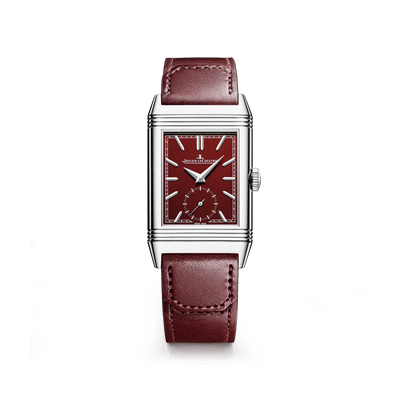
The Tribute Duoface in blue and burgundy is the current market darling. One side shows a sunray blue dial with dauphine hands and applied hour markers. Flip it over, and a deep burgundy dial with a sector layout appears — different character, different mood, same watch. The in-house caliber 854A/2 powers both dials with a dual time zone function, letting you track home time on one side and travel time on the other.
For super clone buyers, the Tribute models represent the pinnacle of Reverso replication. The dials require extraordinary color matching — JLC’s burgundy isn’t just “dark red,” it’s a specific shade that shifts between plum and wine depending on the light. The applied indexes must be gold-toned and precisely positioned within a rectangular dial that has zero tolerance for misalignment. Any index that’s even slightly crooked on a rectangular dial is glaringly obvious — more so than on a round dial where the curvature provides visual forgiveness.
Collector’s Tip: The Reverso Tribute Duoface in blue/burgundy is one of the most photographed watches on Instagram. The two-face design creates incredible content — flip videos consistently go viral in watch communities. If you enjoy sharing your collection online, this is the model to own.
Reverso Duo/Duoface — Two Time Zones, One Watch
The Duo and Duoface models are the practical peak of the Reverso concept. Instead of a blank caseback, the reverse side has its own fully independent dial — typically with its own hour and minute hands, a day/night indicator, and sometimes a second time zone. This transforms the Reverso from a clever case design into a genuine travel watch.
The mechanism works through a differential gear system that allows the movement to drive two separate sets of hands. The front dial shows local time. The back dial shows home time (or any second time zone you set). Advancing the local time on the front doesn’t affect the reference time on the back. It’s mechanically elegant — two faces, one movement, no compromise.
Super clone versions of the Duoface are particularly impressive because they need to get both dials right. Any imbalance in quality — a perfect front and a sloppy back, or vice versa — breaks the illusion immediately. The best factories maintain consistent dial quality across both faces, with matching index application, hand color, and printing precision.
Reverso Hybris Mechanica — Ultra-Complication Territory
JLC has used the Reverso case as a canvas for some of the most ambitious complications in watchmaking. The Hybris Mechanica line includes:
- Quadriptyque — four functional faces (two visible at once), displaying a full calendar, equation of time, sidereal time, and sunrise/sunset indicators
- Reverso Grande Complication à Triptyque — three functional displays including a minute repeater, tourbillon, and perpetual calendar
- Reverso Hybris Artistica Calibre 179 — featuring enamel miniature painting on the caseback
These are not replicated. At this complication level, the movements are so specialized that no factory attempts them. But knowing they exist helps you understand why JLC commands respect in the industry — they’re not just making pretty rectangular watches. They’re engineering at the absolute frontier while wearing an Art Deco suit.
Super Clone Guide — The Flip Test and Beyond
Buying a Reverso super clone requires a specific evaluation framework because the watch has challenges no round watch faces. Here’s the complete QC checklist:
The most common failure point on cheap Reverso replicas is the flip mechanism. When it’s done badly, the case wobbles in the locked position, creating visible movement when you flex your wrist. This is unacceptable — the genuine Reverso locks with military precision, and a good super clone matches that. If your QC video shows any lateral play in the locked position, reject the watch.
Pro Tip: Ask your seller for a video of the flip action, not just photos. A video reveals the smoothness of the slide, the firmness of the click, and any wobble in the locked position. Two seconds of video tells you more about Reverso quality than ten photos combined.
How to Wear a Rectangular Watch
The Reverso is a rectangular watch, which means it follows different styling rules than round watches. Here’s what 30 years of wearing rectangular watches has taught me:
Dress shirts are your best friend. The rectangular case slides under cuffs more easily than any round watch because it sits flat and thin on the wrist. A Reverso under a French cuff shirt is one of the most elegant looks in menswear — just a sliver of steel or gold visible as you reach for your drink.
Leather straps only. The Reverso was designed for leather. Some modern versions come on alligator, others on calf leather, some on cordovan. All look correct. Metal bracelets? JLC has experimented with them, but the design language screams leather. Stick with it.
Match the metal to your accessories. A steel Reverso goes with silver cufflinks and a steel belt buckle. A rose gold Reverso matches gold accessories. This isn’t a rule for round sports watches, but rectangular dress watches demand this level of coordination.
The Reverso works with jeans. Counterintuitive, but true. A steel Reverso Classic on a brown strap with dark jeans, a white Oxford, and a navy blazer is effortless casual elegance. The Art Deco case adds structure to a relaxed outfit without looking overdressed.
Reverso vs Cartier Tank vs Cartier Santos — The Rectangular Watch Showdown
Three watches dominate the rectangular/shaped luxury watch market. Here’s how they compare for the super clone buyer:
The Reverso is the watch person’s choice. It’s less instantly recognizable than a Tank or Santos, but anyone who knows watches will recognize it — and respect it more. The flip mechanism gives it mechanical credibility that no Cartier can match. The Tank is pure elegance. The Santos is versatile sportiness. The Reverso is engineering art. Choose based on what resonates with your identity.
Related Articles You Should Read
- JLC Master Replica
- JLC Polaris Replica
- JLC Duometre Replica
- Best JLC Super Clone
- Super Clone vs Cheap Replica Guide
FAQ — Jaeger-LeCoultre Reverso Replica
Q: Does the flip mechanism actually work on super clone Reversos?
On Tier 1 super clones, absolutely yes. The inner case slides along the rails, rotates 180 degrees, and clicks firmly into position on both sides. The mechanism is well-engineered in the top replicas and provides the same satisfying tactile experience as the genuine. Cheap replicas may have a loose or wobbly flip — always verify this in QC videos.
Q: What size Reverso should I choose?
For wrists 6.5-7.5 inches, the Large (45.6mm x 27.4mm) is ideal — it provides sufficient wrist presence without overwhelming. For wrists under 6.5 inches, the Medium (40.1mm x 24.4mm) works beautifully. Remember, rectangular watches wear differently than round ones — the length extends toward the wrist edges, not top and bottom.
Q: Can I get the caseback engraved on a super clone?
Yes, and this is one of the Reverso’s great features. Any jeweler with an engraving machine can engrave the solid caseback. Initials, dates, quotes, even family crests — the flat steel surface accepts engraving beautifully. This personalization option adds sentimental value that few other watches offer.
Q: Is the Reverso Duoface worth the extra cost over the Classic?
If you travel between time zones or simply love the idea of two watches in one, yes. The Duoface adds genuine utility and doubles the visual impact. However, the Classic has a purity that the Duoface can’t match. The blank caseback is part of the original Reverso charm. Both are excellent choices.
Q: How thick is a Reverso super clone compared to genuine?
Genuine Reverso Classic is approximately 9.14mm. Top super clones hit 9.5-10mm — very close. The Duoface genuine is thicker at around 11mm, and super clones match this well at 11.5-12mm. The extra fraction of a millimeter on replicas is due to the Miyota movement being slightly thicker than JLC’s in-house calibers.
Q: What strap width does the Reverso use?
The Reverso uses non-standard strap widths due to its rectangular case. The Large typically uses 20mm at the lugs tapering to 16mm at the buckle. The Medium uses 17mm to 14mm. Always order straps specifically cut for the Reverso — standard round-watch straps won’t fit the case geometry correctly.
Q: Is Jaeger-LeCoultre considered high-end enough to justify a super clone?
JLC is the manufacturer of manufacturers. They’ve supplied movements to Audemars Piguet, Vacheron Constantin, and Patek Philippe throughout history. They hold over 400 patents and have created over 1,200 calibers. In the watch industry, JLC is arguably the most technically accomplished manufacture in existence. Yes, it’s more than high-end enough.
Q: Will the flip mechanism wear out over time on a super clone?
The mechanism is metal-on-metal sliding, which means it will wear eventually — but we’re talking years of heavy use. The click spring maintains its tension for a very long time. If you flip the case once or twice a day (which most owners do), expect the mechanism to last 10+ years without noticeable degradation. If it does loosen, a watchmaker can adjust the click spring tension.
Q: Can I wear a Reverso with a t-shirt?
You can, but it works best with a deliberate outfit. A Reverso with a plain white tee, dark jeans, and Chelsea boots looks intentionally minimal. A Reverso with a graphic tee and basketball shorts looks mismatched. The watch has inherent formality — work with it, not against it.
Q: Which is harder to replicate well — the Reverso or the Royal Oak?
The Reverso, without question. The Royal Oak is a round movement in an octagonal case — difficult but standard in principle. The Reverso requires a functioning flip mechanism, precise rectangular proportions, proper gadroon finishing, and often dual dials. The engineering complexity is significantly higher, which is why fewer factories attempt it.
Q: What’s the best dial color for a first Reverso?
Silver or white on a brown leather strap. This combination works with the widest range of outfits and occasions. The silver dial provides enough visual interest through its applied indexes and sunburst finish, while staying neutral enough for any setting. Save the burgundy Tribute or blue Duoface for your second Reverso.
Q: How does a Reverso compare to a Cartier Tank for formal events?
Both are perfect for black tie. The Tank has higher general recognition — more people will notice it. The Reverso has deeper credibility among watch enthusiasts — the people who know, will know. For pure elegance, the Tank in yellow gold edges ahead. For conversation and mechanical interest, the Reverso wins by a mile. You can’t flip a Cartier Tank.
Q: Are JLC super clones as well-made as Rolex super clones?
The best JLC super clones match Rolex replicas in case and dial quality but face the additional challenge of the flip mechanism (for Reverso) or ultra-thin cases (for Master). Where JLC replicas have an advantage is lower market scrutiny — far fewer people will examine your Reverso closely compared to a Submariner or Daytona.
Q: What movement is inside a Reverso super clone?
Most use a Miyota 9015 automatic (modified to fit the rectangular case) or a Seagull manual-wind movement. The manual-wind option is more period-correct since genuine Reverso Classics use hand-wound calibers. For Duoface models, the movement is typically a modified Miyota with an added complication module for the second dial.
Q: Is the Reverso a good investment piece in the super clone world?
Super clones aren’t investments in the financial sense — they don’t appreciate. But the Reverso is an investment in your personal style and mechanical appreciation. Few watches teach you more about case engineering, and few watches generate more genuine pleasure through daily interaction. The flip ritual alone makes it worth the purchase.
The Reverso isn’t just a watch — it’s a mechanical conversation between you and 93 years of Art Deco engineering. No other timepiece offers the same interactive experience, the same tactile satisfaction, or the same blend of sporting heritage and formal elegance. Super clones at the $700-1000 level capture that experience with a flip mechanism that clicks with authority and dials that honor JLC’s exacting standards. Whether you choose the Classic, the Tribute, or the Duoface, you’re strapping on a piece of horological history that literally turns heads — including its own. Explore the full Jaeger-LeCoultre replica collection and discover the watch that rewrote the rules of case design.