Jaeger-LeCoultre Polaris Replica — The Sports Watch from the Brand That Invented the Alarm Wristwatch
In 1968, Jaeger-LeCoultre created the Memovox Polaris — a dive watch with an integrated alarm that vibrated against the diver’s wrist underwater. It was the first automatic alarm dive watch ever produced. The alarm wasn’t a gimmick. It was a survival tool — reminding divers of decompression stops, air supply limits, and ascent timing when looking at a gauge was impractical. Fifty-six years later, the Polaris name lives on as JLC’s dedicated sports collection, and the DNA of that original tool watch runs through every piece.
- The 1968 Memovox Polaris — Where It Started
- Modern Polaris — JLC Goes Sporty
- Polaris Date — The Entry Point
- Polaris Chronograph — Function Meets Heritage
- Polaris Geographic World Time
- Polaris Mariner — The True Dive Watch
- Design Language — Three Crowns, Inner Bezel
- Super Clone Guide — What to Look For
- Polaris vs Fifty Fathoms vs Aqua Terra
- FAQ — 15 Questions Answered
Most watch brands build their sports lines by making their dress watches bigger and adding dive bezels. JLC took a different path. The Polaris has its own design language — triple-crown configuration, internal rotating bezel, bold dial colors — that shares zero components with the Master collection. It’s a ground-up sports watch from a brand known for refined dress pieces, and that contrast is what makes it fascinating.
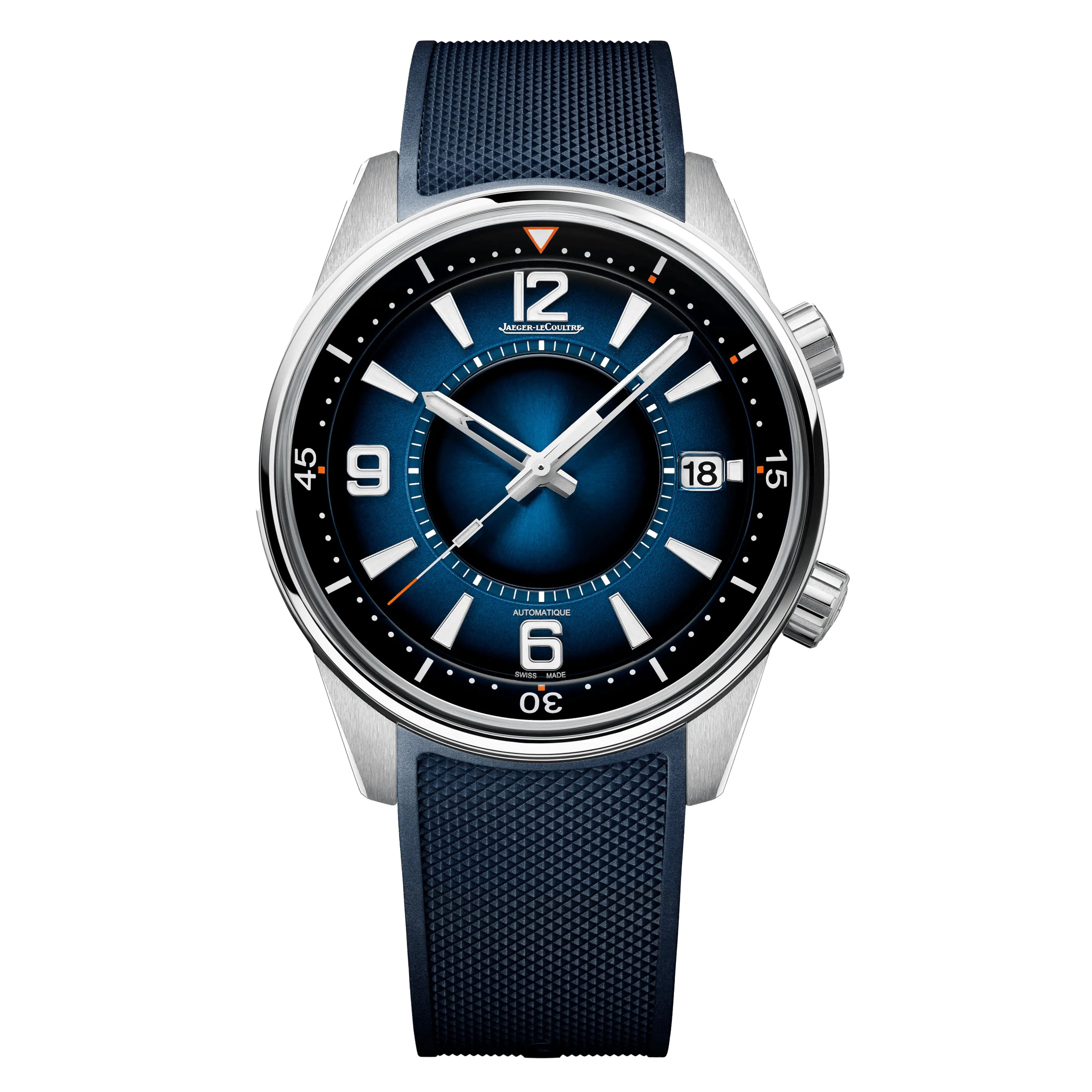
The 1968 Memovox Polaris — Where It Started
The original Memovox Polaris (reference E859) was a technical triumph. It combined three complications in one watch: time display, an internal rotating bezel for dive timing, and a mechanical alarm. The alarm function was activated by an inner case crown at 2 o’clock, and it worked by vibrating a metal membrane against the caseback — producing a buzz felt on the wrist rather than an audible ring. Underwater, where sound travels differently and ambient noise from breathing apparatus is constant, vibration was the only reliable alert method.
The watch measured 42mm — large for 1968 — with a Super Compressor case rated to 200m. The dial featured a beautiful gradient from light center to dark edges (the “tropical” effect that collectors now pay premiums for), luminous triangle markers, and a yellow inner bezel ring for dive timing. Production ran from 1968 to 1970, with estimated numbers around 1,700 pieces.
Auction Record: Original Memovox Polaris references in good condition regularly sell for $50,000-80,000 at auction. Exceptional examples with original box and papers have broken $100,000. The 1968 tropical dial variants — where the black dial has faded to a warm brown or blue over decades — command the highest premiums.
That original Polaris established three design elements that carry forward to today’s collection: the internal rotating bezel (operated by a second crown), the bold dial colors, and the larger-than-typical case size. When JLC revived the Polaris name in 2018 for the 50th anniversary, they honored each of these elements.
Modern Polaris — JLC Goes Sporty (2018-Present)
The modern Polaris collection launched at SIHH 2018 with four models: Date, Chronograph, Geographic, and Memovox (alarm). It was JLC’s clearest statement that they could compete in the luxury sports watch market alongside the Omega Seamaster, the Breitling Superocean, and even the Blancpain Fifty Fathoms.
The design language is distinctly JLC — refined enough for a boardroom but rugged enough for a sailboat. The 41mm cases sit between dress and tool watch territory. The three-crown setup (time at 3, inner bezel at 2, and function-specific at 10) gives each Polaris a distinctive profile that no other sports watch shares. And the movements inside are all JLC manufacture calibers, not modified ETA or Sellita units.
Polaris Date — The Entry Point
The Polaris Date is the collection’s foundation model and the one most commonly replicated. At 41mm with 200m water resistance, it’s a genuine sports watch that can handle real-world activities. The internal rotating bezel, operated by the crown at 2 o’clock, tracks elapsed time with a triangular marker at 12 and minute graduations. The date window sits at 6 o’clock — an unusual placement that maintains dial symmetry.
Dial options include black, blue, and green — all with a sunburst finish that catches light aggressively. The applied hour markers are oversized and lumed, as are the hands, giving the watch genuine legibility in low light. The screw-down crown at 3 o’clock ensures water resistance, while the inner bezel crown at 2 operates freely for quick access.
The movement is JLC’s caliber 899/1 — the same 70-hour power reserve automatic that powers the Master Control. This means the Polaris isn’t just wearing JLC’s sports clothes — it’s packing JLC’s dress watch heart, with all the refinement and accuracy that implies.
Buying Insight: The blue dial Polaris Date is the bestseller in both genuine and super clone markets. The blue plays differently than Omega’s or Rolex’s blues — it’s a darker, more petrol-toned shade that shifts between navy and teal depending on the light angle. If you’re choosing your first Polaris, blue is the universally recommended option.
Polaris Chronograph — Function Meets Heritage
The Polaris Chronograph adds a dual-register chronograph to the internal bezel configuration. The chronograph seconds are displayed on a central hand, with a 30-minute counter at 3 o’clock and a running seconds subdial at 9. The chronograph pushers sit at 8 and 10 o’clock — unconventional positions that keep the right side of the case clean for the two crowns.
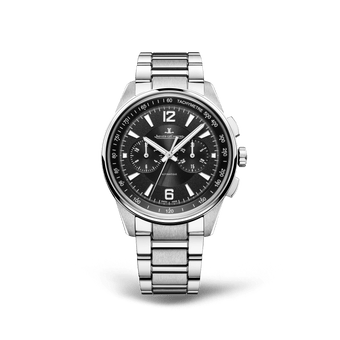
The pusher placement at 8 and 10 is more than aesthetic. It’s functional — with the crowns at 2 and 3, putting pushers at the traditional 2 and 4 positions would create a cluttered right side with four protrusions. By mirroring the pushers to the left, JLC achieves visual balance and ergonomic separation. Each control has its own space on the case edge.
Inside sits the caliber 751H, a column-wheel chronograph with 65-hour power reserve. The column wheel ensures smooth pusher actuation — none of the scratchy, imprecise feel that cheaper cam-lever chronographs produce. When you start the chronograph on a genuine Polaris, the central seconds hand sweeps forward with zero lag. When you stop it, it halts instantly. This is the standard that super clones must meet.
Super clone chronograph versions use the Seagull ST1901 movement (based on the Venus 175 architecture), which provides column-wheel chronograph operation at a fraction of the JLC caliber’s cost. The functional result is surprisingly similar — smooth start/stop/reset with proper chrono hand sweep. The pushers on top replicas provide firm, satisfying clicks that feel purposeful rather than mushy.
Polaris Geographic World Time
The Geographic World Time is the traveler’s Polaris. It displays a second time zone via a subdial at 6 o’clock, with a 24-city disc around the perimeter showing the time in every major time zone. A day/night indicator helps you avoid calling London at 3 AM when it looks like 3 PM on your local dial.
The world time function is operated through the crown at 10 o’clock — advance it one click to jump to the next time zone, and the city disc, second time zone, and day/night indicator all update simultaneously. It’s a true “quick-set” system that makes crossing time zones effortless.
This is a niche model in the super clone market — fewer factories produce it due to the complication module complexity. But for frequent travelers who want something more sophisticated than a GMT hand, the Geographic World Time is unique. No other sports watch at this level offers a city disc world timer with the refinement of JLC finishing.
Polaris Mariner — The True Dive Watch
In 2021, JLC added the Mariner sub-collection — taking the Polaris concept and pushing it firmly into professional dive watch territory. The key changes: 300m water resistance (up from 200m), an external rotating bezel with ceramic insert (replacing the internal bezel), and a more robust case construction with crown guards.
The Mariner Memovox is the standout — it revives the original 1968 concept of an alarm dive watch. The mechanical alarm buzzes against your wrist at a preset time, just as it did for divers in the late 1960s. The alarm function uses a separate crown and can be set to any position within a 12-hour range. It’s both a nostalgic nod to the original Polaris and a genuinely useful complication.
Design Language — Three Crowns, Inner Bezel, and the JLC Touch
What makes the Polaris visually distinctive from every other sports watch on the market:
Triple Crown Configuration: Most watches have one crown. GMT watches sometimes have two. The Polaris has three — and each has a specific, functional purpose. This isn’t decoration; it’s engineering translated to the case edge. The visual effect is a watch that looks more complex and purposeful than its peers without actually being cluttered.
Internal Rotating Bezel: While Rolex, Omega, and most dive brands use external bezels (ceramic or aluminum inserts), the Polaris keeps its timing bezel inside the crystal. This gives the watch a cleaner profile, protects the bezel from accidental rotation, and creates a more refined appearance. The trade-off: it requires a dedicated crown to operate, adding case complexity.
Sector Dial Elements: The Polaris dial borrows the sector layout from the Master Control, with concentric zones delineating hours and minutes. This gives the watch a vintage character that connects it to JLC’s pre-war designs — a visual bridge between the 1930s and the 2020s.
The “JLC Touch”: Even as a sports watch, the Polaris retains finishing details that betray its manufacture origins. The dial text is applied with precision. The hands are perfectly finished with crisp facets. The case edges transition from polished to brushed with deliberate geometric lines. These details separate the Polaris from its mainstream competitors.
Super Clone Guide — What to Look For
The Polaris has specific challenges for replica manufacturers that differ from typical sports watches:
The inner bezel mechanism is the critical test. On the genuine, the crown at 2 o’clock rotates the inner bezel ring with precisely indexed clicks — each click moves the bezel by one minute marker. On cheap replicas, the bezel either doesn’t rotate at all (it’s fixed and decorative) or rotates loosely without any clicking. Top super clones replicate the click mechanism with satisfying precision.
Pro Tip: Request a video of the inner bezel operation in your QC check. The seller should rotate the crown at 2 o’clock while you watch the inner bezel ring turn. Each click should be visible as the triangle marker advances. If the seller can’t or won’t demonstrate this, the bezel likely doesn’t function correctly.
Polaris vs Fifty Fathoms vs Aqua Terra — Sports Watch Alternatives
The Polaris occupies a sweet spot between the Omega Aqua Terra’s mainstream appeal and the Fifty Fathoms’ niche dive heritage. It’s sporty without being obviously a tool watch, refined without being a dress watch pretending to be tough. For the super clone buyer who wants something that watch enthusiasts will recognize and respect — but that won’t trigger the same “is that real?” scrutiny as a Submariner — the Polaris is an excellent choice.
FAQ — Jaeger-LeCoultre Polaris Replica
Q: Does the internal rotating bezel work on Polaris super clones?
On Tier 1 super clones, yes. The crown at 2 o’clock rotates the inner bezel ring with indexed clicks. Each click advances the triangle marker by one minute position. The mechanism is mechanical — no spring-loaded shortcuts. Cheap replicas may have a fixed bezel or a loose one without clicks.
Q: What size Polaris is best for most wrists?
The Polaris Date at 41mm suits wrists from 6.5 to 8 inches. It wears smaller than its diameter suggests because the relatively short lugs keep the watch centered on the wrist. The 42mm Chronograph and Mariner are better for 7+ inch wrists. Under 6.5 inches, the 41mm Date is the maximum recommended size.
Q: Can I actually dive with a Polaris super clone?
The genuine Polaris Date is rated to 200m. Super clones typically achieve 30-50m of actual water resistance when properly assembled. That’s fine for swimming, snorkeling, and rain. Actual scuba diving? Not recommended. The crown seals and caseback gaskets on replicas aren’t pressure-tested to the same specifications. For pool and beach use, you’ll be fine.
Q: How does the Polaris compare to the Reverso as a daily wearer?
The Polaris is the better daily wearer by far. Higher water resistance, more robust case construction, better shock resistance, and sportier styling that works with casual outfits. The Reverso is a dress watch that can tolerate casual settings. The Polaris is a sports watch that can dress up for formal settings. Different tools for different priorities.
Q: Which Polaris dial color is best for super clones?
Blue. The factories have perfected the specific petrol-blue shade that JLC uses, and it’s the most popular option in both genuine and replica markets. Black is the safest choice — hardest to get wrong. Green is striking but less widely available in super clone versions. If you see a green Polaris from a Tier 1 factory, it’s worth considering for its rarity value.
Q: Is the Polaris Chronograph worth the extra complexity?
If you use timing functions regularly — cooking, parking meters, workouts — the chronograph adds genuine utility. The Seagull ST1901 movement in super clones provides reliable chrono operation with smooth start/stop/reset. If you never time anything, the Date model’s cleaner dial and simpler movement make it the better choice.
Q: What’s the lume quality like on Polaris super clones?
Top super clones use quality luminous material on the hands and hour markers. The glow lasts 4-6 hours after exposure to light — shorter than genuine Super-LumiNova (which lasts 8+ hours) but sufficient for reading the time at night. The lume color should be blue-green, matching JLC’s standard. Avoid replicas with yellow or green-tinged lume.
Q: How many crowns does the Polaris Date have?
Two. The main crown at 3 o’clock (time setting and winding, screw-down) and the inner bezel crown at 2 o’clock (non-screw-down, rotates the internal bezel). The Chronograph and Geographic models add a third crown at 10 o’clock for their respective complications. The Mariner Memovox also has three crowns.
Q: Is JLC a good brand for someone who already owns a Rolex replica?
Perfect pairing. Rolex and JLC complement each other beautifully — Rolex provides mainstream recognition and tool-watch robustness, while JLC adds manufacture credibility and refined aesthetics. The Polaris serves a similar sporty purpose as a Submariner but with a completely different design philosophy. Zero overlap.
Q: What strap options work with the Polaris?
The Polaris comes on either a steel bracelet or a rubber strap. Both work equally well. The bracelet has the JLC-typical alternating brushed/polished links with a double-deployant clasp. The rubber strap is molded with a textile-like texture. For aftermarket options, any 21mm strap fits — NATO straps in particular give the Polaris a casual, sporty look that works brilliantly.
Q: How does the Polaris compare to the IWC Aquatimer?
Both use internal rotating bezels, but the execution differs. The IWC Aquatimer’s SafeDive system uses a dedicated clutch mechanism. The Polaris uses a simpler crown-operated system. In terms of movement heritage, JLC significantly outranks IWC. For daily wear and super clone quality, both are excellent choices with similar availability.
Q: Will anyone recognize a JLC Polaris on my wrist?
Watch enthusiasts will recognize it instantly and respect it deeply. The general public? Probably not. JLC doesn’t have the mainstream name recognition of Rolex or Omega. This is a feature, not a bug — for replica buyers, lower recognition means less scrutiny and more genuine appreciation from the people whose opinions matter.
Q: What movement is inside a Polaris Date super clone?
The Miyota 9015 automatic — a Japanese movement with 24 jewels, 28,800 bph beat rate, hacking seconds, and manual winding capability. It provides ±10 seconds/day accuracy out of the box, improvable to ±5 seconds/day with regulation. Power reserve is approximately 42 hours, compared to the genuine’s 70 hours.
Q: How does the Polaris super clone bracelet compare to genuine?
Top super clones use solid 316L stainless steel links with proper brushed/polished alternation. The clasp uses a double-fold deployment with safety release. Weight is approximately 85-90% of the genuine bracelet. The main difference is in the clasp finishing — genuine JLC clasps have a slightly more refined micro-adjustment system. The visual and wearing experience is very close.
Q: Is the Polaris a good investment for a super clone collection?
The Polaris fills a unique niche — a manufacture sports watch from a brand respected at the highest levels of horology. It pairs with dress watches (Master, Patrimony) and complements rather than competes with mainstream sports watches (Submariner, Seamaster). For building a well-rounded collection, the Polaris is an excellent strategic addition.
The Polaris proves that JLC can build a sports watch with the same authority they bring to dress watches and complications. The triple-crown design, the internal bezel, the bold dial colors — all of it serves a purpose while looking unmistakably JLC. Super clones at the $700-1000 level capture this purposeful design with functional inner bezels, reliable Miyota movements, and case finishing that honors the original. Whether you choose the clean Date, the versatile Chronograph, or the adventurous Mariner, you’re wearing a sports watch from the brand that the Holy Trinity trusts with their movements. Explore the full Jaeger-LeCoultre replica collection and discover the sports watch that thinks like a dress watch.