IWC Big Pilot Replica: The 43mm Revolution and the Legend of the Conical Crown
Guide Contents
The B-Uhr Legend — Where the Big Pilot Began
IWC Big Pilot replica watches trace directly to the Beobachtungsuhr (B-Uhr, “observation watch”) specification issued by the German Air Ministry in 1940. Five manufacturers produced B-Uhr watches — IWC, A. Lange & Söhne, Wempe, Laco, and Stowa — but IWC’s version became the archetype. At 55mm diameter with a diamond-tipped onion crown (the ancestor of today’s conical crown), hacking seconds for synchronized timing, and an antimagnetic pilot’s movement (caliber 52 T.S.C.), the original Big Pilot was a cockpit instrument strapped to a wrist.
Navigator pilots used the Big Pilot for dead-reckoning navigation — calculating position by timing between known waypoints. The oversized dial provided instant time reading without shifting focus from navigation charts. The hacking seconds allowed synchronization with ground station chronometers before flight. The onion crown allowed time setting with heavy flight gloves. None of these features were aesthetic choices — they were survival equipment.
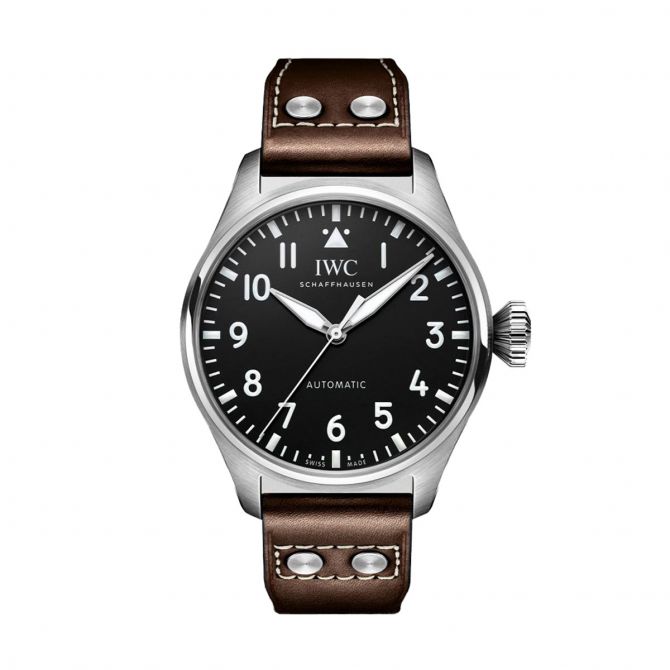
Modern Big Pilot references translate this heritage into contemporary specifications while preserving every visual element that traces to the B-Uhr original: large Arabic numerals, triangle at 12 o’clock, matte black dial, proportionally oversized crown. The super clone market respects this heritage because every design element has documented military provenance — not marketing stories, actual operational history.
43mm vs 46mm — The Great Debate
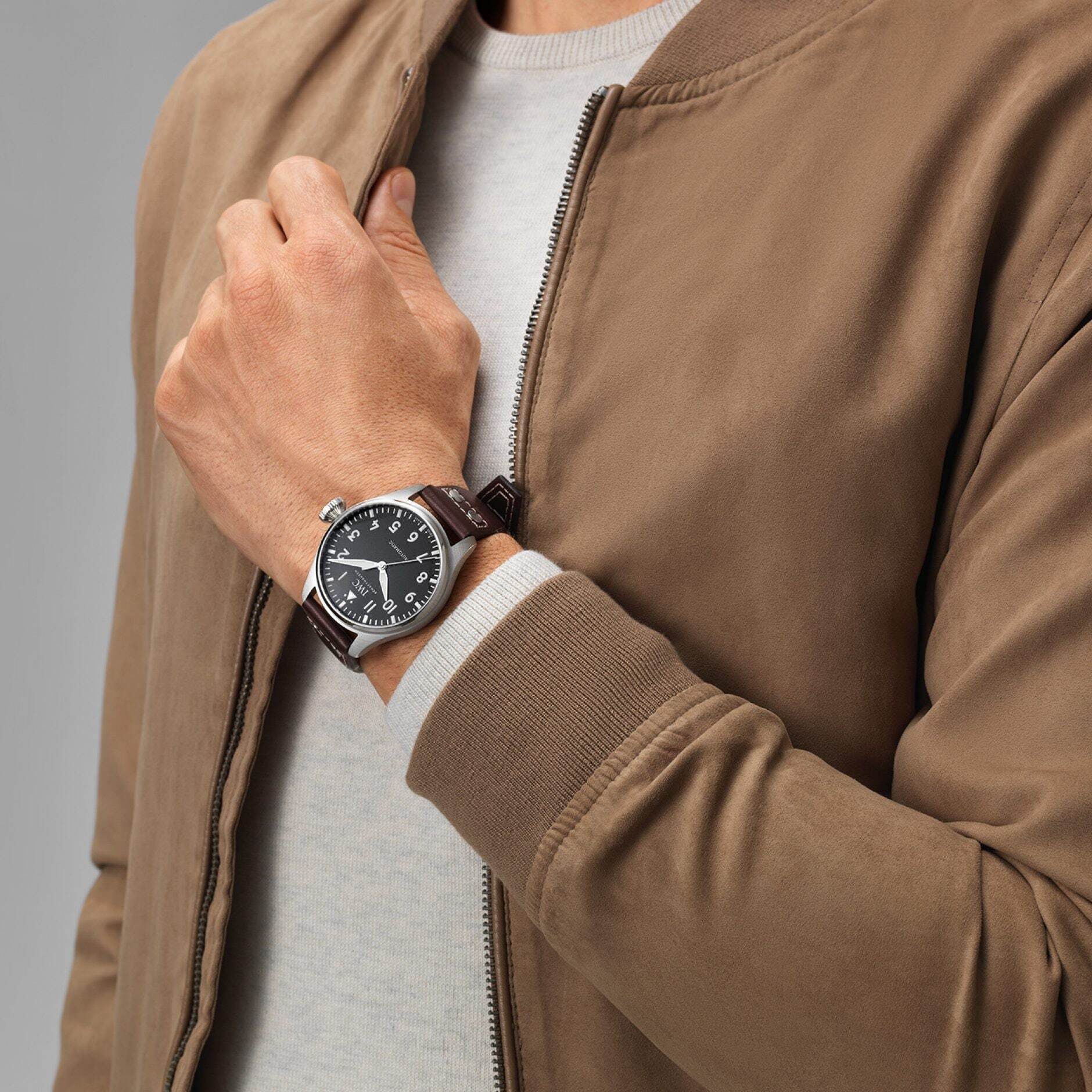
IWC split the Big Pilot into two size tiers: the 43mm “Big Pilot’s Watch 43” (IW329301 series) and the 46.2mm original format (IW501001 series). This division generated genuine debate among collectors — can a 43mm watch be a “Big” Pilot?
| Dimension | Big Pilot 43mm | Big Pilot 46.2mm |
|---|---|---|
| Diameter | 43.0mm | 46.2mm |
| Thickness | 13.6mm | 15.2mm |
| Lug-to-Lug | ~52mm | ~55mm |
| Crown | Conical (smaller proportional) | Conical (full-size) |
| Movement | Cal. 82100 (60h) | Cal. 52110 (168h/7-day) |
| Power Reserve Indicator | No | Yes |
| Min Wrist | 6.75″ | 7.25″ |
| Weight (steel) | ~120g | ~145g |
The 43mm wins the daily wearability argument decisively. It maintains every visual element of the Big Pilot — the conical crown, the instrument dial, the triangle at 12, the oversized Arabic numerals — at a size that works on 6.75-inch wrists and fits under most shirt cuffs. The 3mm difference sounds minor, but the combined reduction in diameter, thickness, and lug-to-lug transforms the wearing experience from “deliberate oversized statement” to “confidently large daily watch.”
The 46mm wins the heritage argument. The original B-Uhr was 55mm; the 46mm is the closest modern production gets to that specification. The 7-day power reserve with visual indicator at 3 o’clock is exclusive to the 46mm and carries significant collector cachet. And the full-size conical crown on the 46mm is unmistakable — visible across a room, it’s the single most recognizable crown in watchmaking.
Verdict: Buy the 43mm for a watch you’ll wear daily. Buy the 46mm for a collection statement piece you’ll rotate on weekends and special occasions. If you can only have one, the 43mm serves better — you’ll wear it three times as often, and the Big Pilot identity remains fully intact at the smaller size.
The Conical Crown — Engineering Purpose
The Big Pilot’s conical crown is its most instantly recognizable feature and the single most important quality checkpoint on any Big Pilot super clone. The genuine crown is machined from solid steel with a tapered (conical) profile — wider at the base, narrowing toward the tip. Fine knurling covers the surface for grip. The design serves a specific purpose: a conical shape is easier to grip and turn with thick flight gloves than a flat or domed crown.
On the 46mm Big Pilot, the crown measures approximately 8mm in diameter and 5mm in height — genuinely substantial. On the 43mm, the crown is proportionally smaller (~7mm × 4mm) but maintains the conical profile. In both cases, the crown should feel heavy, solid, and precisely machined. The knurling should be fine and consistent around the entire circumference — no smooth patches, no rough spots, no variation in depth.
Super clone crown quality varies dramatically. Premium factories machine their crowns from solid steel with proper CNC-cut knurling. Budget factories use hollow crowns or poorly finished solid ones — identifiable by lighter weight (pick it up by the crown and feel the heft) or inconsistent knurling. The crown is the component that people touch most often — its quality directly impacts the daily ownership experience.
7-Day Power Reserve Movement
The 46mm Big Pilot houses the caliber 52110 — IWC’s 7-day (168-hour) automatic movement with Pellaton bidirectional winding and a power reserve indicator. This movement uses dual barrels with a very long mainspring, wound by IWC’s proprietary Pellaton system where bidirectional pawls engage the mainspring more efficiently than conventional rotor winding. The result: wear it Monday, take it off Friday night, and it’s still running Monday morning with power to spare.
Super clone 52110 replications can’t match the genuine 168-hour reserve. Premium examples achieve 48-60 hours — good for a standard automatic but short of the genuine’s week-long capability. The power reserve indicator on super clones works proportionally within the available reserve — showing “full” when wound and depleting over 2-3 days rather than 7. For most wearing patterns (daily wear with weekday rotation), this is functionally adequate.
The 43mm Big Pilot uses the caliber 82100 — a simpler in-house automatic with 60-hour power reserve and no power reserve indicator. Super clones achieve 40-48 hours with reliable daily accuracy. The absence of the power reserve complication actually benefits the 43mm super clone — one fewer mechanism to replicate, resulting in more consistent quality.
Instrument Dial Mastery
The Big Pilot dial follows the B-Uhr specification with modern refinement: matte black background, oversized luminous Arabic numerals at every hour position, luminous triangle at 12 o’clock (for orientation), and luminous hands with a distinctive tail on the seconds hand. The 46mm adds a power reserve subdial at 3; the 43mm keeps the dial completely clean with only a date window at 6.
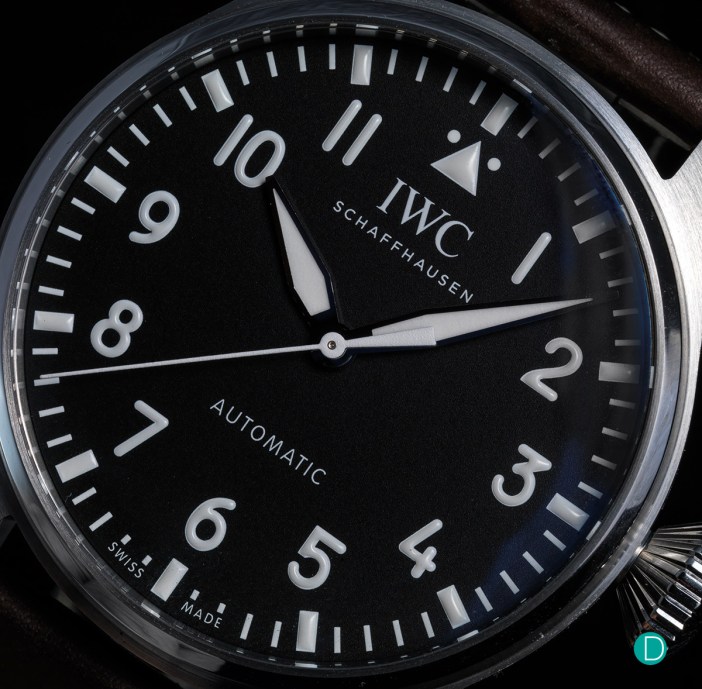
The key quality markers on the dial: matte finish must be absolutely flat (no gloss under any lighting), numerals must be uniformly filled with lume compound (no thin spots visible under magnification), and the triangle at 12 must be precisely centered. The most common failure on budget Big Pilot copies is off-center triangle placement — the triangle shifts slightly left or right of center, visible even at arm’s length to anyone who knows the watch.
Lume performance is particularly important on the Big Pilot because the genuine is designed for low-light reading. After UV charging for 30 seconds, all numerals and hands should glow with uniform intensity. The triangle at 12 should be the brightest element (it needs to be visible from the greatest distance in a dark cockpit). On quality super clones, the lume maintains visible glow for 6+ hours in complete darkness.
Reference Guide
| Reference | Size | Dial | Movement | Clone Quality |
|---|---|---|---|---|
| IW329301 | 43mm | Black | 82100 | ★★★★★ |
| IW329303 | 43mm | Blue | 82100 | ★★★★★ |
| IW329305 | 43mm | Green | 82100 | ★★★★☆ |
| IW501001 | 46.2mm | Black, PR | 52110 | ★★★★★ |
| IW501015 | 46.2mm | Blue, PR | 52110 | ★★★★☆ |
| IW501012 | 46.2mm | Le Petit Prince blue | 52110 | ★★★★★ |
The Le Petit Prince editions (IW501012) in deep blue with gold-toned markers are among the most sought-after Big Pilot super clones. The blue-on-gold combination creates a warmth that the standard black dial lacks, and the literary association with Saint-Exupéry’s novella adds cultural depth. Factories have produced Le Petit Prince Big Pilots for years, resulting in refined quality that matches the standard black references.
Strap Culture — Riveted to NATO
The Big Pilot has a strong strap culture. The factory strap uses a classic pilot configuration: dark brown or black calfskin with riveted attachment at the lugs. The rivets reference vintage pilot watches where strap failure at altitude could mean losing the watch — rivets provided more secure attachment than spring bars.
Super clone Big Pilot straps range from acceptable to excellent. The strap width (22mm on the 43mm, 23mm on the 46mm) limits aftermarket options slightly compared to standard 20mm or 22mm widths. For the 46mm, custom strap makers who specialize in pilot watches are the best source for upgrades — they produce straps in the correct width with authentic rivet placement.
NATO straps work surprisingly well on the Big Pilot — the military heritage justifies the casual material, and the fabric sits underneath the case, adding a slight cushion that improves comfort on the heavier 46mm. Olive green, grey, and black NATO straps complement the instrument dial’s military aesthetic.
Daily Wearing Reality
The 43mm Big Pilot works as a daily wearer for desk-oriented lifestyles. At 13.6mm thick, it’s noticeable but manageable under loose cuffs. The weight in steel (~120g) is substantial but not uncomfortable — the case distributes well on the wrist due to its proportioned lug design. On leather, it’s comfortable from first wear; on NATO, even more so.
The 46mm is a weekend watch for most people. At 15.2mm thick and 145g, wearing it during a full office day with shirt cuffs creates constant friction between case and fabric. The oversized crown catches on cuffs. The visual mass draws attention in conservative settings. None of these are problems if you’re wearing the 46mm intentionally — at a watch meetup, a weekend market, a casual dinner, it’s magnificent. But five days a week in a suit? The 43mm handles that better.
Quality Assessment
1. Conical crown — Weight, knurling consistency, taper profile. This is the Big Pilot’s signature — budget copies fail here most obviously.
2. Crown guards — The Big Pilot doesn’t have crown guards (unlike the Pilot Chrono). If your “Big Pilot” has crown guards, it’s the wrong reference or a misidentified model.
3. Triangle at 12 — Precisely centered. Any lateral offset is immediately visible and marks the watch as substandard.
4. Numeral size — Arabic numerals should be proportionally large relative to the dial. Budget copies sometimes use undersized numerals from smaller Pilot references.
5. Power reserve (46mm) — The indicator should move smoothly from full to empty. Jumping or sticking indicates a poorly integrated complication.
6. Case proportions — Lug-to-lug must match the diameter. Too-short lugs on a large dial create a “mushroom” appearance. Too-long lugs cause wrist overhang.
7. Matte finish — Absolutely no gloss on the dial. Even micro-gloss under direct light indicates incorrect dial material.
8. Soft iron cage — Present on genuine and premium clones. Provides antimagnetic protection verifiable with a compass test.
Frequently Asked Questions
IWC Big Pilot Replica — 15 Expert Answers
43mm for daily wear on wrists 6.75″+ — maintains full Big Pilot identity at manageable dimensions. 46mm for collection statement on wrists 7.25″+ — full heritage experience with 7-day power reserve indicator. If choosing one, the 43mm serves better for most lifestyles.
No. Super clone “7-Day” Big Pilots achieve 48-60 hours. The power reserve indicator functions proportionally within this range but depletes in 2-3 days rather than 7. The genuine’s 168-hour reserve requires IWC’s proprietary twin-barrel Pellaton system.
Designed for operation with flight gloves — the tapered shape allows a gloved hand to grip and turn the crown without removing gloves. On modern watches, it’s the Big Pilot’s visual signature. Check knurling quality and weight — premium clones use solid machined steel; budget uses hollow or poorly finished crowns.
The 43mm: yes, with looser cuffs and casual to smart-casual suits. The 46mm: no — too thick and heavy for most formal environments. The Big Pilot is primarily a casual to smart-casual watch regardless of size.
Special editions with deep blue dials and gold markers, referencing Antoine de Saint-Exupéry’s novella. The Le Petit Prince Big Pilot is one of the most popular and best-executed super clone references — the blue-gold combination is visually stunning.
Both are large, bold watches with military heritage. The Big Pilot is aviation-focused with a clean instrument dial. The Luminor is naval-focused with a sandwich dial and crown guard. The Big Pilot is the sleeker design; the Luminor is the chunkier presence.
Dark brown calfskin with rivets (heritage look). Black leather for versatility. NATO straps (olive, grey) for casual military aesthetic. Avoid metal bracelets — they add weight to an already substantial watch and contradict the pilot watch ethos.
Yes — genuine and premium super clones include a soft iron cage for antimagnetic protection. This was a B-Uhr specification requirement to protect the movement from cockpit instrument magnetic fields.
±10-15 seconds daily on premium examples. The movements are based on proven automatic architectures that can be regulated to ±5-8 seconds by a competent watchmaker. Annual service maintains this accuracy.
Different watches. The Mark XX (40mm) is a daily tool watch with day/date. The Big Pilot 43 is a commanding presence piece with the conical crown, larger numerals, and more substantial case. The Big Pilot has significantly more wrist presence even at just 3mm larger.
The genuine is rated at 60m (basic water resistance). Premium super clones handle splashes and rain but aren’t recommended for swimming. The conical crown’s screw-down engagement doesn’t provide dive-watch-level sealing. For water activities, choose a diver.
Black (classic), blue (Le Petit Prince), green (modern), and grey (limited). Black is the most historically accurate. Blue is the most popular. All are available in quality super clone form for both the 43mm and 46mm.
5-8 years with standard maintenance. The 43mm (simpler movement, no power reserve complication) trends toward the higher end. The 46mm may need slightly earlier service due to the power reserve mechanism.
For buyers who want a bold, conversation-starting watch with genuine military heritage — yes. For buyers who need versatility across formal and casual settings — the Portugieser or Portofino serves better. The Big Pilot makes a strong first impression but has a narrower wearing range.
Most sellers offer optional IWC-style packaging. The Big Pilot’s presentation box is distinctive — larger than standard IWC boxes to accommodate the watch. Whether to buy packaging is personal preference; it adds to the ownership experience.
Final Word on IWC Big Pilot Replicas
The IWC Big Pilot replica market has been elevated by the 43mm variant — a watch that brings the legend’s full visual identity to a size that works for daily life. The conical crown, the instrument dial, the military heritage — all present, all convincing, all accessible. The 46mm remains the ultimate statement for collectors with the wrists and lifestyle to support it. Both deliver the Big Pilot experience that has captivated aviation enthusiasts and watch collectors for decades.
The Big Pilot super clone rewards buyers who appreciate purposeful design. Every element exists for a reason — and those reasons connect to actual combat aviation, not marketing departments. That authenticity gives the Big Pilot a depth that pure design exercises can’t match. Browse the full IWC replica collection and explore our guides on the Pilot Watch, Portugieser, and Portofino to find the IWC that fits your wrist and lifestyle.