AP Royal Oak Skeleton Replica — Double Balance Wheel, Openworked Dials, and the Art of Seeing Through Time
Last updated: March 2026 • 20-minute read • 6 skeleton references compared
AP Royal Oak skeleton replica watches represent the pinnacle of what the super clone industry can achieve — and its most honest limitation. An openworked dial hides nothing. Every bridge, every gear, every surface finish is visible from both sides of the watch. JF and ZF both produce skeleton Royal Oaks, and the quality has reached a point where the movement decoration genuinely impresses. But skeleton watches also expose more potential flaws than any solid-dial model. This guide covers the 15407ST Double Balance Wheel, the 15305ST Openworked, the Offshore skeleton variants, and exactly what to examine when evaluating these transparent timepieces.
The openworked references are in our AP Royal Oak replica collection, including the Royal Oak 15500 ceramic and the double balance wheel 15407.
Table of Contents
- 01 Why Skeleton AP Watches Fascinate
- 02 15407ST — Double Balance Wheel
- 03 15305ST — Classic Openworked
- 04 Offshore Skeleton Variants
- 05 Skeleton Movement Architecture
- 06 Movement Finishing Deep Dive
- 07 Skeleton vs Solid Dial — Which to Buy
- 08 QC Specifics for Skeleton Models
- 09 Factory Comparison for Skeleton
- 10 Living with a Skeleton AP
- 11 FAQ — 15 Skeleton Questions

Why Skeleton AP Watches Fascinate
A solid-dial Royal Oak shows you time. A skeleton Royal Oak shows you how time works. The appeal isn’t just aesthetic — though the visual impact is undeniable — it’s philosophical. When you look at a skeleton AP, you see every gear, every spring, every jewel that collaborates to measure time. The balance wheel oscillating at 28,800 beats per hour. The mainspring slowly unwinding. The escape wheel releasing energy in precisely measured pulses. It’s mechanical engineering on full display.
Audemars Piguet was among the first luxury brands to offer factory skeleton watches rather than having independent artisans modify existing movements. AP’s approach: design the movement architecture so that skeletonization enhances the visual narrative rather than just removing material. The bridges are shaped as structural art — wide enough to showcase finishing techniques, narrow enough to reveal the components beneath. The result is a watch that looks complex but reads clearly, which is the entire challenge of skeleton watchmaking.
For replica purposes, skeleton watches present an interesting paradox. On one hand, the exposed movement means every detail is visible — there’s nowhere to hide poor finishing or incorrect architecture. On the other hand, skeleton watches are so visually busy that individual flaws disappear in the overall visual complexity. A slightly imperfect Geneva stripe on a skeleton bridge is less noticeable than on a solid movement plate because the eye is processing dozens of surfaces simultaneously rather than focusing on one.
15407ST — Double Balance Wheel

The Royal Oak Double Balance Wheel Openworked (ref. 15407ST) is AP’s most dramatic skeleton Royal Oak. The headline complication: two balance wheels connected by a shared balance staff, beating in synchronized opposition. Genuine AP’s Cal. 3132 uses this dual-balance system to improve timekeeping stability — similar in concept to Breguet’s Résonance, though mechanically different. The visual impact is immediate: two balance wheels oscillating in mirror rhythm, visible through both the dial and caseback.
The super clone version approaches this differently. Creating a genuine dual-balance system at this scale requires precision that’s currently beyond clone movement factories. Instead, JF’s version uses a single balance wheel movement with a decorative second balance wheel that rotates freely — it moves from the energy of the mainspring but doesn’t contribute to timekeeping. From a visual perspective at arm’s length, both wheels oscillate and the effect is convincing. Under a loupe, a watchmaker would note the mechanical difference. On the wrist, in motion, during everyday wear — the visual spectacle is maintained.
The case on the 15407 is standard Royal Oak dimensions — 41mm diameter, the same octagonal bezel, same integrated bracelet. JF’s casework is solid here, using the same molds as their regular Royal Oak production. Where the skeleton model differs from a standard 15500 is the dial — or rather, the absence of one. The bridges are visible from 12 o’clock through to 6, with applied hour markers on a slim ring that circles the movement. The depth effect is remarkable: you’re looking through layers of mechanical architecture.
The bridge architecture on JF’s 15407 follows genuine’s layout closely. The two large symmetrical bridges that frame the balance wheels are positioned at the correct angles, with the correct cutout shapes. The smaller bridges for the gear train are similarly placed. The overall visual architecture — the “map” of where metal and void alternate — matches genuine from dial side and caseback side. This matters because anyone who’s seen photos of a genuine 15407 would recognize if the bridge layout was wrong.
15305ST — Classic Openworked
The 15305ST is the “original” skeleton Royal Oak — predating the Double Balance Wheel model and offering a more traditional openworked presentation. Where the 15407 draws attention to the dual balance wheels as a focal point, the 15305 presents the movement more evenly — there’s no single dramatic complication to anchor your eye. Instead, the entire movement architecture is the show. Every bridge, every wheel, every jewel contributes equally to the visual composition.

Genuine AP’s Cal. 3129 in the 15305 is a single-balance movement with conventional architecture — one balance wheel, one barrel, standard gear train. The skeletonization removes material from the bridges and plates to reveal the components beneath while maintaining structural integrity. The challenge: every removed gram of metal reduces the bridge’s stiffness, which can affect timekeeping accuracy if done without careful engineering. AP solved this by designing the bridges with internal ribbing invisible from the surface — engineering strength into the minimal remaining material.
JF’s 15305 super clone uses the Miyota 9015 with custom skeleton bridges that follow the genuine Cal. 3129’s visual layout. Since the 9015 and 3129 have different internal architectures, the custom bridges serve dual purposes: they visually replicate the genuine’s openworked pattern while properly supporting the 9015’s gear train. The execution is clever — the bridge shapes are correct from a visual standpoint, and the functional requirements of the 9015 are met through internal structural elements hidden behind the decorative surfaces.
The 15305 is generally considered easier to replicate well than the 15407 because there’s no dual balance wheel complication to address. The movement decoration — Geneva stripes, perlage, anglage on bridge edges — is the primary differentiator between a good and excellent skeleton replica, and JF’s current production shows markedly improved finishing over previous generations.
Offshore Skeleton Variants
AP also produces skeleton versions of the Royal Oak Offshore — combining the Offshore’s larger case (42-44mm), rubber strap, and sporty design language with an openworked dial. The visual effect is different from the standard Royal Oak skeleton: the Offshore’s larger case gives the movement more room to breathe visually, and the Mega Tapisserie pattern on the inner ring adds a second texture element that plays against the movement’s mechanical surfaces.
JF produces the Offshore skeleton chronograph — a watch with both an openworked dial and functioning chronograph pushers. This is genuinely impressive from a manufacturing standpoint. The movement needs to be skeletonized, the chronograph needs to function, and the visual balance between mechanical components and open space needs to work. JF’s version achieves this with the modified Asian 7750 base — the chronograph functions work (start, stop, reset), the subdials are visible through the skeleton bridges, and the overall visual density is appropriate.
The ceramic Offshore skeleton is the most dramatic variant — a matte black ceramic case framing a visible movement, typically with blue or red accent details on the bridges. JF uses actual ceramic for these models. The contrast between the dark ceramic case and the silver/rhodium movement surfaces creates a visual impact that photographs well and wears even better. The ceramic skeleton Offshore is arguably the most Instagram-ready AP in the super clone catalog.
Collector note: Skeleton Offshore models are rarer in the super clone market than standard Offshore references. JF produces them in smaller batches, so availability can be inconsistent. If your dealer says a skeleton Offshore is “out of stock,” it genuinely might be — these aren’t always in continuous production like the 15710 Diver or 26470 Chronograph.
Skeleton Movement Architecture
Understanding how skeleton super clone movements work requires understanding what you’re actually looking at. The movement inside a skeleton Royal Oak super clone is a Miyota 9015 — the same proven Japanese caliber used in solid-dial AP replicas. The difference: the standard 9015 has solid bridges and a solid plate, designed purely for function. The skeleton version replaces these functional components with custom-machined bridges that serve the same structural role but are shaped to visually match AP’s genuine skeleton calibers.
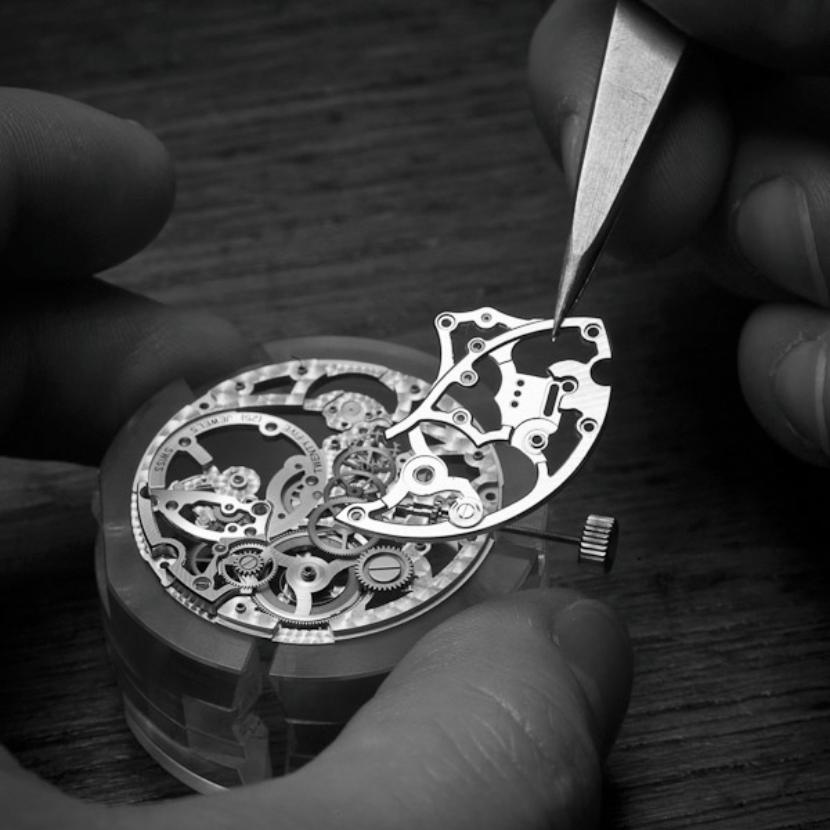
The custom bridges are CNC-machined from brass or German silver (an alloy of copper, nickel, and zinc), then finished with Geneva stripes, perlage, and edge beveling. The quality of this finishing is what determines whether a skeleton replica looks like fine watchmaking or a science fair project. Here’s what each finishing technique involves:
Geneva stripes (Côtes de Genève): Parallel decorative lines that run across the bridge surfaces. On genuine AP, these are applied by a rotating abrasive disk that creates perfect, evenly-spaced, slightly overlapping arcs. On super clones, they’re typically laser-etched — the visual result is similar from normal viewing distance, but under magnification the laser lines have slightly sharper edges compared to genuine’s softer, mechanically-applied stripes.
Perlage (circular graining): Small overlapping circles applied to flat surfaces, usually on the main plate visible through gaps between bridges. Genuine AP applies perlage by hand using a rotating peg coated with abrasive paste. Super clones use a machine-applied process — faster, more consistent, but lacking the subtle irregularities that identify hand work. The visual result is clean and attractive; the philosophical difference is craftsmanship method rather than appearance.
Anglage (edge beveling): The angled polishing of bridge edges that creates a reflective mirror surface along each edge. This is the single most labor-intensive finishing technique in watchmaking — on genuine AP, anglage is applied by hand, one edge at a time, using a series of increasingly fine abrasive tools. Super clone anglage is machine-polished and generally appears as a matte bevel rather than a mirror-finished bevel. This is the most detectable difference between genuine and super clone skeleton movements under magnification.
Movement Finishing Deep Dive
Since the movement IS the dial on a skeleton watch, the quality of finishing directly determines the watch’s visual impact. Let me break down what current-generation JF and ZF skeleton movements deliver:
Bridge surface treatment: Both JF and ZF apply Geneva stripes across the full length of each visible bridge. The stripes run in the correct direction for each bridge (perpendicular to the long axis, as per Geneva Convention standards — yes, there’s actually a standard). The stripe spacing is approximately 1.2mm, matching genuine AP’s specification. The visual effect under ambient indoor lighting: clean, reflective parallel lines that shift as you tilt the watch. Exactly what you want.
Rotor decoration: The oscillating weight (rotor) is the most visible component through the display caseback and is also partially visible from the dial side on skeleton models. JF uses a 21-karat gold mass on the rotor (genuine uses 22k — visually identical). The rotor surface carries “Audemars Piguet” text with the AP logo, and Geneva stripes cover the rotor arm. Current JF production shows improved text clarity compared to older generations — the letters are sharper and more evenly spaced.
Color treatment: Some skeleton AP references feature colored elements — blue screws, rhodium-plated bridges, rose gold accents. JF handles these with reasonable accuracy. Blue screws are heat-treated to the correct cornflower blue (genuine AP uses thermal bluing, JF uses a chemical process that achieves similar color). Rhodium plating on bridges shows the correct cool silver-grey tone. Rose gold accents on limited editions are plated to match AP’s pink gold (5N gold) warmth.
The honest assessment: If you hold a genuine AP skeleton and a JF skeleton side by side and examine them with a loupe, you’ll see differences — primarily in anglage quality, the depth of Geneva stripes, and the polish on jewel chatons. If you wear a JF skeleton on your wrist and look at it during a meeting, in a restaurant, at a bar — the movement is beautiful, the finishing catches light attractively, and the visual complexity delivers the “wow” that skeleton watches are supposed to provide.
Skeleton vs Solid Dial — Which to Buy

This decision depends on what you want from your AP. Both are excellent watches — they just serve different purposes and make different impressions. Here’s a straightforward comparison to help you decide:
If this is your only AP: get the solid dial (ZF 15500ST). It’s more versatile, easier to read, and ZF’s execution is class-leading. The tapisserie dial is what defines the Royal Oak for most people, and you should experience it before exploring variations.
If this is your second AP: the skeleton is a perfect complement. You already own the classic — now add the dramatic. The skeleton wears the same dimensions but delivers a completely different experience. You’ll find yourself wearing it for evenings out, weekend adventures, and any occasion where you want your watch to be noticed rather than blended.
If you’re primarily interested in the mechanical spectacle — watching gears turn, balance wheels oscillate, the mainspring slowly unwind — the skeleton is the obvious choice regardless of whether it’s your first or fifth AP. Some people buy watches for status, others for aesthetics, others for engineering appreciation. If you fall in the engineering camp, the skeleton speaks your language.
QC Specifics for Skeleton Models
Quality controlling a skeleton AP requires different focus points than a solid-dial model. You’re evaluating movement finishing rather than tapisserie quality, bridge placement rather than date alignment. Here’s a skeleton-specific QC checklist:
Skeleton QC Checklist:
- Bridge symmetry: Main bridges should be visually balanced left-right
- Geneva stripes: Consistent spacing and direction on all visible bridges
- Dust/debris: No particles trapped between bridges (hard to remove post-assembly)
- Balance wheel oscillation: Request a video — it should spin freely and smoothly
- Hour markers: Applied markers on the chapter ring should be straight and secure
- Hands: Clear visibility against the movement — correct lume fill
- Rotor text: “Audemars Piguet” clearly legible on the oscillating weight
- Caseback view: Movement should look identical from the back — mirror of the dial side
- Screw color: Blued screws (if present) should be consistent shade of blue
- Bezel and bracelet: Same checks as solid-dial models apply here too
Important: Always request a video for skeleton models, not just photos. A video shows the balance wheel oscillating, which confirms the movement is running correctly and the “double balance wheel” effect (on 15407) is functioning. Photos alone don’t verify movement function on skeleton watches.
Factory Comparison for Skeleton
Fewer factories produce skeleton AP models compared to solid-dial versions. The movement finishing requirements are higher, and the market for skeleton watches is smaller. Here’s where each factory stands:
JF Factory is the clear leader for skeleton AP. They produce the 15407ST Double Balance Wheel, the 15305ST Openworked, and skeleton Offshore variants. Their movement finishing is the best available in the super clone market for these references. JF’s decade-plus experience with AP gives them a finishing standard that newer factories haven’t matched on skeleton models. Recommendation: JF for any skeleton Royal Oak or Offshore.
ZF Factory has experimented with skeleton Royal Oaks but their focus remains on solid-dial models where their bracelet and tapisserie advantages matter most. ZF’s skeleton production is smaller in volume and less refined in movement finishing compared to JF. If you want a skeleton AP and ZF is your only option through a particular dealer — it’s acceptable. But given the choice, JF is the better pick for exposed-movement models.
APS Factory has not significantly entered the skeleton space. Their strength — dial color accuracy — is irrelevant on a watch without a traditional dial. APS may expand into skeleton production in the future, but as of early 2026, they’re not a contender for these references.
Living with a Skeleton AP
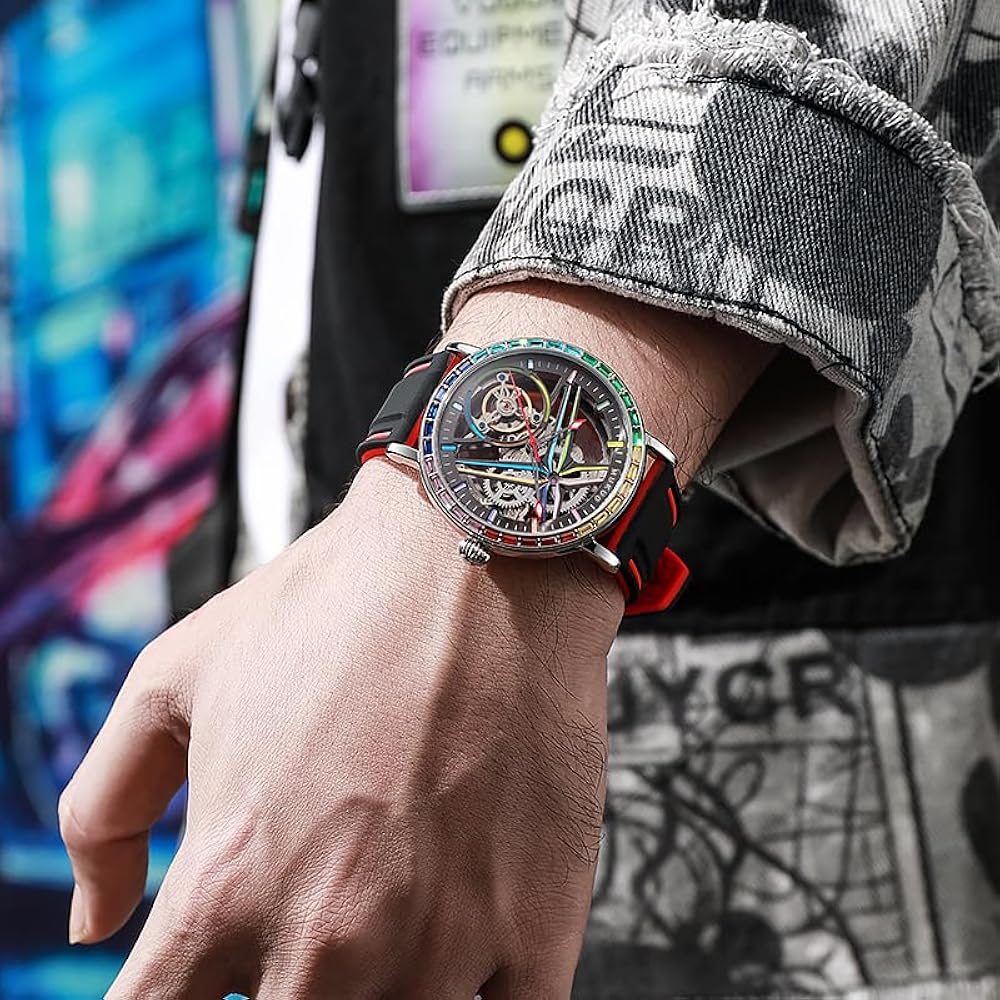
Owning a skeleton watch changes how you interact with time. You don’t just glance at the time and look away — you find yourself watching the mechanism work. The balance wheel’s hypnotic oscillation becomes a meditation anchor during meetings. The rotor’s swing when you gesture becomes a private animation only you can see. It sounds like marketing copy, but it’s genuinely how skeleton watch owners describe the experience.
Practical considerations: the skeleton dial is slightly harder to read quickly than a solid dial with contrasting hands and markers. The hands on a skeleton Royal Oak are lume-filled, and AP designed them with enough width and luminous material to remain legible against the busy movement background. In good lighting, readability is fine. In dim conditions, the lume helps significantly. In total darkness, the skeleton is actually easier to read than you’d expect because the luminous hands glow against a dark background (the movement doesn’t glow).
Dust is the skeleton watch owner’s minor enemy. Over time, microscopic particles can find their way between the crystal and movement, settling on bridge surfaces where they’re visible. Genuine or super clone, this happens to all skeleton watches. The solution: periodic cleaning during regular service intervals (every 3-5 years). Between services, avoid exposing the watch to dusty environments without protection — but don’t overthink this. Normal daily wear in normal environments is fine.
The social aspect: skeleton watches attract attention. People who would walk past a standard Royal Oak without noticing will stop and comment on a skeleton version. “Is that the inside of the watch?” is the most common question. Whether this attention is positive or uncomfortable depends on your personality. If you enjoy sharing your appreciation of mechanical engineering — the skeleton opens those conversations naturally.
FAQ — 15 Skeleton Questions
Does the double balance wheel actually work on the super clone?
The movement uses one functional balance wheel and one decorative wheel that rotates freely. Both oscillate visually — the dual-wheel effect is visually convincing at arm’s length. Functionally, timekeeping relies on the single primary balance wheel.
Which factory makes the best skeleton AP?
JF Factory. Their movement finishing — Geneva stripes, bridge shaping, rotor decoration — is the best available for skeleton AP references. They produce both the 15407 Double Balance Wheel and 15305 Openworked.
Is the movement finishing close to genuine AP?
At arm’s length and under normal indoor lighting, yes — the Geneva stripes, perlage, and bridge shapes match genuine’s visual character. Under a loupe, differences in anglage (edge beveling) and engraving depth become apparent. The overall visual impression at wearing distance is convincing.
Can I read the time easily on a skeleton dial?
Yes, though it takes a fraction of a second longer than a solid dial. The hands have luminous fill that provides contrast against the movement. In bright lighting, readability is straightforward. In dim conditions, the lume activates and makes the hands stand out clearly.
Is the skeleton more fragile than the solid dial version?
The case and bracelet are identical in strength. The movement bridges are slightly thinner due to skeletonization, but they’re still robust enough for daily wear. Don’t drop it on tile — but that advice applies to all watches.
Should a skeleton AP be my first replica watch?
Probably not. Start with a solid-dial model (ZF 15500ST) to appreciate the Royal Oak’s core design language — the tapisserie, the bracelet, the octagonal bezel. Once you love the platform, the skeleton variant becomes a meaningful second piece rather than a novelty first purchase.
Do skeleton AP replicas hold up over time?
Yes. The movement is the same proven Miyota 9015 base as solid-dial models. The decorative bridges don’t affect long-term reliability. Service intervals are the same: every 3-5 years for cleaning and lubrication.
What about dust getting inside the movement?
The case is sealed just like solid-dial models — dust can’t enter during normal wear. Over years, microscopic particles may accumulate and become visible on bridge surfaces during servicing. Regular service addresses this. Don’t open the caseback yourself.
Is the ceramic skeleton Offshore available?
JF produces ceramic skeleton Offshore models in limited batches. Availability fluctuates — check with your dealer for current stock. When available, they use real ceramic components (not painted metal) with the skeleton movement visible through the openworked dial.
Can a watchmaker service a skeleton super clone?
Yes. Tell them it’s a Miyota 9015 with custom decorative bridges. The functional components are standard 9015 parts. The skeleton bridges lift off to expose the same gear train any 9015-experienced watchmaker knows. No special tools required.
How does the skeleton compare to a Hublot Big Bang skeleton?
Different design philosophy. Hublot’s skeleton is more industrial and modern — layered materials, visible screws, aggressive angles. AP’s skeleton is classical — Geneva stripes, traditional bridge shapes, refined finishing. Choose based on your aesthetic preference: industrial vs traditional.
What’s the power reserve on skeleton models?
Approximately 38-42 hours depending on the specific model. The 15407 Double Balance Wheel runs slightly shorter (~38 hours) due to the additional rotating mass. The 15305 achieves the standard ~42 hours. Both easily handle overnight off the wrist.
Are there rose gold skeleton Royal Oaks available?
JF produces skeleton models in rose gold plating — the 15407OR and similar references. The rose gold case and bracelet with visible movement create a striking luxury aesthetic. Plating durability is 2-3 years with daily wear on high-contact areas.
What QC photos should I request specifically for skeleton?
In addition to standard photos: a macro dial shot showing bridge finishing quality, a caseback shot showing rotor decoration, and — critically — a short video showing the movement running. The video confirms balance wheel function, rotor spin, and overall movement health.
Is the 15407 or 15305 better as a first skeleton AP?
The 15407 Double Balance Wheel has more visual drama — the dual oscillating wheels are mesmerizing. The 15305 is more traditionally elegant with a cleaner movement presentation. For maximum impact, 15407. For understated sophistication, 15305.
Final Word
A skeleton Royal Oak is a declaration: you don’t just appreciate the time on your wrist — you appreciate the engineering that measures it. JF Factory’s current skeleton production delivers movement finishing that photographs well, wears impressively, and rewards the kind of repeated close inspection that skeleton watches invite. Whether you choose the dramatic dual-balance 15407 or the classical 15305, you’re getting a watch that turns a mechanical movement from hidden infrastructure into visible art. Pair it with a solid-dial Royal Oak in your collection and you’ve covered both sides of what makes AP special — the iconic tapisserie and the masterful movement beneath it.
Related guides: Royal Oak Replica Guide • Offshore Replica Guide • Best AP Super Clone Factory Rankings • Best Replica Watches 2026 • Browse AP Collection