Jaeger-LeCoultre Duometre Replica — Dual-Wing Architecture That Redefined Precision Timekeeping
Most watches have one movement powering everything — time, date, chronograph, whatever complications they carry. The Jaeger-LeCoultre Duometre has two. Two separate power sources, two independent gear trains, sharing one regulating organ. JLC calls this “Dual-Wing” architecture. The rest of the industry calls it groundbreaking. When a complication runs on its own dedicated power supply, it doesn’t steal energy from the timekeeping train — meaning accuracy stays constant whether your chronograph is running or not. That’s not a theoretical advantage. It’s measurable precision.
- What Is Dual-Wing Architecture?
- Duometre Chronographe — 1/6th Second Precision
- Duometre Quantieme Lunaire — Calendar + Moon
- Duometre Spherotourbillon — Gravity Defied
- Dial Design — The Art of Symmetry
- Movement Architecture Explained
- Super Clone Reality — What’s Possible
- Duometre vs Datograph vs El Primero
- Wearing a Duometre — Statement Piece Rules
- FAQ — 15 Questions Answered
I encountered the Duometre concept for the first time at SIHH 2007, when JLC unveiled the Duometre a Chronographe. The technical presentation lasted an hour. An actual horologist explained the dual-barrel system using a cutaway movement model the size of a dinner plate. By the end, everyone in the room understood why this mattered — and why it was so difficult to achieve. Two independent power flows sharing one balance wheel isn’t something you bolt together from existing components. It requires a movement designed from scratch, with every gear, spring, and jewel calculated for dual-source operation.
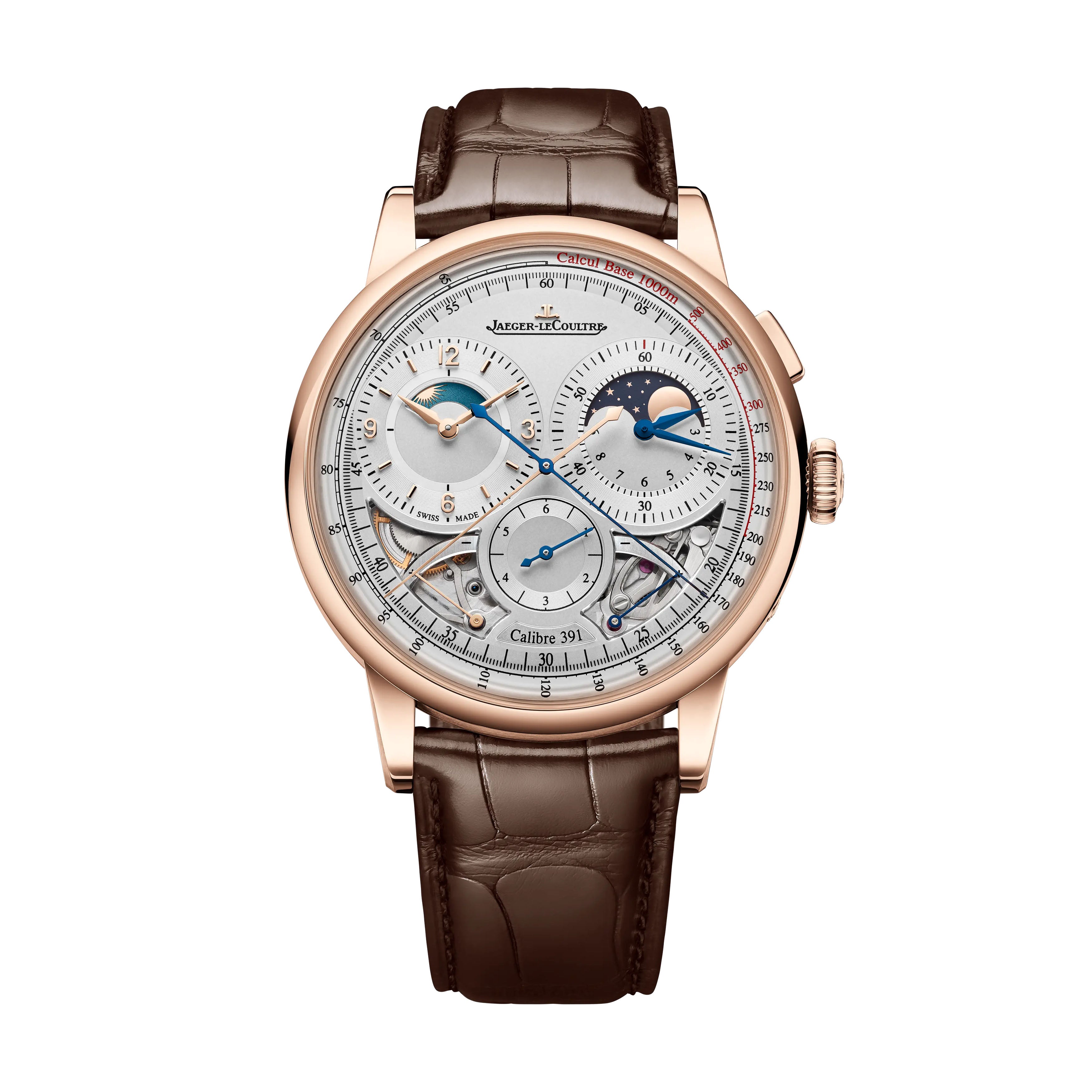
What Is Dual-Wing Architecture?
In a standard chronograph watch, one mainspring barrel powers everything — the hours, minutes, seconds, and the chronograph function. When you start the chronograph, it draws power from the same barrel that’s keeping time. This causes a tiny but measurable drop in amplitude (the swing arc of the balance wheel), which affects timekeeping accuracy. Most people never notice because it’s measured in seconds per day. But JLC noticed.
Dual-Wing architecture solves this by using two barrels with separate gear trains:
The genius is in the sharing. Both wings feed into the same balance wheel, which oscillates at a constant rate regardless of which wing is drawing power. Because each wing has its own barrel and gear train, starting or stopping the chronograph (or any complication) has zero effect on the timekeeping wing’s power delivery. The balance wheel sees a consistent energy flow from both sides.
For the collector, this translates to a watch that keeps perfect time whether the chronograph is running or not — a claim that no single-barrel chronograph can make with the same confidence. For the super clone buyer, it translates to a watch that represents JLC’s absolute highest technical achievement in a wristwatch format.
Technical Context: Only three brands have produced watches with independent dual-power-source architecture: JLC (Duometre), F.P. Journe (Resonance), and A. Lange & Sohne (Datograph). Each uses a different approach to the same problem. JLC’s solution — shared balance wheel with dual gear trains — is the most mechanically elegant.
Duometre a Chronographe — 1/6th Second Precision
The Chronographe was the first Duometre, launched in 2007. It measures elapsed time to 1/6th of a second — each second on the chronograph subdial is divided into six increments. The foudroyante (jumping sixths) hand at 4 o’clock ticks six times per second, creating a mesmerizing visual effect that’s both technically impressive and genuinely useful for precise timing.
The dial layout reflects the dual-wing concept: the left side belongs to Wing 1 (timekeeping — hours, minutes, power reserve indicator), and the right side belongs to Wing 2 (chronograph — elapsed minutes, foudroyante seconds, chronograph power reserve). This visual separation isn’t arbitrary — it’s a direct representation of the movement’s architecture.
The movement contains 463 components — that’s about 50% more parts than a typical chronograph caliber. Every additional part adds potential failure points, which is why the Duometre undergoes JLC’s extended testing protocol. The 54 jewels (compared to ~30 in a standard chronograph) provide additional friction points with synthetic ruby bearings.
Duometre Quantieme Lunaire — Calendar and Moon
The Quantieme Lunaire applies the Dual-Wing concept to a calendar complication with moonphase. Wing 1 handles timekeeping. Wing 2 powers the complete calendar (day, date, month) and the moonphase display. The result is a calendar watch where the calendar complications don’t affect timekeeping accuracy — the same precision guarantee as the Chronographe, applied to a different complication family.
The moonphase on the Quantieme Lunaire is one of the most detailed in the industry. JLC uses a multi-layer disc with actual surface texture on the moon, applied stars on a deep blue background, and a precision that’s accurate to one day in 122 years (compared to the standard moonphase accuracy of one day in 2.5 years). This is astronomical moonphase precision — far beyond what most brands achieve.
The dial layout mirrors the Chronographe’s left/right split: Wing 1 (timekeeping) on the left, Wing 2 (calendar and moonphase) on the right. Two power reserve indicators — one for each wing — let you monitor both energy sources independently. If the calendar wing runs down, the timekeeping wing continues unaffected.
Duometre Spherotourbillon — Gravity Defied
This is JLC at their most ambitious. The Spherotourbillon adds a multi-axis tourbillon to the Dual-Wing architecture. While a standard tourbillon rotates the balance wheel in one plane (compensating for gravity in one position), the Spherotourbillon rotates in two planes simultaneously — the inner cage completes one rotation every 15 seconds while the outer cage rotates every 30 seconds. This compensates for gravity in all positions, not just the vertical ones.
The Spherotourbillon is visible through an aperture at 6 o’clock, where the gyroscopic rotation of the dual-axis cage creates a hypnotic visual effect. It’s one of the most complex mechanical devices ever fitted in a wristwatch — and JLC builds it in their own manufacture in Le Sentier, where one watchmaker spends several weeks assembling each tourbillon cage by hand.
Reality Check: The Spherotourbillon retails above $300,000 and is not replicated in the super clone market. No factory has attempted the multi-axis tourbillon mechanism — the precision required for the dual-cage rotation is beyond current replica manufacturing capability. It’s mentioned here for context on JLC’s technical range, not as a buying option.
Dial Design — The Art of Symmetry
The Duometre dial is one of the most distinctive in haute horlogerie. The visual split between Wing 1 (left) and Wing 2 (right) creates a bilateral symmetry that no other watch brand uses. It’s immediately recognizable — if you see a watch with this left/right layout and dual power reserve indicators, it’s a Duometre. No other brand structures their dials this way because no other brand uses Dual-Wing architecture.
Design elements that define the Duometre aesthetic:
The Duometre’s dial is complex but not cluttered. JLC achieves this through careful hierarchy — the time display is always the largest element, complications are contained in their subdials, and the power reserve indicators are tucked into logical positions near their respective wings. Your eye moves naturally from time → complication → power status without any confusion.
Movement Architecture Explained
The Duometre movements are among the most sophisticated calibers JLC has ever produced. Understanding the architecture helps you appreciate both the genuine and the challenge it presents for replication:
Power Flow: Crown winds both barrels simultaneously through a differential mechanism. Each barrel has its own click spring and gear train. The power flows separately through each train until they converge at the shared balance wheel. Two rivers feeding one lake.
The Balance Wheel: The shared balance wheel is the most critical component. It must oscillate at a constant rate regardless of the power balance between the two wings. JLC uses a free-sprung balance with four adjustable weights — the same technology found in their most precise observatory-grade timepieces.
The Jumping Seconds (Chronographe): The foudroyante mechanism on the Chronographe uses a star wheel with six teeth. Every oscillation of the balance wheel advances the star wheel by one tooth, producing six jumps per second. This creates the distinctive staccato motion of the chronograph seconds hand.
Through the display caseback, the Duometre movement is a visual feast — Geneva stripes on the bridges, polished beveled edges, gold chatons holding the jewels, and the dual barrel arrangement clearly visible. This is where JLC’s finishing reputation is most evident. Every surface is decorated to the Hallmark of Geneva standard.
Super Clone Reality — What’s Possible and What Isn’t
Honesty is important here: the Duometre cannot be replicated in full mechanical fidelity. The Dual-Wing architecture requires a movement engineered from scratch — no Miyota or Seagull base can be modified to replicate dual independent gear trains sharing one balance wheel. What super clones can replicate is the visual experience:
The key understanding: a Duometre super clone captures the design, the visual character, and the wrist presence of the genuine. The chronograph functions. The dial layout is accurate. The case finishing is impressive. But the internal architecture is a standard chronograph movement, not a Dual-Wing caliber. This is transparent and expected — no one in the super clone market expects mechanical parity at this complication level.
Honest Assessment: If you want the Duometre for its visual impact, its conversation-starting dial layout, and its association with JLC’s highest technical achievement — a super clone delivers that experience. If you want the actual Dual-Wing mechanical precision, only the genuine will satisfy. Know what you’re buying and buy accordingly.
Duometre vs Datograph vs El Primero — Chronograph Legends
Each of these watches represents a different philosophy of chronograph design. The El Primero is the pioneer — speed and heritage. The Datograph is the perfectionist — impeccable finishing and complication mastery from Saxony. The Duometre is the innovator — a fundamentally new approach to powering complications. For the super clone buyer, the El Primero offers the best mechanical fidelity, the Datograph the most prestige, and the Duometre the most distinctive visual presence.
Wearing a Duometre — Statement Piece Rules
The Duometre is not an everyday watch. At 42mm x 14.3mm in rose gold, it’s a statement piece — the kind of watch you wear when you want the watch to be noticed and appreciated. Here’s how to wear it well:
Dress up, not down. The Duometre’s rose gold case and complex dial demand clothing that matches its level of refinement. Navy or charcoal suits, cashmere blazers, Italian leather shoes. This is not a jeans-and-sneakers watch.
Let the watch talk. Skip the bold pocket square, the flashy cufflinks, the statement tie. The Duometre is the statement. Everything else should be understated — solid colors, minimal patterns, quiet accessories that don’t compete for attention.
Occasion-appropriate. Board meetings, gallery openings, formal dinners, anniversary celebrations — these are Duometre occasions. Weekend brunch? Wear the Polaris. Tuesday at the office? Wear the Master. Saturday night at a private event? Now you reach for the Duometre.
FAQ — Jaeger-LeCoultre Duometre Replica
Q: Does the Duometre super clone have the actual Dual-Wing movement?
No. The Dual-Wing architecture requires a bespoke movement that no replica factory produces. Super clones use standard chronograph movements (typically Seagull ST1901) housed in an accurately reproduced case with a visually correct dial layout. The chronograph functions work, but the dual independent power supply system is not replicated.
Q: Does the foudroyante (1/6th second) work on the super clone?
No. The foudroyante requires a dedicated star wheel mechanism running at six jumps per second. This is not present in standard chronograph movements. The subdial where the foudroyante would be typically shows a running seconds or a decorative hand. This is one of the features that only the genuine delivers.
Q: Is the Duometre super clone worth buying given the mechanical limitations?
If you value the visual design, the conversation-starting dial layout, and the association with JLC’s highest complication work — yes. The case finishing, dial quality, and overall wrist presence are excellent in Tier 1 super clones. If mechanical accuracy to the genuine is your primary concern, consider the Master Ultra Thin instead, where the super clone mechanism more closely matches the genuine’s simplicity.
Q: What’s the case made of on a Duometre super clone?
316L stainless steel with rose gold PVD coating. The genuine is solid 18k rose gold (which contributes to its $40,000+ retail). The PVD coating on super clones is well-executed and lasts 2-3 years of regular wear before showing any thinning. For occasional wear (which is appropriate for a Duometre), the coating will last significantly longer.
Q: How thick is the Duometre super clone?
Approximately 14.5-15mm — very close to the genuine’s 14.3mm. The thickness is inherent to the design — the Duometre was never intended to be slim. This is a substantial watch that makes its presence felt on the wrist. The thickness also means it sits above the shirt cuff rather than sliding underneath.
Q: Do the dual power reserve indicators work?
Typically one works (the main power reserve from the standard movement) and the other is decorative or set to a fixed position. This is a limitation of using a single-barrel movement to replicate a dual-barrel design. On the wrist, the visual effect of two power reserves is maintained — only someone who monitors them over hours would notice the discrepancy.
Q: What movement is inside a Duometre Chronographe super clone?
The Seagull ST1901 — a column-wheel chronograph movement based on the Venus 175 architecture. It provides reliable start/stop/reset chronograph operation, manual winding, and approximately 45 hours of power reserve. The movement is decorated with Geneva stripes and visible through the display caseback.
Q: How rare are Duometre super clones?
Very. The Duometre is a niche model even in the genuine market, and only 1-2 factories produce super clones. Availability is inconsistent — factories produce them in small batches, and popular variants sell out quickly. If you find a well-reviewed Duometre from a reputable source, don’t hesitate. It may not be available again for months.
Q: Is the Duometre a good conversation starter?
One of the best in all of watchmaking. The left/right dial split, the dual power reserves, the concept of Dual-Wing architecture — these are topics that fascinate anyone with even a passing interest in mechanical engineering. Be prepared to explain what the watch does. People will ask.
Q: How does the Duometre compare to other JLC models for super clones?
In terms of mechanical fidelity to the genuine, the Reverso and Master offer closer replications because their genuine movements are simpler. The Duometre super clone is more of a visual and design homage than a mechanical reproduction. It’s the right choice for people who prioritize the aesthetic and status statement over mechanical accuracy.
Q: Can I get the Quantieme Lunaire version as a super clone?
Availability is extremely limited. The Chronographe version is more commonly replicated because the chronograph function translates directly to available movements. The Quantieme Lunaire’s calendar complication requires additional modules that fewer factories produce. It exists in the super clone market but requires patience and a reliable source to find.
Q: What’s the best strap for a Duometre super clone?
Dark brown or black alligator leather — matching the dress watch character. The genuine comes on JLC’s hand-stitched alligator with a folding deployant clasp. Super clones include a similar strap. For an upgrade, aftermarket straps from Hirsch or ABP Paris in genuine alligator dramatically improve the wrist experience.
Q: Will a watchmaker service a Duometre super clone?
Yes — the Seagull ST1901 inside is a well-documented movement that any competent independent watchmaker can service. Parts are readily available, and the service procedure is standardized. Cost: $100-175 for a full chronograph service including cleaning, oiling, and regulation. Service interval: every 4-5 years for a chronograph movement.
Q: Is the Duometre too niche for most replica buyers?
It’s a connoisseur’s piece — that’s exactly its appeal. If you want something that most people recognize, buy a Rolex. If you want something that the 1% of watch enthusiasts will respect deeply, buy a Duometre. The niche status is a feature for buyers who value exclusivity over recognition.
Q: How does the Duometre fit into a collection?
As the special occasion piece — the watch you reach for when you want maximum impact. It pairs well with a daily Polaris (sporty) and a versatile Master (dress). Three JLC models covering every scenario: sport, daily dress, and statement. That’s a complete collection from one of watchmaking’s most technically accomplished houses.
The Duometre represents JLC at their most technically ambitious — a watch that fundamentally rethought how complications should be powered. While the Dual-Wing architecture itself isn’t replicated in super clones, the visual design, case finishing, and dial artistry are captured with impressive fidelity. This is a statement piece for collectors who want something that transcends mainstream luxury and enters the realm of horological innovation. Browse the full Jaeger-LeCoultre replica collection and discover the watch that redefined what “power” means in timekeeping.