Vacheron Constantin Historiques Replica — Owning 270 Years of Watchmaking Heritage Without the Museum Price
Vacheron Constantin’s Historiques line doesn’t just reference history — it reconstructs it, movement by movement, dial detail by dial detail. These are watches that trace back to actual pocket watches from the 1800s, to Vacheron creations worn by royals and explorers. When a brand has been running continuously since 1755, its archive isn’t a marketing tool. It’s a living library. And the Historiques collection is the reading room.
- The Oldest Watch House and Its Time Capsule
- American 1921 — The Tilted Legend
- Cornes de Vache 1955 — The Chronograph Collector’s Grail
- Triple Calendrier 1942 — The Complete Calendar
- Historiques 222 — The Birth of the Overseas
- Movement DNA Across the Collection
- Replica Craft — What Separates Superb from Shoddy
- Historiques Models Compared
- Styling Historiques on a Modern Wrist
- FAQ — 15 Questions Answered
I’ve spent three decades watching collectors chase pieces. I’ve seen trends come and go — oversized divers, skeleton tourbillons, ceramic everything. But the people who buy Historiques aren’t chasing trends. They’re chasing provenance. These are watches based on actual references from Vacheron’s archive, many of which were produced in quantities smaller than most limited editions today. The original American 1921 had fewer than 30 pieces made. The Cornes de Vache chronograph? A few dozen.
That scarcity drives authentic prices into territory that makes even Patek owners blink. And that reality created the super clone market for Historiques — a market that, when done right, captures what makes these watches special without demanding a second mortgage.
The Oldest Watch House and Its Time Capsule
Founded in 1755 by Jean-Marc Vacheron in Geneva, this is the oldest continuously operating watch manufacturer on Earth. Not the oldest brand — the oldest one that never stopped. Patek Philippe came later, in 1839. A.Lange & Sohne had a gap during the war years. Vacheron kept its doors open through revolutions, world wars, and the quartz crisis.
The Historiques collection draws from this unbroken archive. Vacheron’s heritage department maintains original drawings, movement specifications, even correspondence with clients from two centuries ago. When they decide to create a Historiques piece, they go back to the actual blueprints.
This isn’t like a “heritage-inspired” piece from a younger brand. When Vacheron references the 1920s, they can pull the original invoice showing who bought the watch, what complications it had, and how much it cost in Swiss francs. That depth of documentation is unmatched in the industry.
Historical Fact: Vacheron Constantin’s archive contains over 1,100 original movement designs dating back to the 18th century. Each Historiques model can be traced to a specific reference number in their historical catalog.
The Historiques line currently includes around eight active references, each tied to a different era and complication. They range from the Art Deco geometry of the American 1921 to the sporty elegance of the 222 from 1977. Every piece tells a specific story from a specific year.
American 1921 — The Tilted Legend
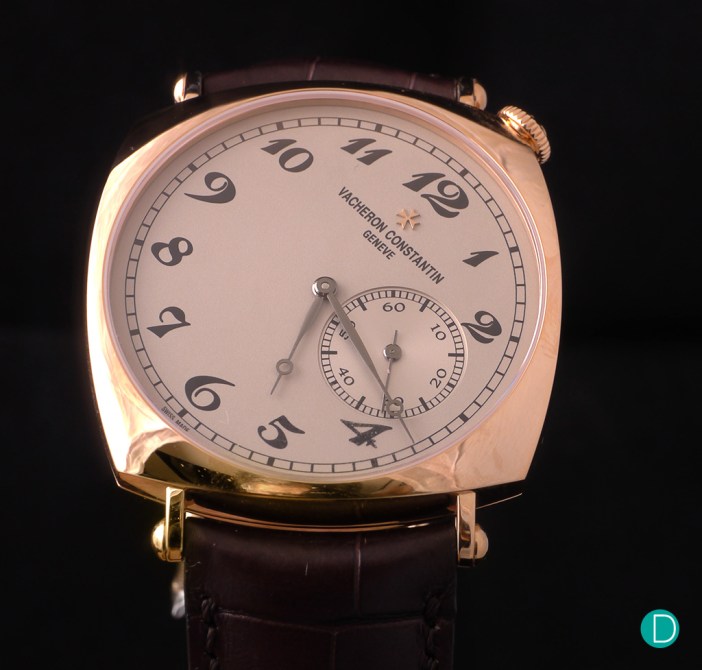
This is arguably the most recognizable Historiques model, and for good reason. The dial sits at a 45-degree angle inside a cushion-shaped case. The crown is at 1:30. The lugs are asymmetric. Nothing about this watch follows convention — and that was exactly the point in 1921.
The original was commissioned by an American collector who wanted to read the time while driving. With the left hand on the steering wheel, a tilted dial at 45 degrees becomes perfectly legible. The design was so unusual that Vacheron produced fewer than 30 examples. Today, those originals command prices north of $1 million at auction when they surface at all.
The modern reissue keeps the original’s DNA intact — the cushion case, the tilted dial, the crown at 1:30. But Vacheron updated the movement to their in-house caliber 4400AS, giving it a 65-hour power reserve and Geneva Seal finishing. The case grew slightly to 40mm, fitting modern wrist expectations without losing the vintage proportions.
For replica buyers, the American 1921 presents a unique challenge. The cushion case must be perfect — any deviation in the curve, any wrong angle in the tilt, and the whole watch falls apart visually. The crown position at 1:30 requires custom tooling. This is why only the top-tier super clone factories attempt it, and why the results from those factories are so impressive.
Collector’s Note: The American 1921 is one of the few watches where the case shape matters more than the movement finishing. A good cushion case with proper 45° dial alignment will look correct from across the room. A bad one screams replica at any distance.
Cornes de Vache 1955 — The Chronograph Collector’s Grail
The name translates to “cow horns” — a reference to the distinctive shape of the lugs, which curve downward with a pointed elegance that looks exactly like what it sounds like. This chronograph debuted in 1955 with the legendary Lemania-based caliber, and it’s been on collector radar ever since.
Originals from the 1950s are extraordinarily rare. Vacheron produced them in small numbers, and most that survived ended up in private collections that rarely see auction houses. When one does appear at Christie’s or Phillips, expect six figures minimum. A platinum version with a salmon dial hit $800,000 at Phillips Geneva in 2022.
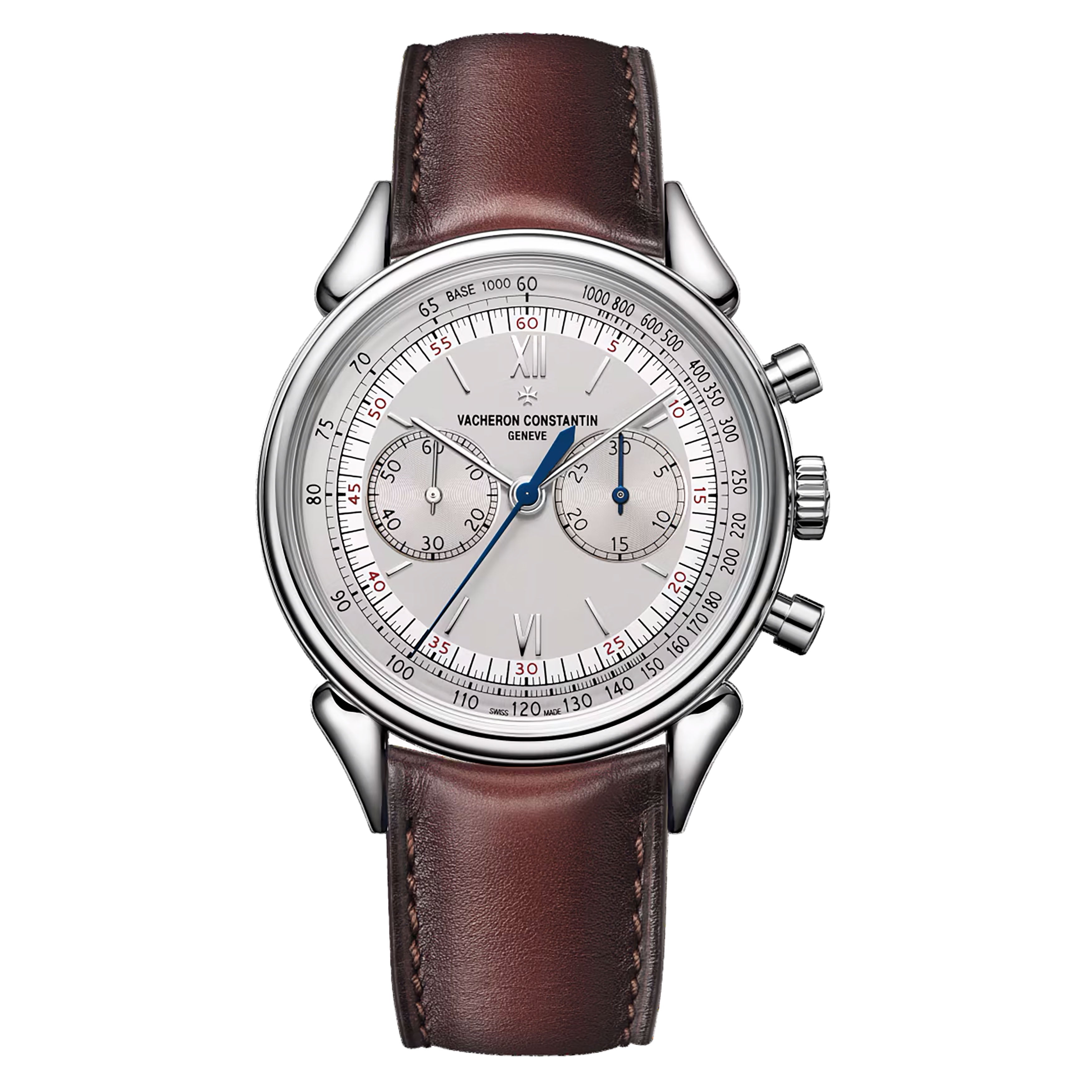
The modern reissue uses Vacheron’s in-house caliber 1142, a manual-wind chronograph movement with column wheel and horizontal coupling. The pulsometer scale on the dial adds medical heritage — doctors used these to measure heart rates in the field. The 38.5mm case sits perfectly on the wrist, neither vintage-tiny nor modern-bloated.
In the super clone world, the Cornes de Vache is considered a badge of factory capability. Getting those lugs right — the precise curve, the taper, the way they sweep downward from the case — takes exceptional metalwork. The chronograph pushers need to be period-correct: thin, mushroom-shaped, with the right resistance. When a factory nails the Cornes de Vache, they can handle anything Vacheron makes.
Triple Calendrier 1942 — The Complete Calendar
A triple calendar watch displays the day, date, and month. It’s one of the most useful complications for daily wear — you glance down and get the full date without any mental math. Vacheron’s version from 1942 does this with a cleanliness that makes other triple calendars look cluttered.
The layout puts the day at 9 o’clock, the month at 3 o’clock, and the date is indicated by a central hand pointing to numbers around the outer edge of the dial. A moonphase aperture sits at 6 o’clock. Four pieces of information, zero visual confusion. That’s the Vacheron way.
The genuine advantage of a complete calendar over a perpetual? Simplicity of the movement, which translates to reliability and slimmer case thickness. Yes, you need to manually correct the date five times per year (at the end of months with fewer than 31 days). But collectors who wear Historiques watches see that as a feature — it forces a moment of interaction with the watch, a ritual that perpetual calendar owners never experience.
Super clone factories have gotten remarkably good at reproducing the triple calendar layout. The dual windows for day and month require precise printing on the discs beneath, and the central date hand must sweep smoothly through 31 positions without jamming. The moonphase disc is another area where quality separates tiers — cheap replicas use a printed disc that looks flat and lifeless, while top super clones use a proper recessed disc with applied stars against a deep blue background.
Historiques 222 — The Birth of the Overseas
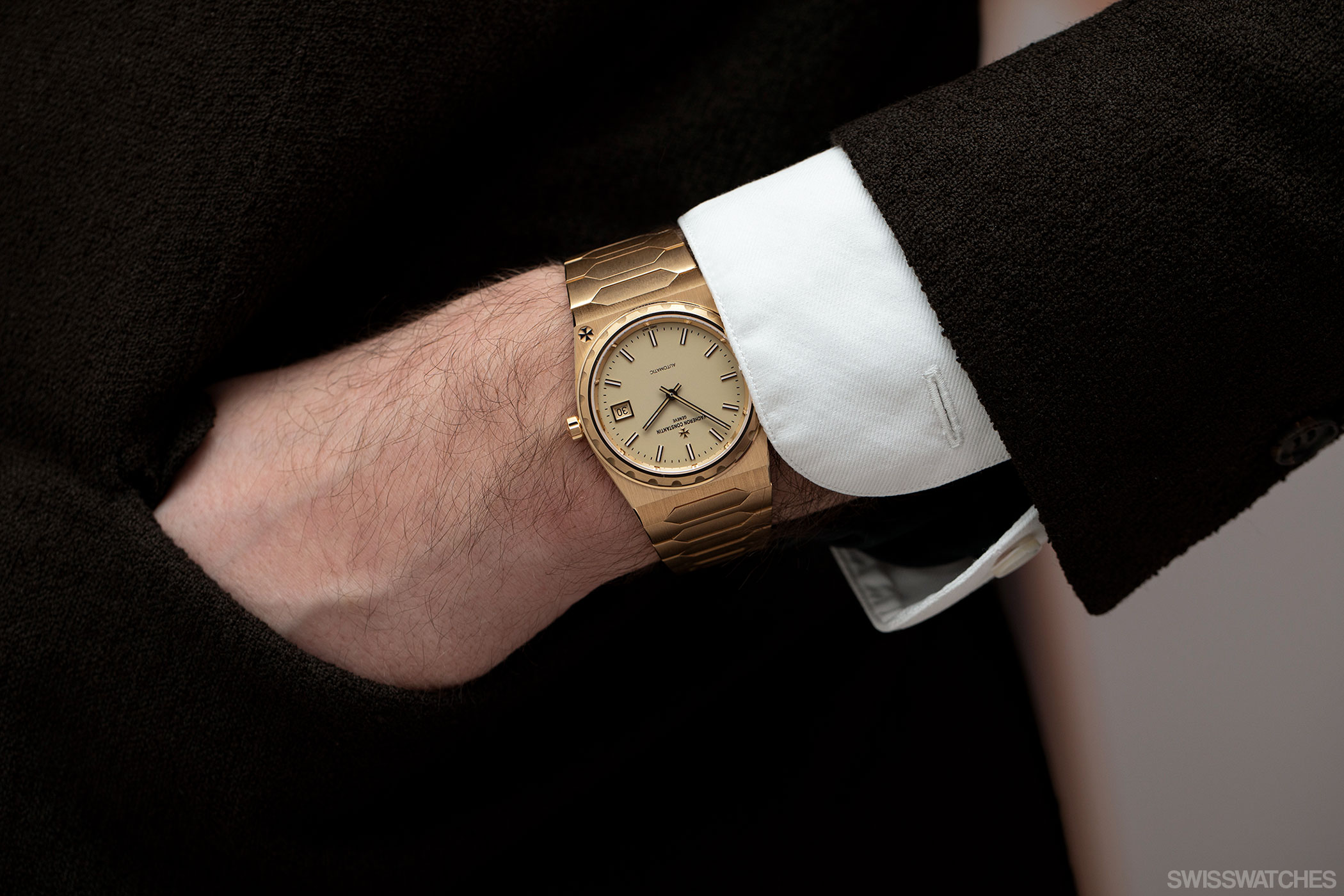
In 1977, the same year Star Wars hit theaters, Vacheron Constantin released the 222 — their answer to the Audemars Piguet Royal Oak (1972) and the Patek Philippe Nautilus (1976). Designed by Jorg Hysek, the 222 was Vacheron’s first integrated-bracelet sports watch. It featured a 37mm case with a distinctive notched bezel and a Maltese cross emblem at 6 o’clock.
The 222 was produced until 1985, replaced by the Phidias and eventually evolving into what we now know as the Overseas collection. But the original 222 has cult status. It’s the missing link, the proto-Overseas, the one that started Vacheron’s journey into luxury sports watches.
In 2022, Vacheron reissued the 222 as part of the Historiques collection. The reaction was volcanic. The watch world lost its collective mind. A 37mm integrated-bracelet watch in yellow gold, faithful to the original design, powered by the new caliber 2455/2 automatic movement. It sold out before most people finished reading the press release.
Market Reality: The Historiques 222 reissue in yellow gold had a retail of approximately $48,000. Secondary market prices jumped to $120,000+ within months. The integrated bracelet design and heritage appeal created demand that Vacheron simply couldn’t match with production numbers.
For the super clone market, the 222 is gold. An integrated bracelet watch with the prestige of the Holy Trinity, the design heritage of the 1970s golden era, and a look that sits between a Royal Oak and a Nautilus without copying either. The bracelet is the challenge — those flat, polished links with their specific taper need precise machining to feel right on the wrist. Top factories use 316L steel with a weight that’s remarkably close to the original’s gold heft.
Movement DNA Across the Collection
Vacheron doesn’t share movements across collections like some brands. Each Historiques model uses a caliber chosen specifically for its historical context. The American 1921 gets the 4400AS — a slim manual-winder that fits the dress watch profile. The Cornes de Vache gets the 1142, a chronograph caliber with column wheel. The 222 reissue uses the 2455/2, an automatic with a 40-hour reserve.
All genuine calibers carry the Hallmark of Geneva (Poincon de Geneve) — one of the strictest quality certifications in watchmaking. It governs not just accuracy but finishing quality: beveled edges, polished screw heads, Geneva stripes on the bridges. This is what replica buyers should focus on when evaluating a super clone through caseback photos. Does the movement decoration look systematic and sharp? Or does it look like someone ran a polishing wheel across flat surfaces and called it a day?
The best super clones use decorated Miyota 9015 or Seagull movements that, while not matching genuine finishing, create a visual impression through the caseback that reads correctly. Striped bridges, blued screws, and a custom rotor with the Maltese cross — these details matter more at the Historiques level than they would on a simpler watch.
Replica Craft — What Separates Superb from Shoddy
The Historiques line is where cheap replicas fail hardest. These aren’t tool watches with chunky bezels that hide imperfections. They’re refined dress and complication pieces where every millimeter is visible. A badly applied index on a Submariner disappears under a dive bezel. A badly applied index on an American 1921’s tilted dial? It’s the first thing you see.
Here’s what to evaluate when looking at Historiques super clones:
The strap deserves special attention on Historiques replicas. Genuine Vacheron uses hand-stitched alligator leather with a specific scale pattern — large square scales on top, smaller ones at the edges. They use a saddleback stitch (visible thread holes alternate sides) rather than a simple running stitch. Top super clone factories source similar alligator-pattern leather and replicate this stitching. It’s a detail that anyone who handles watches regularly will notice immediately.
Pro Tip: When ordering a Historiques super clone, always request QC (quality control) photos before shipping. Ask specifically for: dial macro shot, caseback detail, crown close-up, lug profile, and strap stitching. These five angles reveal 95% of potential issues before the watch reaches your wrist.
Historiques Models Compared — Which One Fits Your Style?
Each Historiques model serves a different purpose and aesthetic. Choosing between them isn’t just about which looks best — it’s about how you dress, what you do, and what story you want on your wrist.
The 222 wins on versatility because of its integrated bracelet — it transitions from boardroom to beach bar without missing a beat. The American 1921 wins on conversation-starting power — no one walks past that tilted dial without asking about it. The Cornes de Vache is the collector’s choice, the watch you buy when you already have five watches and want something that impresses other watch people. And the Triple Calendrier is the daily driver for the person who wants function and beauty in equal measure.
Styling Historiques on a Modern Wrist
Historiques watches are vintage-inspired, which means they work best with outfits that have some texture and personality. Here’s how to wear each one:
American 1921: This watch pairs brilliantly with double-breasted suits, turtlenecks, and anything with a creative edge. The tilted dial is an instant statement — match it with a silk pocket square that echoes the dial’s warmth. Avoid overly casual settings; the cushion case looks odd with board shorts.
Cornes de Vache: The pulsometer dial gives it a slightly medical, scientific air. Works beautifully with tweed jackets, Oxford shirts, and loafers. Think university professor who happens to have exceptional taste. The brown alligator strap version pairs with earth tones; the black strap version goes formal.
Triple Calendrier: This is your everyday dress watch. White or cream dial versions work with nearly anything — navy suits, gray flannels, chinos and a blazer. The moonphase adds a touch of romance that makes it perfect for dinner dates. Just remember to set the date correctly for those five months that don’t have 31 days.
222: Treat it like you’d treat a Royal Oak or Nautilus — it goes with everything. The integrated bracelet makes it a true all-rounder. Polo shirt and chinos? Perfect. Charcoal suit? Perfect. It’s the one Historiques model that doesn’t demand you think about what you’re wearing.
Styling Rule: Historiques watches should never compete with your outfit. They should complement it. If your jacket has a bold pattern, let the watch sit quietly. If your outfit is minimal, let the American 1921’s tilted dial or the Cornes de Vache’s pulsometer scale do the talking.
Related Articles You Should Read
- Vacheron Constantin Overseas Replica
- Vacheron Patrimony Replica
- Vacheron Fiftysix Replica
- Best Vacheron Constantin Super Clone
- Super Clone vs Cheap Replica Guide
FAQ — Vacheron Constantin Historiques Replica
Q: What makes the Historiques collection different from other Vacheron lines?
The Historiques line directly recreates historical Vacheron watches from their archive spanning 270 years. Each model traces to a specific vintage reference, unlike Patrimony or Overseas which are modern designs. It’s the difference between a museum reproduction and a contemporary painting.
Q: Which Historiques model is most popular among replica buyers?
The American 1921 leads by a wide margin. Its distinctive tilted dial makes it instantly recognizable and creates tremendous wrist presence. The 222 reissue is gaining fast since its 2022 launch, especially among buyers who want integrated bracelet watches beyond the Royal Oak and Nautilus.
Q: Is 37mm too small for the 222 on a modern wrist?
Not at all. The integrated bracelet extends the visual width across your wrist, making 37mm wear closer to 40mm in perceived size. The original was designed for 1970s wrist proportions, and the modern reissue kept that sizing deliberately. On wrists up to 7.5 inches, the 37mm 222 looks proportionally ideal.
Q: Do super clone Historiques use automatic or manual-wind movements?
Depends on the model. The 222 replicas use automatic movements (typically Miyota 9015 or clone 2824) since the original is automatic. The American 1921 and Cornes de Vache super clones typically use manual-wind Seagull movements, matching the original’s hand-wound character. Always verify movement type with QC photos before purchase.
Q: How accurate is the chronograph function on Cornes de Vache replicas?
Top-tier super clones use Seagull ST1901 chronograph movements (based on the Venus 175 architecture). These are functional, reliable chronographs that start, stop, and reset correctly. The pulsometer scale on the dial is decorative in practice — the seconds hand sweeps accurately enough for casual timing but not for medical use.
Q: Can I swim with a Historiques 222 super clone?
The original 222 was water-resistant to 120m — impressive for 1977. Super clones typically achieve 30-50m resistance when properly assembled. That means rain, hand washing, and accidental splashes are fine. Actual swimming? Risky. The integrated bracelet clasp and crown sealing on replicas aren’t tested to the same pressure standards.
Q: What’s the difference between the Historiques 222 and the Overseas?
The 222 is the ancestor of the Overseas. The Overseas evolved from the 222 through the Phidias line in the 1990s. Key differences: the 222 has a simpler bezel without the Overseas’ notched ring, a smaller 37mm case versus the Overseas’ 41mm, and a more vintage overall character. Think of the 222 as the original recipe and the Overseas as the modern interpretation.
Q: How does the cushion case of the American 1921 sit on the wrist?
Uniquely. The cushion shape distributes weight differently than a round case — it sits flatter and wider, hugging the top of the wrist. The tilted dial means you naturally rotate your wrist slightly to read the time, which looks more elegant than the typical wrist flip. The case is 40mm point-to-point, but because of the cushion shape, it wears smaller than a 40mm round watch.
Q: Are Historiques replicas harder to find than Overseas or Patrimony replicas?
Yes, significantly. Historiques pieces require specialized tooling — the cushion case of the American 1921, the cow horn lugs of the Cornes de Vache, the integrated bracelet of the 222. Not every factory invests in these unique shapes. Expect fewer options and longer wait times compared to mainstream models like the Overseas.
Q: What strap should I pair with a Historiques replica?
For the American 1921 and Cornes de Vache, stick with leather — dark brown alligator-pattern is the classic choice. For the Triple Calendrier, black alligator keeps it formal. The 222 should stay on its bracelet — the whole point is the integrated design. If you want to swap straps on the leather models, look for 20mm or 22mm quick-release straps in quality leather.
Q: Does the moonphase on the Triple Calendrier replica actually work?
On top-tier super clones, yes. The moonphase disc rotates through a 29.5-day cycle, tracking the actual lunar phase. You’ll need to set it correctly at the start and it will maintain accuracy for about six months before drifting slightly. Cheap replicas often have a fixed or non-functional moonphase — another reason to invest in quality.
Q: How does Vacheron Historiques compare to Patek vintage reissues?
Patek doesn’t do direct reissues the way Vacheron does. Patek references heritage through design language but rarely recreates specific vintage references. Vacheron goes further — the American 1921 is a deliberate recreation of Ref. 11677 from 1921. This gives Historiques a documentary quality that Patek’s modern pieces, however beautiful, don’t quite match.
Q: What’s the best first Historiques super clone to buy?
The American 1921 if you want maximum impact and conversation-starting power. The 222 if you want an everyday wearer that goes with everything. The Cornes de Vache if you’re a chronograph lover. Skip the Triple Calendrier as a first purchase — it’s a connoisseur’s piece that’s best appreciated after you’ve worn a few high-end replicas.
Q: Will a watchmaker service a Historiques super clone?
Independent watchmakers familiar with Miyota and Seagull movements will service these without issue. The movements inside super clones are standard calibers with documented service procedures. Avoid brand boutiques and authorized service centers. A good independent watchmaker charges $50-100 for a basic service and $150-200 for a full movement overhaul.
Q: How do I verify my Historiques super clone quality before buying?
Request QC photos from five specific angles: dial macro (check text alignment and printing quality), caseback (movement decoration and engravings), crown close-up (Maltese cross detail), lug profile (correct shape and finishing), and strap/bracelet detail (stitching quality for leather, link fit for bracelet). Compare these against official Vacheron press photos. Any reputable seller will provide these before shipping.
The Historiques collection represents something rare in watchmaking — a living archive that you can wear. Whether it’s the tilted geometry of the American 1921, the chronograph purity of the Cornes de Vache, the practical elegance of the Triple Calendrier, or the revolutionary spirit of the 222, each piece connects you to a specific moment in the world’s oldest continuously operating watch manufacture. Super clones at the $700-1000 level capture that connection with remarkable accuracy, putting 270 years of Geneva watchmaking on your wrist at a fraction of the authentic cost. Browse the full Vacheron Constantin replica collection and find the piece of history that speaks to you.