Richard Mille RM 027 Replica — Nadal’s 20-Gram Tourbillon, Cable-Suspended Movement, and Why This Is the Most Extreme Watch Ever Built
Last updated: March 2026 • 18-minute read • The world’s lightest mechanical watch explained
The Richard Mille RM 027 is a tourbillon wristwatch that weighs 20 grams including the strap. Twenty grams. That’s less than a sheet of paper folded four times. It was engineered specifically for one person — Rafael Nadal — to wear during professional tennis matches, where wrist forces exceed 400 G on every forehand. The movement is suspended on steel cables inside the case, like a bridge over a canyon, absorbing shock that would destroy any conventional mechanical watch. Only 50 were ever made. They sold for approximately $690,000 each. On the secondary market today, an RM 027 commands over $1.5 million. This is not a watch you can buy a genuine super clone of — no factory has replicated the tourbillon or the cable suspension system. But the RM 027 is essential knowledge for anyone interested in Richard Mille, because everything the brand does traces back to this singular, obsessive piece of engineering. Understanding the RM 027 helps you understand why the RM 035, RM 011, and RM 055 exist — and why Richard Mille watches cost what they do.
Table of Contents
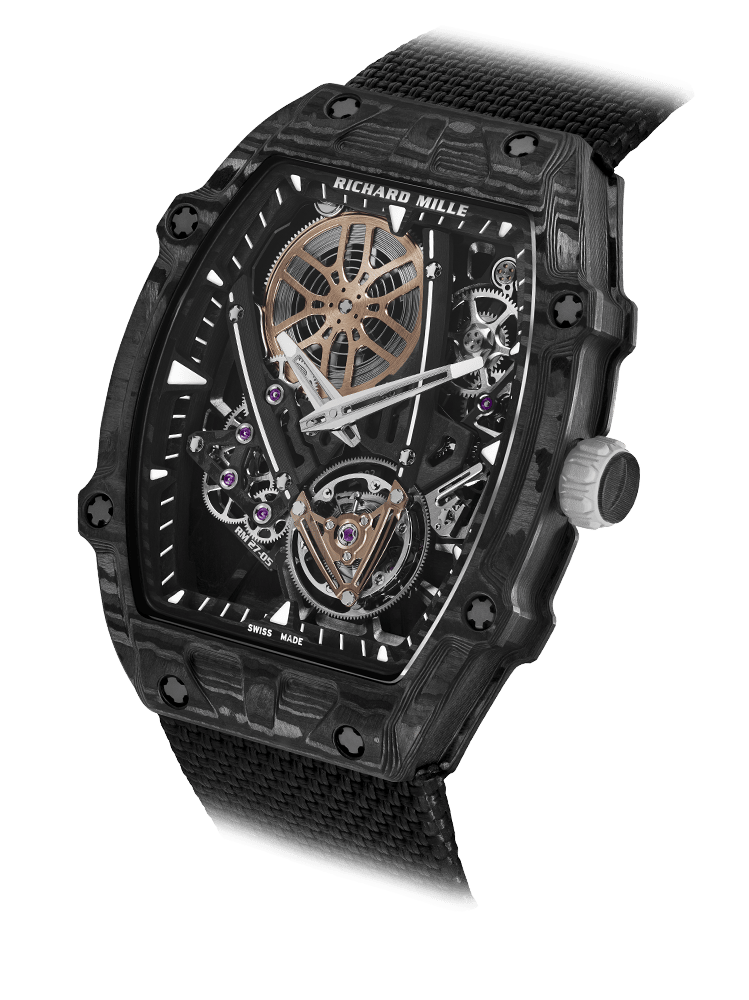
The Impossible Brief
In 2008, Richard Mille sat down with his engineering team and gave them a brief that most watchmakers would consider insane: build a tourbillon wristwatch light enough and shock-resistant enough for a professional tennis player to wear during Grand Slam matches. The watch needed to survive repeated impacts of 400+ G forces. It needed to weigh almost nothing — because any weight on the wrist affects a player’s swing mechanics. It needed to be completely reliable — a watch that stops or breaks during a televised match would be catastrophic for the brand.
The problem was physics. A tourbillon is one of the most delicate mechanisms in watchmaking — a rotating cage containing the escapement and balance wheel, spinning once per minute. The components are tiny, precisely balanced, and sensitive to shock. A strong tap on a normal tourbillon watch can stop the mechanism. Mille was asking his team to make a tourbillon survive forces that would destroy most mechanical watches, while simultaneously making the entire assembly weigh less than a AAA battery.
The solution took three years of development and cost Richard Mille over $1 million in R&D. The result was the RM 027 — a watch that redefined what was mechanically possible. It became the most important product in Richard Mille’s history, not because of sales volume (only 50 were made), but because it proved the brand’s engineering philosophy was real, not marketing. Everything that Richard Mille has built since — the RM 011, the RM 035, the RM 055 — traces its DNA back to the RM 027.
Cable Suspension System
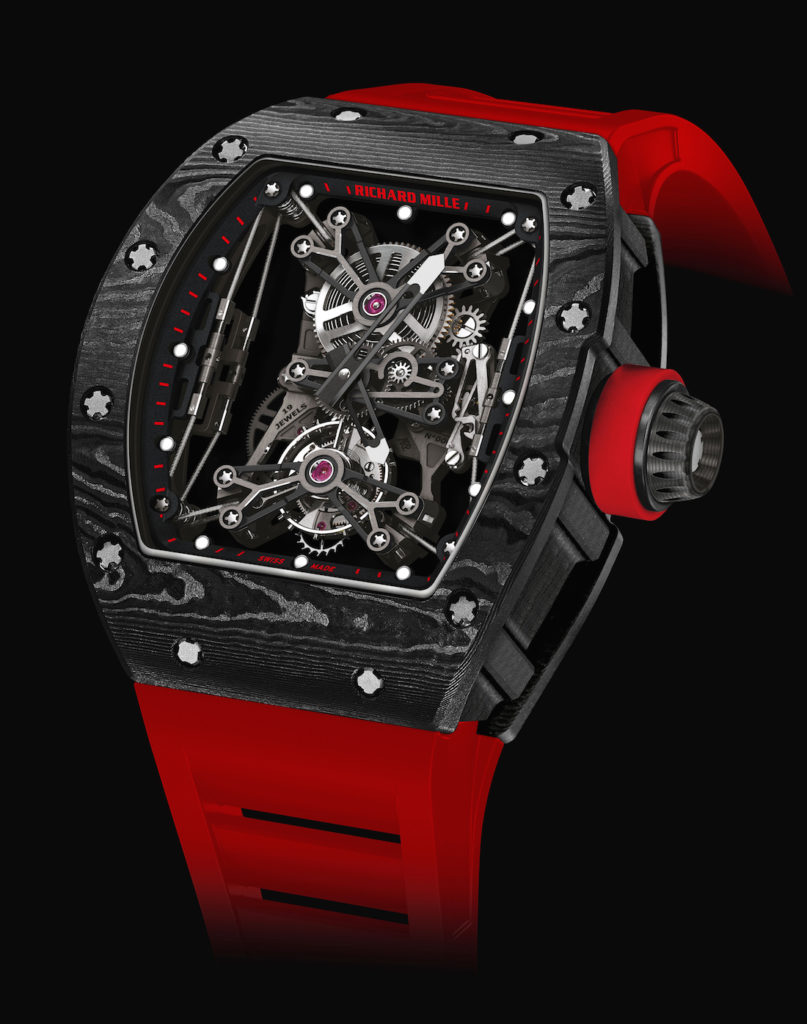
The RM 027’s defining engineering feature is its cable suspension system — and it has no equivalent in any other wristwatch, period. The movement baseplate is not screwed to the case like every other watch in existence. Instead, it’s suspended inside the case on four braided steel cables, tensioned at specific loads, functioning exactly like a suspension bridge. When the watch experiences a shock — say, a 400 G forehand impact — the cables flex and absorb the force. The movement moves slightly inside the case rather than taking the full impact rigidly.
The cable material is the same high-tensile braided steel used in yacht rigging — specifically, the cables used on America’s Cup racing yachts. Each cable is 0.35mm in diameter and tensioned to a precisely calculated force. Too loose, and the movement would swing excessively inside the case. Too tight, and the cables would transmit shock forces directly to the movement, defeating the purpose. The tension calibration was one of the most challenging aspects of the RM 027’s development — getting the right balance between flexibility and stability.
Engineering Detail: The cable suspension concept came from the world of civil engineering — specifically, seismic isolation systems used in earthquake-resistant buildings. Buildings in earthquake zones use flexible supports that allow the structure to move slightly during a tremor, absorbing seismic forces rather than resisting them rigidly (which causes collapse). Richard Mille’s engineers applied the same principle at miniature scale: let the movement move within the case, absorb the shock through flexible cables, prevent the force from reaching the delicate tourbillon mechanism.
The result was a watch that survived forces no tourbillon should survive. Richard Mille tested the RM 027 with simulated tennis impacts — repeated shocks exceeding the actual forces generated during professional play — and the tourbillon continued running within chronometer specifications. When Nadal wore the first prototype during practice sessions, the watch performed flawlessly. It went on to survive thousands of match hours across some of the most physically demanding tennis ever played.
The Tourbillon
The tourbillon in the RM 027 is manufactured by Renaud & Papi (APRP) — the same movement maker that builds tourbillons for Audemars Piguet’s most complicated watches. It’s a manual-wind tourbillon with a titanium cage, rotating once per minute. The tourbillon cage itself is visible through the dial at 6 o’clock, one of the most mesmerizing mechanical spectacles in horology — a tiny rotating framework containing the escapement, balance wheel, and hairspring, all spinning in continuous rotation.
The tourbillon was invented by Abraham-Louis Breguet in 1801 to compensate for the effect of gravity on pocket watches. When a pocket watch sits vertically in a vest pocket, gravity pulls on the balance wheel unequally, causing timekeeping errors. The tourbillon solves this by rotating the entire escapement, averaging out gravitational effects over each rotation. In a wristwatch — which constantly changes position on the wrist — the practical timekeeping benefit is debatable. But the mechanical artistry is undeniable, and in the RM 027, the tourbillon serves a secondary purpose: it proves that Richard Mille’s shock-absorption system works well enough to protect the most fragile complication in watchmaking.
Weight Engineering — How Do You Build a 20-Gram Watch?
Twenty grams including the strap. To appreciate how extreme this is, consider that a typical stainless steel sports watch weighs 130-170 grams. A Rolex Submariner is 155 grams. Even a lightweight titanium watch is typically 70-80 grams. The RM 027 weighs less than two tablespoons of water. Richard Mille achieved this through obsessive material selection at every component level.
The case uses LITAL — a lithium-aluminum alloy that’s even lighter than carbon fiber. LITAL was originally developed for aerospace applications (satellite structures). It has a density of approximately 2.6 g/cm³ compared to steel’s 8.0 g/cm³. The later RM 027 versions switched to NTPT Carbon cases, which are slightly heavier but offer better visual presence and the signature Richard Mille wavy pattern. Both materials achieve the core goal: a case that barely registers on a scale.
The strap is perhaps the most overlooked engineering detail. A typical rubber watch strap weighs 15-25 grams — in a 20-gram total, there’s no room for that. The RM 027’s strap is woven textile composite, closer to a thin fabric belt than a traditional watch strap. It weighs approximately 5 grams. The titanium clasp is stripped to the minimum functional structure — no deployant mechanism, no safety catch, just a simple folding clasp that weighs approximately 3 grams.
Full Specifications
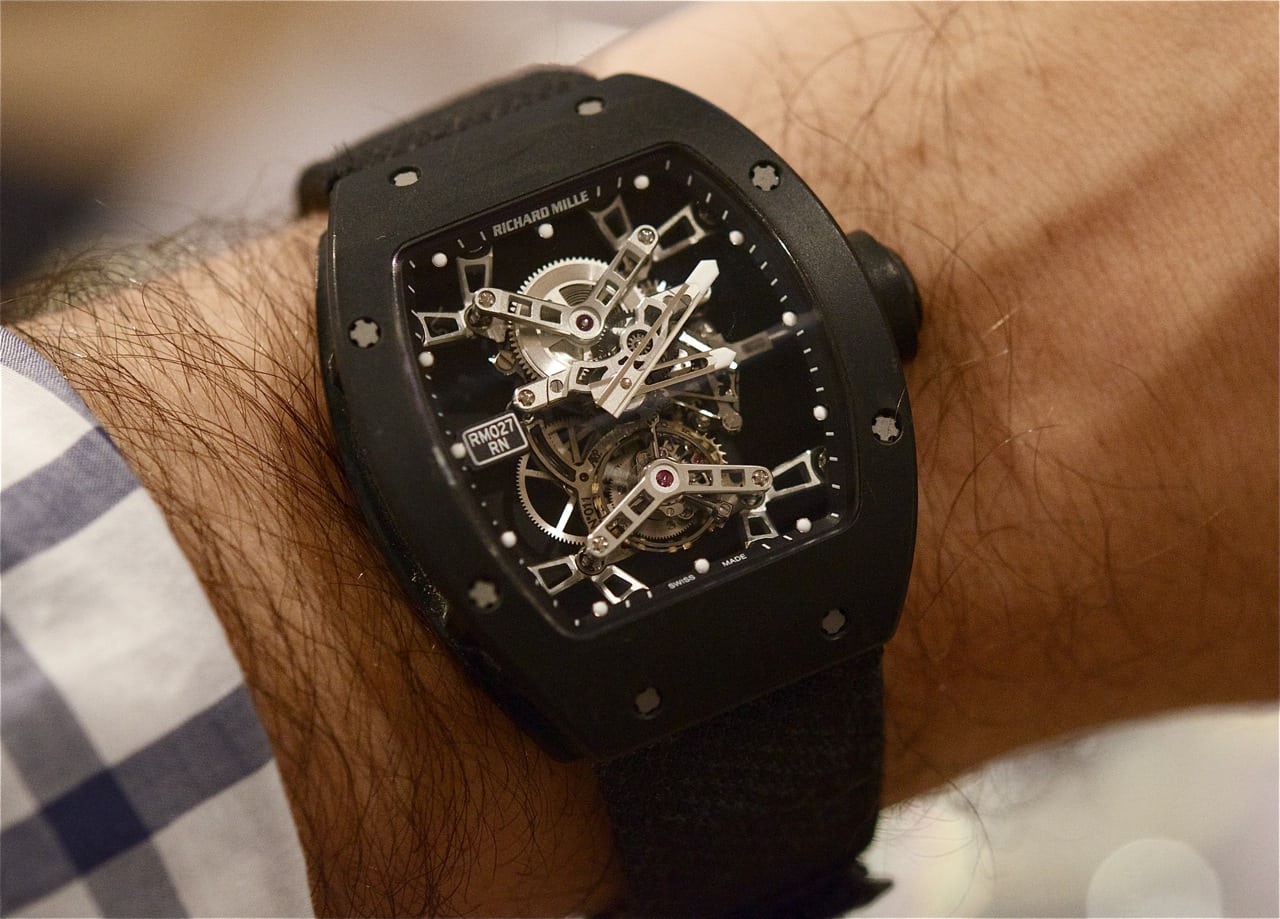
Nadal’s Grand Slam Record While Wearing Richard Mille
Nadal began wearing Richard Mille watches during competition in 2010. His partnership with the brand spans his most dominant era in tennis history. The watches he wore to his major victories — primarily the RM 027 and later the RM 27-04 — became inseparable from his competitive identity.
Nadal won 14 of his 22 Grand Slam titles while wearing Richard Mille watches. The brand has never had a mechanical failure during match play — a remarkable record given the extreme conditions. This track record is Richard Mille’s most powerful marketing asset: it proves that their engineering claims are genuine, not aspirational. When they say a watch can survive 5,000 G forces, Nadal’s wrist is the proof.
RM 027 to RM 27-04 — The Evolution
The RM 027 wasn’t a one-and-done product — Richard Mille continued developing Nadal-specific tourbillon watches, each generation refining the engineering:
Each generation reduced weight (until the RM 27-04, which added weight back for increased shock resistance) and improved the cable suspension system. The RM 27-04, the current generation, is rated to survive 10,000 G forces — more than twice the RM 027’s 5,000 G specification. It uses TitaCarb, a new material combining titanium and carbon at the molecular level, for even better strength-to-weight ratios.
Why No Super Clone Exists
There is no quality super clone of the RM 027. Cheap copies exist on DHGate and AliExpress — they use the RM 027 case shape with a quartz movement or a basic automatic hidden behind a decorative skeleton plate. But no factory has produced a genuine super clone with a working tourbillon and cable suspension system. Here’s why:
Hard Truth: Three technical barriers prevent an RM 027 super clone: (1) A working tourbillon adds $2,000+ to manufacturing costs — the Chinese tourbillon movements that exist are designed for round cases, not RM tonneau geometry. (2) The cable suspension system requires precision tensioning that’s hand-assembled — there’s no automated process. (3) The 20-gram target weight means every component must use exotic, expensive materials (LITAL, ultra-thin carbon). The economics don’t work — a genuine RM 027 super clone would cost $3,000-5,000 to produce, far above the super clone price ceiling.
Cheap DHGate copies of the RM 027 use a completely different approach — they stuff a quartz movement or basic Chinese automatic into an RM 027-shaped case and print a fake skeleton dial over it. The “tourbillon” visible through the dial is typically a decorative spinning wheel powered by a separate motor, not an actual tourbillon mechanism. These watches weigh 80-120 grams (four to six times the genuine weight), the case is painted plastic or resin, and they have no cable suspension system. They share only the shape and the brand name with the genuine — nothing else.
Super Clone Alternatives — Getting the Nadal Look
If you want a Richard Mille associated with Rafael Nadal, the RM 027 is off the table for super clones. But the Nadal aesthetic — ultralight NTPT Carbon, skeleton dial, tonneau case — is available through two excellent alternatives:
The RM 035 is the clear recommendation if you want the Nadal association. It’s named “Rafael Nadal,” it uses the same NTPT Carbon material, it has the same ultralight philosophy (30 grams genuine, 50-55 grams super clone), and it’s the watch Nadal wears most frequently in public. The RM 035 super clone from KV Factory is one of their best products. You get 90% of the Nadal Richard Mille experience without the tourbillon premium.
FAQ — 12 RM 027 Questions Answered
Can I buy an RM 027 super clone?
No quality super clone of the RM 027 exists. The tourbillon mechanism, cable suspension system, and extreme weight target make it impossible to replicate at super clone price points. Cheap copies on DHGate use quartz movements with decorative spinners — they share only the shape with the genuine. If you want a Nadal Richard Mille, the RM 035 super clone is the correct choice.
How much does a genuine RM 027 cost today?
The original retail was approximately $690,000. On the secondary market in 2026, an RM 027 in good condition sells for $1.5 million or more. Some rare examples have sold at auction for over $2 million. Only 50 were ever produced, and most are in collector vaults — finding one for sale is itself a challenge.
Did Nadal ever break an RM 027 during a match?
No. Richard Mille has never reported a mechanical failure on any watch worn by Nadal during competition. The cable suspension system has proven completely reliable across thousands of match hours. This track record is one of the most remarkable achievements in modern watchmaking — a tourbillon surviving years of professional tennis is genuinely unprecedented.
What is a tourbillon?
A tourbillon is a rotating cage that contains the escapement (the timekeeping mechanism) of a mechanical watch. It rotates once per minute, averaging out gravitational effects on the balance wheel. Invented by Breguet in 1801, it’s one of the most complex and prestigious complications in watchmaking. The RM 027’s tourbillon is manufactured by Renaud & Papi, the same firm that builds tourbillons for Audemars Piguet.
What does “cable suspension” mean?
Instead of bolting the movement directly to the case (like every other watch), the RM 027 suspends the movement on four braided steel cables inside the case. The movement floats, connected to the case only by these cables. When the watch experiences shock — like a tennis forehand — the cables flex and absorb the force, protecting the delicate movement. It’s the same principle used in earthquake-resistant buildings.
Why is it so light?
Every component uses the lightest possible material: LITAL (lithium-aluminum alloy) for the case, titanium for the movement, ultra-thin sapphire for the crystal, textile composite for the strap. The movement itself weighs only 3.5 grams. Even the clasp is stripped to minimal titanium. The 20-gram total is the result of obsessive engineering at every component level.
Is the RM 27-04 the same as the RM 027?
The RM 27-04 is the latest generation of Nadal’s tourbillon. It shares the cable suspension concept but weighs 30 grams (vs 20g for the original RM 027), uses TitaCarb case material, and is rated to 10,000 G forces (vs 5,000G). It’s the evolution, not a direct successor — different case design, different movement generation, different materials.
What about cheap “RM 027 tourbillon” watches on DHGate?
These are not tourbillons. They use a quartz movement with a decorative spinning wheel visible through the dial. The spinning wheel has no timekeeping function — it’s powered by a tiny motor, not by the watch’s escapement. The case is painted plastic or resin (80-120g, four to six times heavier than genuine). These watches are toys wearing a designer costume. They fool nobody who has ever seen a real Richard Mille.
What’s the best Nadal-related super clone I can actually buy?
The RM 035 Rafael Nadal from KV Factory. It uses the same NTPT Carbon material, has the same ultralight philosophy, is officially named after Nadal, and is the watch he wears most frequently in public. The KV Factory version scores 8.5/10 in our assessment — genuine carbon fiber composite, real manual-wind skeleton movement, correct proportions.
How many RM 027 exist?
Fifty pieces total for the original RM 027. Subsequent generations (RM 027-02, RM 27-01, RM 27-03, RM 27-04) were also limited — typically 50 pieces each. Total across all Nadal tourbillon generations, approximately 250 watches exist worldwide. This extreme scarcity is part of why the secondary market price exceeds $1.5 million.
Is the RM 027 the lightest watch ever made?
The RM 027 was the lightest mechanical tourbillon wristwatch when released. The RM 27-03 at 18.4 grams later took that title. For non-tourbillon watches, the RM 035 at 30 grams and the RM 67-02 at approximately 32 grams are among the lightest mechanical wristwatches ever produced. In the broader luxury watch market, no other brand has seriously competed with Richard Mille’s weight records.
Why should I read about the RM 027 if I can’t buy a super clone?
Understanding the RM 027 is essential context for evaluating any Richard Mille super clone. The engineering philosophy — extreme lightness, exotic materials, shock resistance — flows from the RM 027 into every other RM model. When you know what Richard Mille achieved with the RM 027, you understand why the RM 011, RM 035, and RM 055 exist — and you can evaluate their super clones with genuine knowledge.
The Bottom Line on the RM 027
The Richard Mille RM 027 is the most extreme wristwatch ever built. A 20-gram tourbillon on cable suspension that survived thousands of hours of professional tennis — it’s a genuine engineering marvel with no equivalent. You can’t buy a quality super clone of it, and you shouldn’t try. The cheap copies that exist are embarrassing — quartz movements in painted plastic, weighing four times what the genuine weighs. But the RM 027 is the reason Richard Mille exists as the force it is today. Every RM super clone you consider — the RM 011, the RM 035, the RM 055 — carries DNA from this impossible watch. Understanding it makes you a more informed buyer. And if you want the Nadal Richard Mille experience in a super clone, the RM 035 from KV Factory is the answer: same NTPT Carbon material, same ultralight philosophy, same association with the greatest tennis player in history. Just without the tourbillon and the cable suspension — and without the $690,000 price tag.