Audemars Piguet Perpetual Calendar Replica — 26574ST, Moon Phase Complications, and How Close Super Clones Get to Grand Complications
Last updated: March 2026 • 19-minute read • Perpetual calendar mechanics explained
Audemars Piguet perpetual calendar replica watches tackle the most intellectually ambitious complication in watchmaking — a mechanism that tracks day, date, month, moon phase, and leap year simultaneously, requiring no manual adjustment until the year 2100. The Royal Oak Perpetual Calendar (ref. 26574ST) packs this grand complication into the Royal Oak’s 41mm case, and super clone factories have created versions that replicate both the appearance and — to varying degrees — the functionality. This guide covers what perpetual calendar super clones actually do versus what genuine AP’s caliber does, which variants are available, how the moon phase complication works in replica form, and the honest limitations you should understand before buying.
Table of Contents
- 01 What a Perpetual Calendar Actually Does
- 02 26574ST — The Royal Oak Perpetual
- 03 Clone vs Genuine — What Works, What Doesn’t
- 04 Moon Phase — The Visual Star
- 05 Dial Layout and Subdial Architecture
- 06 Which Factory Makes the Best Perpetual
- 07 Available Dial Variants
- 08 Setting and Operating the Functions
- 09 Who Should Buy a Perpetual Calendar Replica
- 10 QC Protocol for Perpetual Calendar
- 11 FAQ — 15 Perpetual Calendar Questions
What a Perpetual Calendar Actually Does
A perpetual calendar is watchmaking’s answer to the Gregorian calendar’s irregularities. Most months have 30 or 31 days. February has 28 — except during leap years, when it has 29. A standard date watch doesn’t know the difference: it advances the date by one unit every 24 hours and needs manual correction at the end of months with fewer than 31 days. Five times a year, you need to adjust the date. It’s a minor inconvenience, but it represents a problem that watchmakers have been solving mechanically since the 18th century.
A genuine perpetual calendar movement has a mechanical “memory” — a series of cams and levers programmed with the calendar’s pattern. It knows that April has 30 days, that February usually has 28, and that every fourth year February gets an extra day. This programming is encoded in the shape of physical metal components: a 48-month cam that rotates once every four years, with each “notch” corresponding to a month’s day count. When the date reaches the last day of any month, the cam’s profile tells the mechanism whether to advance to 29, 30, or 31 — or roll to the next month.
AP’s genuine perpetual calendar (Cal. 5134) displays: day of the week (Monday through Sunday), date (1-31), month (January through December), astronomical moon phase, and a leap year indicator (4-year cycle). All of this on a 41mm Royal Oak dial without looking cluttered — which is a design achievement as impressive as the mechanical one.
Calendar context: AP’s perpetual calendar is accurate until March 1, 2100 — the next non-leap year that would normally be a leap year (century years divisible by 100 but not 400 aren’t leap years). After that, a one-day manual correction is needed. Your great-grandchildren can worry about it.
26574ST — The Royal Oak Perpetual

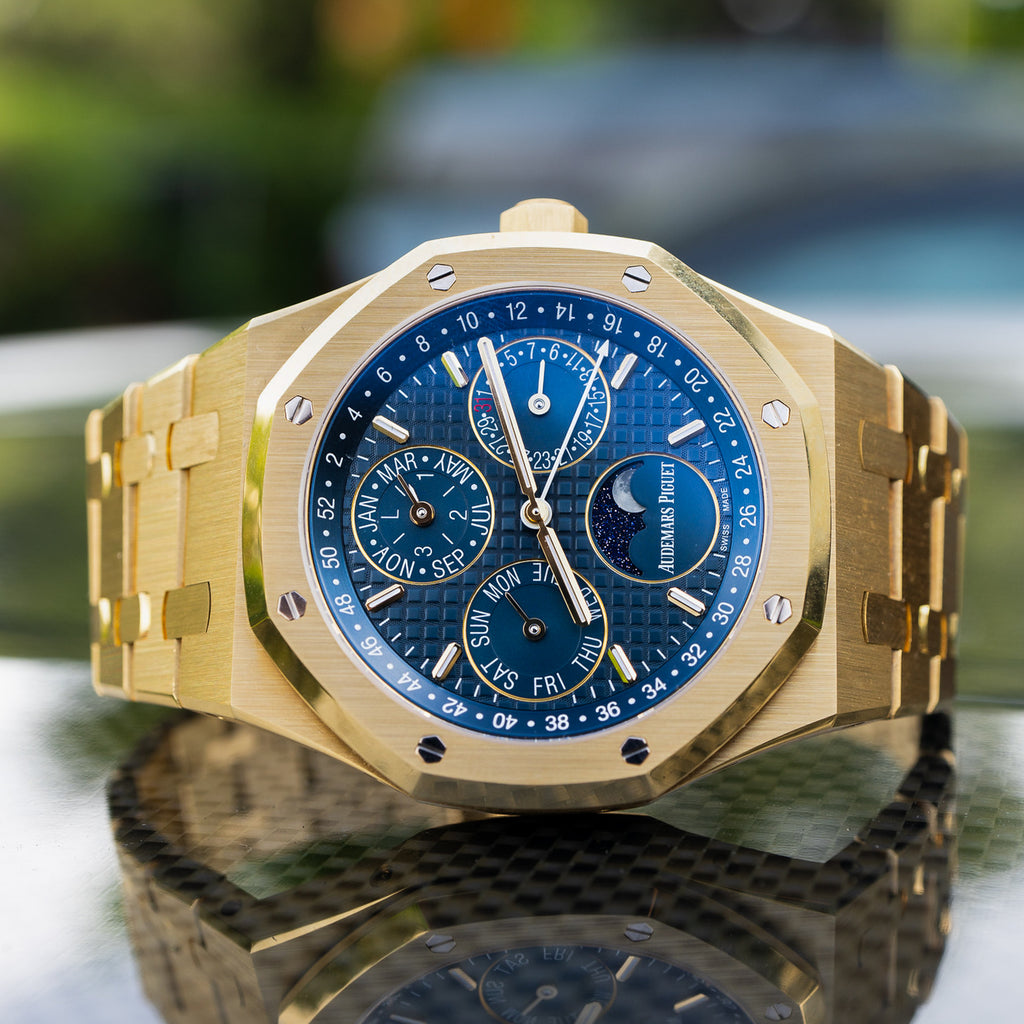
The Royal Oak Perpetual Calendar ref. 26574ST packages AP’s grand complication expertise into the Royal Oak case. The case is the standard 41mm diameter with the octagonal bezel, integrated bracelet, and tapisserie dial — all the Royal Oak signatures. What differentiates it from a 15500ST are the four subdials: day at 9, date at 3, month at 12, and moon phase at 6. Plus a week-of-year display around the outer chapter ring and a leap year indicator integrated into the month subdial.
The dial is busier than a standard Royal Oak — necessarily so, since there’s significantly more information to display. AP handles this by using smaller subdials with fine text and hands, the tapisserie pattern providing visual cohesion across the entire dial surface. The moon phase aperture at 6 o’clock is the visual anchor — a small window showing a gold moon disc against a dark blue sky with stars, rotating once every 29.5 days to track the lunar cycle.
Genuine AP prices the 26574ST in the $70,000-$90,000 range at retail — making it one of the most accessible perpetual calendar watches from a top-tier manufacturer. Compared to Patek Philippe’s Nautilus Perpetual Calendar (north of $100,000 retail, over $200,000 secondary market), AP’s pricing actually represents reasonable value in the context of grand complications. This positioning makes the super clone version particularly interesting: you’re replicating a genuine watch that’s already positioned as the “accessible” grand complication.
Clone vs Genuine — What Works, What Doesn’t
This is the most important section in this guide, and I’m going to be direct about it: no super clone perpetual calendar replicates the genuine perpetual calendar mechanism. A true perpetual calendar requires a 48-month programmed cam, precision lever work, and an integrated gear train that connects day, date, month, and leap year displays to a single mechanical brain. Building this mechanism requires watchmaking expertise and tooling that clone factories don’t possess — it’s the most complex calendar complication in horology.
What super clone perpetual calendars do instead: they replicate the visual presentation — all four subdials, the moon phase, the leap year indicator — while implementing simplified mechanics beneath. Here’s what actually works on the super clone and what’s cosmetic:
What works mechanically:
- Time: Hours, minutes, seconds — fully functional (Miyota 9015 base)
- Date: Advances automatically at midnight — standard date complication
- Moon phase: Functional — driven by a 29.5-day gear train, accurately tracks the lunar cycle
- Day of week: Functional on some versions — advances automatically with the date
What’s display-only (cosmetic):
- Month display: Shows months but doesn’t advance automatically — set manually via case corrector
- Leap year indicator: Display only — doesn’t track the 4-year cycle independently
- Automatic month-end adjustment: The date doesn’t “know” if a month has 30 or 31 days — you’ll need to manually advance past short months, same as a standard date watch
Is this a dealbreaker? That depends entirely on why you’re buying. If you want a genuine perpetual calendar mechanism — the intellectual satisfaction of owning a 48-month programmed cam — the super clone won’t satisfy that desire. You’d need the genuine AP or another genuine perpetual calendar watch.
If you want a watch that looks like AP’s most sophisticated Royal Oak, with a functioning moon phase and the visual grandeur of four subdials working together — the super clone delivers that experience. The moon phase is real. The time is real. The date works. The visual complexity is genuine. You’ll need to adjust the month manually at the end of February, April, June, September, and November — but you’d need to do that with any non-perpetual date watch anyway.
Honest take: The perpetual calendar super clone is best understood as a moon phase Royal Oak with additional subdials. That’s still a remarkable watch — moon phase is a genuine complication, the dial is stunning, and the visual impact of the perpetual calendar layout is preserved. Just don’t expect the 48-month cam that makes the genuine version a horological milestone.
Moon Phase — The Visual Star
The moon phase complication is the visual centerpiece of any perpetual calendar, and it’s the one complication on the super clone that works exactly as intended. At 6 o’clock, a small aperture reveals a disc with two gold moons against a dark blue enamel sky scattered with gold stars. This disc rotates continuously, completing one full revolution every 59 days — representing two complete lunar cycles. As the disc rotates, the aperture’s shape creates the visual effect of the moon waxing and waning through its phases.
Genuine AP’s moon phase disc is lacquered enamel with applied gold moons and stars. The super clone version uses a printed disc — the moons and stars are printed rather than applied. Under normal viewing, the visual effect is the same: gold against deep blue, with the moon’s shape changing daily. Under magnification, the printing is slightly less dimensional than genuine’s applied elements. This is one of those “loupe vs arm’s length” differences that defines the super clone experience.
The mechanical accuracy of the moon phase is driven by a 59-tooth gear (representing the 59-day double cycle). This is standard moon phase mechanism technology used in watches from $500 to $500,000 — the mechanical principle is identical regardless of price point. The super clone’s moon phase will track the actual lunar cycle accurately for years. Theoretical accuracy is ±1 day in 2.7 years — practically, you’d need to adjust the moon phase once every few years to stay perfectly synchronized.
Dial Layout and Subdial Architecture
The perpetual calendar dial is AP’s most information-dense Royal Oak, and the layout balance is critical — too crowded and it looks cluttered, too sparse and the complication doesn’t impress. Genuine AP threads this needle precisely, and the super clone replicates the layout with high accuracy:

12 o’clock — Month display: A small subdial with a hand indicating the current month. On genuine AP, this advances automatically once per month. On the super clone, it’s set manually via a corrector recessed into the case side. The hand and dial printing match genuine’s layout — month abbreviations arranged around the subdial perimeter with the current month indicated by a thin pointer.
3 o’clock — Date display: The date subdial shows 1-31 with a pointer hand. On both genuine and super clone, this advances automatically at midnight. The only difference: genuine knows to skip from 30 to 1 in April, while the super clone will advance to 31 and need manual correction. The subdial printing, hand shape, and scale markings match genuine.
6 o’clock — Moon phase: The star of the dial. Gold moon disc against dark blue sky, framed by a small aperture. Fully functional on the super clone. The disc quality and color accuracy vary between factories — the best versions have clean gold printing against deep, saturated blue.
9 o’clock — Day display: Shows Monday through Sunday with a pointer hand. On some super clone versions, this advances automatically with the date change. On others, it’s set manually. Either way, the visual presentation matches genuine — day abbreviations around the subdial with a centered pointer.
Leap year indicator: Integrated into the month subdial or as a separate small display between subdials (varies by reference). On the super clone, this is purely decorative — it shows a leap year position but doesn’t mechanically track the 4-year cycle.
The tapisserie pattern on the perpetual calendar is the same Grande Tapisserie as the standard Royal Oak — providing visual continuity across the AP lineup. The subdials are recessed slightly into the tapisserie surface, creating depth layers that make the dial feel three-dimensional. This recession is replicated on the super clone, though the depth is sometimes marginally shallower (0.1-0.2mm difference).
Which Factory Makes the Best Perpetual
The perpetual calendar Royal Oak is produced by fewer factories than the standard Royal Oak or Offshore. The complication movement, even in simplified form, requires additional engineering that not all factories invest in. Here’s the current landscape:
APS leads for the perpetual calendar specifically. Their dial printing is the most accurate — subdial text is sharp, the scale markings are correctly proportioned, and their moon phase disc has the best color saturation. APS’s strength in dial color work (their advantage on standard Royal Oak blue dials) extends to the perpetual calendar’s more complex dial layout. Their subdials have good functional range — the corrector-adjusted displays feel solid and click into position cleanly.
JF offers a competitive perpetual calendar with slightly more functional subdials — their day display auto-advances on some models, which is a meaningful advantage for daily wear. The dial work is good but not quite at APS’s level for subdial text sharpness. JF’s strength here is the movement: their modified caliber for the perpetual has better subdial hand alignment and smoother corrector action.
ZF produces a perpetual calendar version that benefits from their excellent case and bracelet work — the best in the business. The dial is well-executed but their complication movement is the least sophisticated of the three. If you prioritize bracelet feel and case finishing over subdial functionality, ZF is the choice. For the full perpetual calendar experience, APS or JF serve better.
Available Dial Variants

AP produces the 26574 in several dial colors, and super clone factories replicate the most popular configurations:
The blue dial perpetual calendar is the most popular choice and the most photographed online — making QC comparison easy. The tapisserie pattern under the blue color creates the same depth effect as the standard Royal Oak blue, with the added visual layers of the subdials and moon phase creating a dial that rewards extended viewing. Every angle reveals a different interplay between the blue surface, the subdial hands, and the gold moon phase disc.
Setting and Operating the Functions
Setting a perpetual calendar super clone is simpler than setting a genuine perpetual calendar — since fewer functions are mechanically linked, there are fewer interdependencies to worry about. Here’s the process:
Time: Pull the crown to position 2 and set hours and minutes. Standard operation, same as any watch. The seconds hand hacks (stops) when the crown is pulled, allowing precise synchronization.
Date: Pull the crown to position 1 and turn to advance the date. It advances automatically at midnight during normal wear. At the end of 30-day months (April, June, September, November) and February, manually advance past the extra days. Quick tip: do this before noon to avoid confusing the day-change mechanism.
Day, month, moon phase: These are set via small corrector pushers recessed into the case side, between the lugs. Use a wooden toothpick or the provided corrector tool (some dealers include one) — never use metal tools that could scratch the case. Each press of a corrector advances its corresponding display by one increment. The correctors are small and require precision — work in good lighting and take your time.
Setting tip: Set the moon phase first, then the month, then the day. The moon phase changes once per day at midnight, so set it to the current lunar phase and let it track from there. The moon phase is the most satisfying complication to watch change — you can verify it’s advancing correctly by checking against any moon phase app over a few days.
Who Should Buy a Perpetual Calendar Replica
Not everyone. The perpetual calendar super clone serves a specific buyer profile, and being honest about who benefits most helps you make a better decision:
Ideal buyers: People who love the visual complexity of grand complication dials. If you stare at watches as much as you check the time — if you appreciate the artistry of four subdials working together in a 41mm space — the perpetual calendar delivers an aesthetic experience that simpler watches don’t match. The moon phase alone is worth the premium over a standard Royal Oak for some collectors.
Also ideal: Collectors who already own a standard Royal Oak (solid dial) and want a second AP that’s visually distinct. The perpetual calendar shares the Royal Oak case and bracelet DNA but has a completely different dial personality. It’s the same watch and a different watch simultaneously — perfect for a two-watch AP collection.
Not ideal: Buyers who expect genuine perpetual calendar functionality. If the mechanical programming — the 48-month cam, the automatic month-end correction — is what draws you to a perpetual calendar, the super clone won’t satisfy that desire. The intellectual marvel of a genuine perpetual calendar is in its mechanical intelligence, not its dial layout. The super clone captures the layout but not the intelligence.
Also not ideal: First-time AP buyers. The perpetual calendar is an advanced purchase. Start with a 15500ST to fall in love with the Royal Oak platform, then graduate to complications once you appreciate the base design. Skipping straight to the perpetual calendar is like starting with a concert grand piano — technically possible, but you’ll appreciate it more after learning on a simpler instrument.
QC Protocol for Perpetual Calendar
Quality controlling a perpetual calendar adds complexity beyond standard Royal Oak QC. You’re checking everything you’d check on a 15500ST plus the subdials and moon phase. Here’s the perpetual-specific protocol:
Perpetual Calendar QC Checklist:
- All 4 subdial hands centered in their respective subdials
- Moon phase disc — clean printing, no smudges, gold on blue clearly defined
- Subdial text — month names, day abbreviations legible and correctly spelled
- Hand alignment — all subdial hands point cleanly to their markings, no offset
- Tapisserie — consistent pattern across the dial including around subdial cutouts
- Subdial depth — subdials should appear slightly recessed, not flush with main dial
- Standard RO checks — bezel screws, bracelet gap, crystal, caseback
- Request function test — ask dealer to advance each corrector one position and photograph the change
FAQ — 15 Perpetual Calendar Questions
Does the perpetual calendar function actually work on the super clone?
Partially. Time, date, and moon phase work mechanically. The month and leap year displays are set manually via correctors. The watch doesn’t automatically know month lengths — you’ll adjust at the end of short months, same as a standard date watch.
Is the moon phase real?
Yes. The moon phase is driven by a 59-tooth gear that accurately tracks the 29.5-day lunar cycle. It’s functionally identical to moon phase complications on genuine watches at any price point. Once set, it’ll stay accurate for years with only occasional adjustment.
Which factory makes the best perpetual calendar replica?
APS for dial accuracy and moon phase quality. JF for subdial functionality. ZF for case and bracelet finishing. If forced to pick one: APS, because the perpetual calendar is primarily a visual complication in super clone form, and APS’s dial work is the most convincing.
How thick is the perpetual calendar compared to a standard Royal Oak?
About 0.7mm thicker — 10.2mm vs 9.5mm on genuine. The super clone adds slightly more (10.2mm) due to the modified movement architecture. On the wrist, this difference is minimal and the watch still wears comfortably under shirt cuffs.
Is the perpetual calendar harder to maintain than a standard Royal Oak?
Slightly. The additional subdial mechanics add moving parts that may need attention during servicing. The core movement (Miyota 9015) is the same — any watchmaker can handle it. The complication layer is simpler than a genuine perpetual, so it’s actually easier to service than real grand complications.
Should I buy the perpetual calendar or the skeleton?
Different appeals entirely. The perpetual calendar is about information density and visual complexity on the dial surface. The skeleton is about transparency and mechanical visibility. If you love complications and data displays — perpetual. If you love watching gears turn — skeleton.
How do I set the moon phase?
Use the moon phase corrector (recessed pusher in the case side) and a wooden toothpick. Advance the moon disc until it matches the current lunar phase — check any moon phase app for today’s phase. Each press advances one day. Set it and let it track from there.
Can I read the time easily on the perpetual calendar dial?
Yes. Despite the visual complexity, AP designed the perpetual calendar for legibility. The hour and minute hands are larger and more prominent than the subdial hands, the hour markers have luminous fill, and the tapisserie provides enough contrast for the hands to read clearly against the dial surface.
Is the perpetual calendar available in rose gold?
APS and JF produce rose gold plated versions of the perpetual calendar (26574OR reference). The combination of rose gold case, blue dial, and moon phase is spectacular — arguably the most visually impressive AP super clone available. Plating durability: 2-3 years on high-contact surfaces.
How often do I need to adjust the month display?
Five times per year — at the end of February, April, June, September, and November. Each time, you’ll use the month corrector to advance to the next month and the date corrector to roll back to 1. Takes about 30 seconds once you’re familiar with the correctors.
What happens if the watch stops? Do I lose all the settings?
The time stops and the date won’t advance, but the subdial positions and moon phase stay where they are. When you restart, set the correct time and advance the date manually to catch up. The moon phase may need a few clicks of correction depending on how long the watch was stopped.
Is this a good investment for a first super clone?
No. Start with a ZF Royal Oak 15500ST. The perpetual calendar is best as a second or third piece — after you already appreciate the Royal Oak platform and want to explore its complication variants. The additional complexity adds maintenance requirements and the manual month adjustment can frustrate newcomers.
How does the AP perpetual compare to a Patek Nautilus perpetual replica?
Similar approach — both use simplified mechanics with manual correctors for month adjustment. The AP has the tapisserie dial as an additional visual element. The Patek Nautilus perpetual has the gradient dial and different dial architecture. Both deliver impressive visual complexity; choose based on which design language you prefer.
What’s the power reserve?
Approximately 42 hours — standard for the Miyota 9015 base. The additional complication mechanism doesn’t significantly drain power since the subdials advance incrementally. Easily survives overnight off the wrist; will stop after approximately two full days of non-wear.
Which dial color should I choose?
Blue is the most popular and the most accurately replicated. The blue tapisserie with gold moon phase creates a stunning color combination that photographs beautifully. White is the most legible — easiest to read the subdials. Black is the most dramatic. For a first perpetual calendar, blue is the classic choice.
Final Word
The AP Royal Oak Perpetual Calendar super clone is a watch that requires honest expectations. It won’t track leap years automatically or know that April has 30 days. What it will do: put a functioning moon phase, four beautifully printed subdials, and AP’s iconic Royal Oak design on your wrist in a 41mm package that commands attention and invites close inspection. The moon phase works. The dial is stunning. The tapisserie adds depth. And the overall impression — a complex grand complication Royal Oak on an integrated bracelet — is maintained. For collectors who understand what they’re getting and appreciate the visual artistry of a complex dial, the perpetual calendar super clone delivers an experience that no simpler watch can match.
Related guides: Royal Oak Replica Guide • Skeleton Royal Oak Guide • Best AP Super Clone Rankings • Offshore Replica Guide • Browse AP Collection