Audemars Piguet Royal Oak Replica — ZF Factory Tapisserie, Bezel Screws, and Every Reference Ranked
Last updated: March 2026 • 22-minute read • Based on examination of 10 Royal Oak references
The Royal Oak is the watch that proved stainless steel could be luxury. Gerald Genta’s 1972 design turned the industry on its head — an octagonal bezel secured by eight visible hexagonal screws, on a fully integrated bracelet, in steel. Fifty years later, the Royal Oak remains the most architecturally distinctive sports watch in existence, and ZF Factory’s replica is the closest anyone has come to capturing its industrial precision. This guide breaks down every element that makes or breaks a Royal Oak replica — the tapisserie dial pattern, the bezel screw alignment, the integrated bracelet, and the specific references worth buying from ZF’s current production.
All the references ranked below are in stock in our AP Royal Oak replica collection, from the 15500 to the 26240 chronograph.
Table of Contents
- 01 Genta’s Vision — Why the Royal Oak Matters
- 02 The Tapisserie — AP’s Signature Detail
- 03 Bezel Screws — The Eight-Point Test
- 04 15500ST Blue Dial — The Benchmark
- 05 15500ST Black, White & Grey Dials
- 06 15202 “Jumbo” — The Ultra-Thin
- 07 Royal Oak Chronograph 26331
- 08 ZF’s Movement Strategy
- 09 Royal Oak QC Checklist
- 10 Royal Oak vs Offshore
- 11 FAQ — 15 Royal Oak Questions
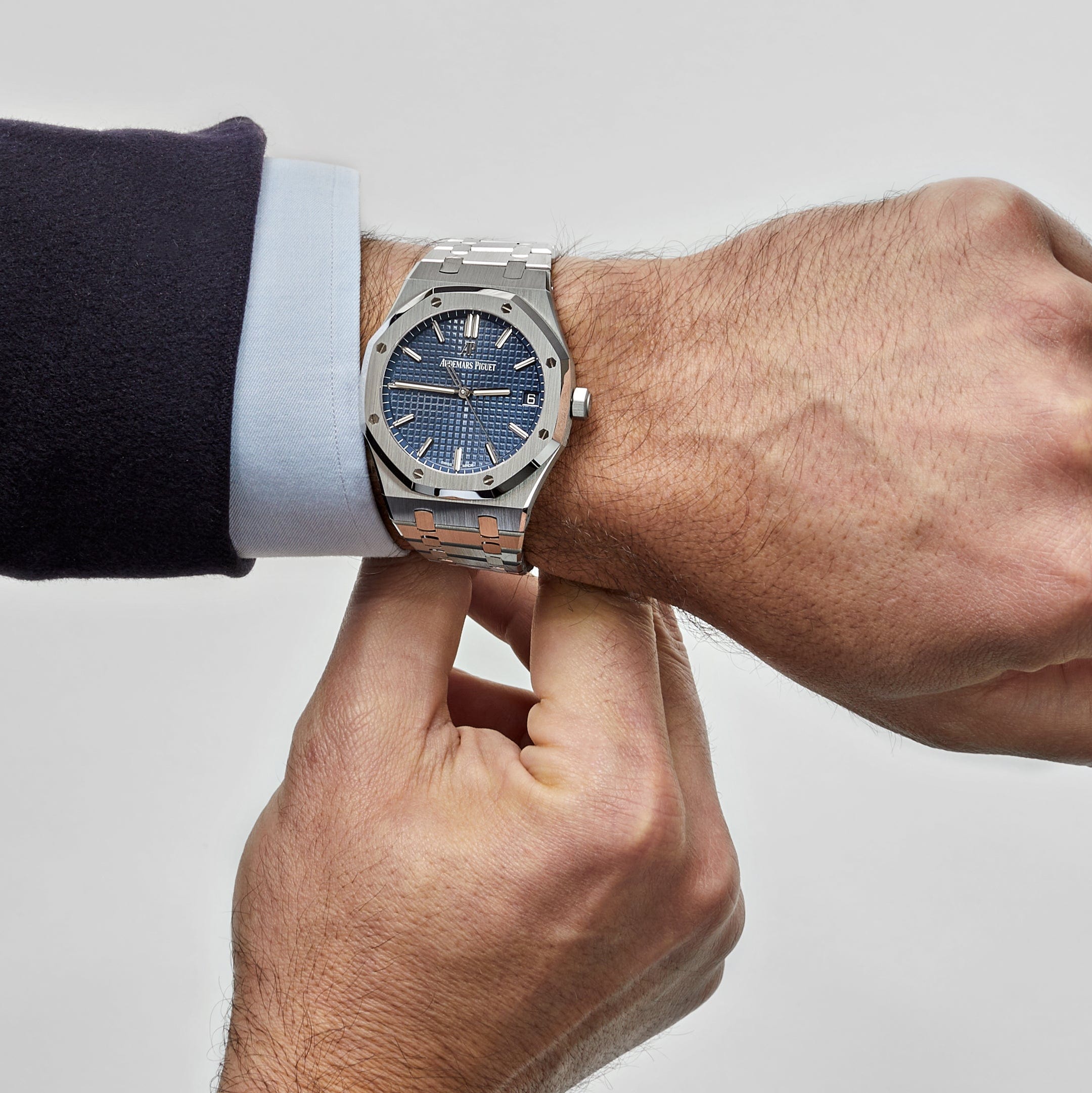
Genta’s Vision — Why the Royal Oak Matters
Gerald Genta sketched the Royal Oak on a hotel napkin the night before Baselworld 1972. Audemars Piguet needed a design that would justify selling a steel watch for the price of gold. Genta’s answer: make the steel itself the luxury. The octagonal bezel, inspired by a diver’s helmet porthole, transformed a base material into an icon. It was controversial — critics called it “ugly” and “too bold.” Within a decade, it had rewritten the rules of luxury watchmaking.
The Royal Oak’s design language is built on contrasts. Brushed surfaces against polished chamfers. The octagon of the bezel against the circle of the dial. The industrial aesthetic of exposed screws against the refined tapisserie pattern. These contrasts create visual tension that makes the watch endlessly interesting to look at — it’s never static, always revealing new details as light changes.
For replica factories, the Royal Oak is a torture test. Every surface has two finishes — brushed top, polished edge. The eight screws must align precisely. The tapisserie must have correct depth and consistency. The integrated bracelet must flow seamlessly from the case. Get any of these wrong, and the watch’s fundamental character changes. ZF Factory has come closest to capturing all of these elements simultaneously, which is why they dominate the Royal Oak replica market the way Clean dominates Submariner.
The Tapisserie — AP’s Signature Detail
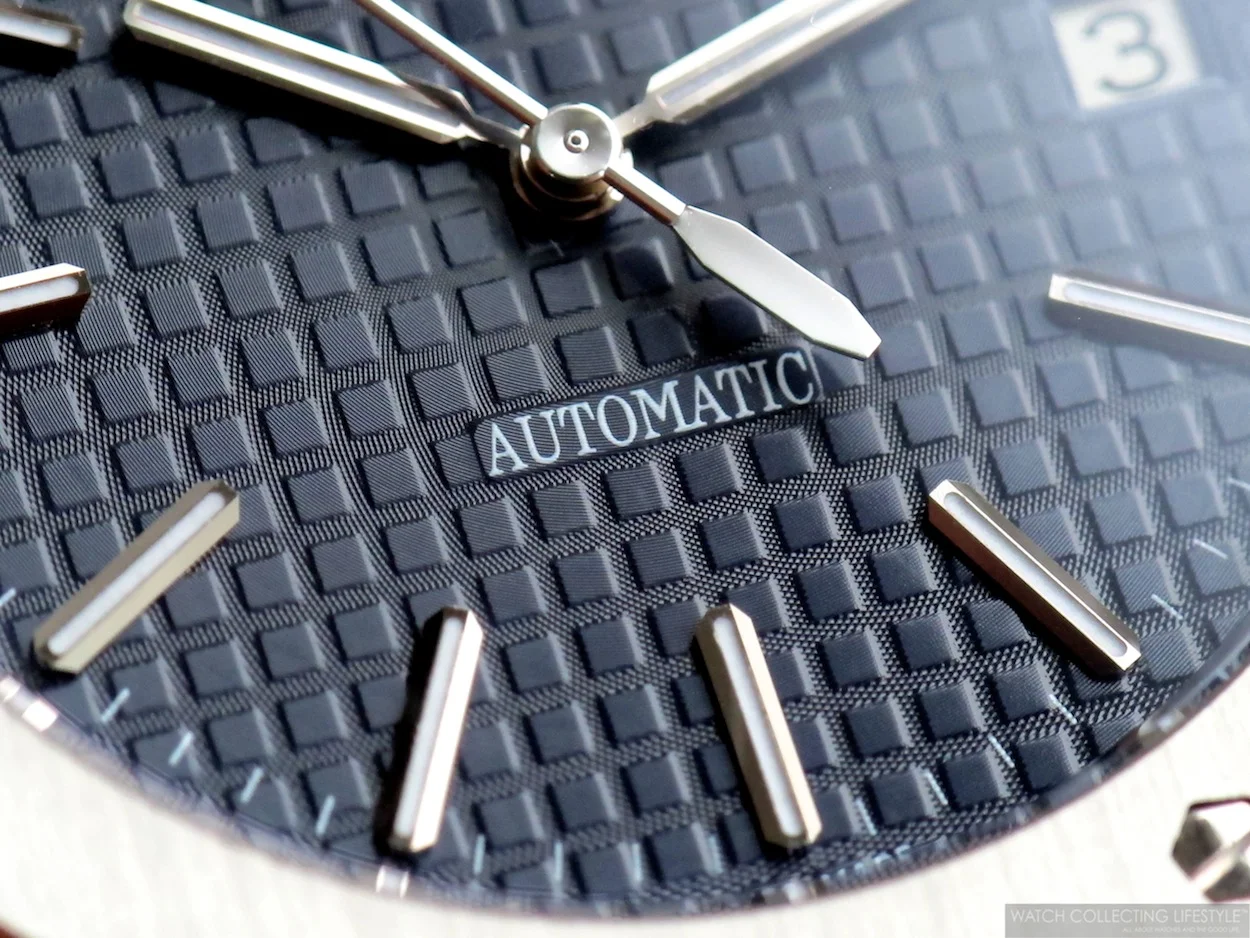
The “Grande Tapisserie” pattern is what makes a Royal Oak dial unmistakable. It’s a grid of small raised squares, each bordered by tiny channels, creating a checkerboard texture that plays with light as you move the watch. On genuine AP, this pattern is stamped into the dial with industrial precision — each square measures approximately 1mm x 1mm with channels about 0.15mm deep.
ZF’s tapisserie has improved dramatically over the past three years. Current production achieves approximately 95% accuracy relative to genuine. The pattern is crisp, the grid alignment is consistent from edge to edge, and the squares have the correct embossed profile — slightly raised in the center with clean borders. Where ZF’s tapisserie still falls marginally short: the depth of the channels between squares is about 10-15% shallower than genuine. This means the shadows between squares are slightly less pronounced under strong direct light. Under normal wearing conditions, this is invisible.
The tapisserie interacts differently with different dial colors. On the blue dial, the pattern creates a rich play of navy and steel-blue tones as light moves across it. On black, it adds texture without color variation. On white/silver, the pattern is most visible and most scrutinized — any imperfection in the stamping is more apparent on a light background. ZF’s blue dial tapisserie is their strongest; white is where the remaining 5% gap to genuine is most visible.
Collector Note: The genuine Royal Oak uses a “Petite Tapisserie” pattern on the subdials of chronograph models (smaller squares) and “Grande Tapisserie” on the main dial. ZF replicates both patterns correctly on their respective models — the scale difference between main dial and subdial textures is maintained.
Bezel Screws — The Eight-Point Test
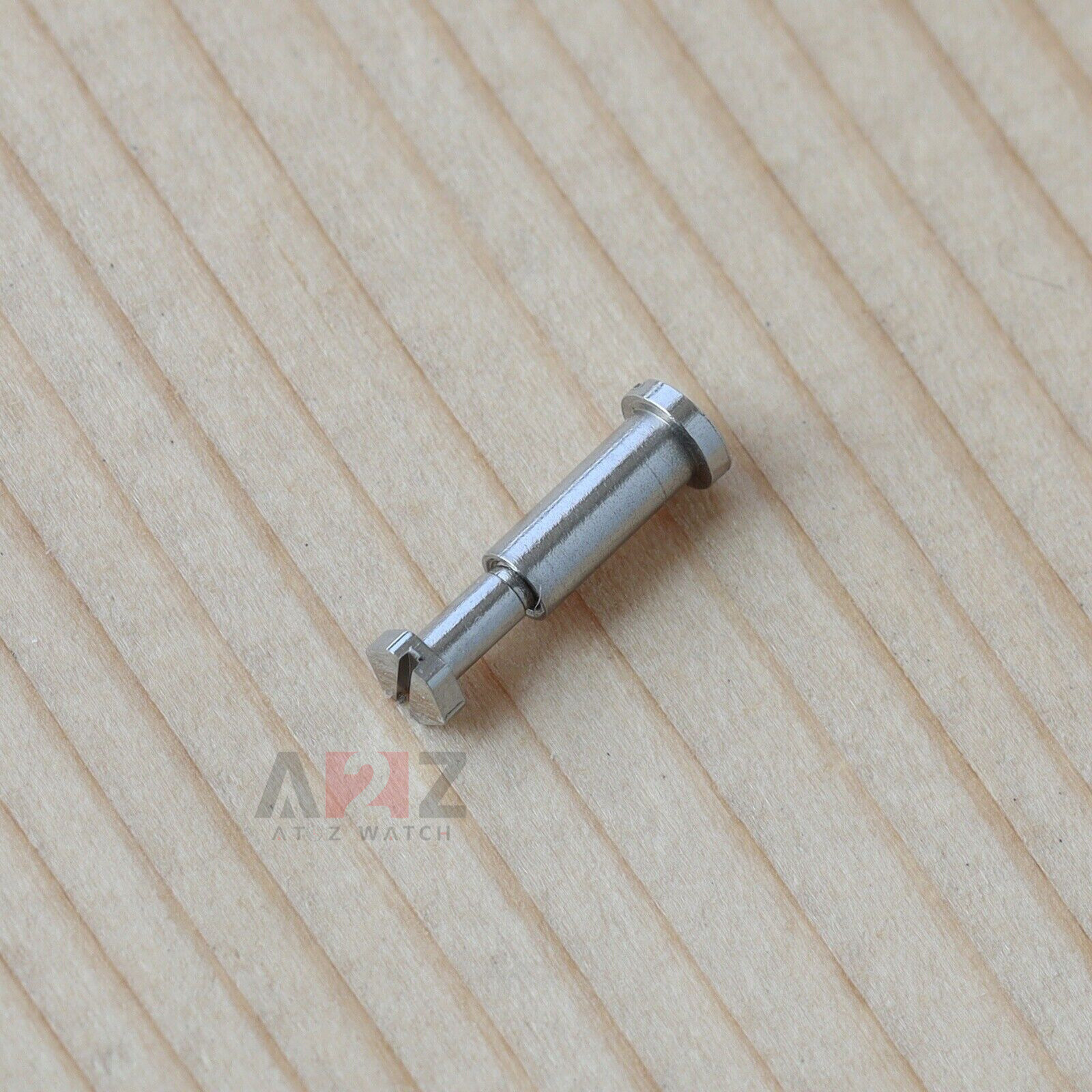
The eight hexagonal screws on the Royal Oak bezel are not decorative — on genuine AP, they actually secure the bezel to the case. Each screw is individually polished on its head while the bezel surface between screws is brushed, creating that signature alternating finish. The screws must sit flush with the bezel surface, each one aligned with its corresponding slot oriented in the correct direction.
ZF’s screw work is their strongest quality point. Each screw is correctly hexagonal with a polished flat head that sits flush with the bezel. The slot alignment follows the correct pattern — on genuine AP, the slots point toward the center of the watch at certain positions and perpendicular at others, following a specific pattern. ZF replicates this pattern correctly on their current production.
What to check in QC: examine each screw head for consistent polish. They should all have the same level of shine with no dull or scratched heads. The edges of each screw should be sharp and defined — blurry or rounded screw edges indicate lower production quality. The screw heads should be perfectly flat and flush with the bezel surface — no screw should protrude above or sink below the bezel plane.
The spacing between screws should be visually equal all around. Genuine AP uses CNC positioning to place screws at precise angular intervals. ZF’s positioning accuracy is within 0.2mm of genuine — imperceptible to the naked eye but confirming that they’re using proper CNC tooling rather than manual placement.
15500ST Blue Dial — The Benchmark
The 15500ST replaced the legendary 15400ST in 2019, gaining a thinner case profile and updated movement. The blue dial (ref. 15500ST.OO.1220ST.01) is the most popular reference and the one ZF has invested the most development resources into. It’s the Royal Oak equivalent of Clean’s Submariner 126610LN — the hero product that showcases the factory’s best capabilities.
The case measures 41mm in diameter and 10.4mm thick. ZF achieves this thickness within 0.1mm — their version measures approximately 10.4-10.5mm, which is remarkably close for a watch with this level of finishing complexity. The case shape follows AP’s distinctive design with the porthole-style bezel and integrated bracelet lugs that flow into the first links without visible transition.
The blue dial on ZF’s 15500 is their best color reproduction — a rich navy blue with the tapisserie creating subtle tonal variations as light plays across it. The applied AP logo at 12 o’clock and the baton indices at each hour position are correctly dimensioned with polished surfaces that reflect light sharply. The date window at 3 o’clock is cleanly cut with the correct frame thickness.
15500ST Black, White & Grey Dials
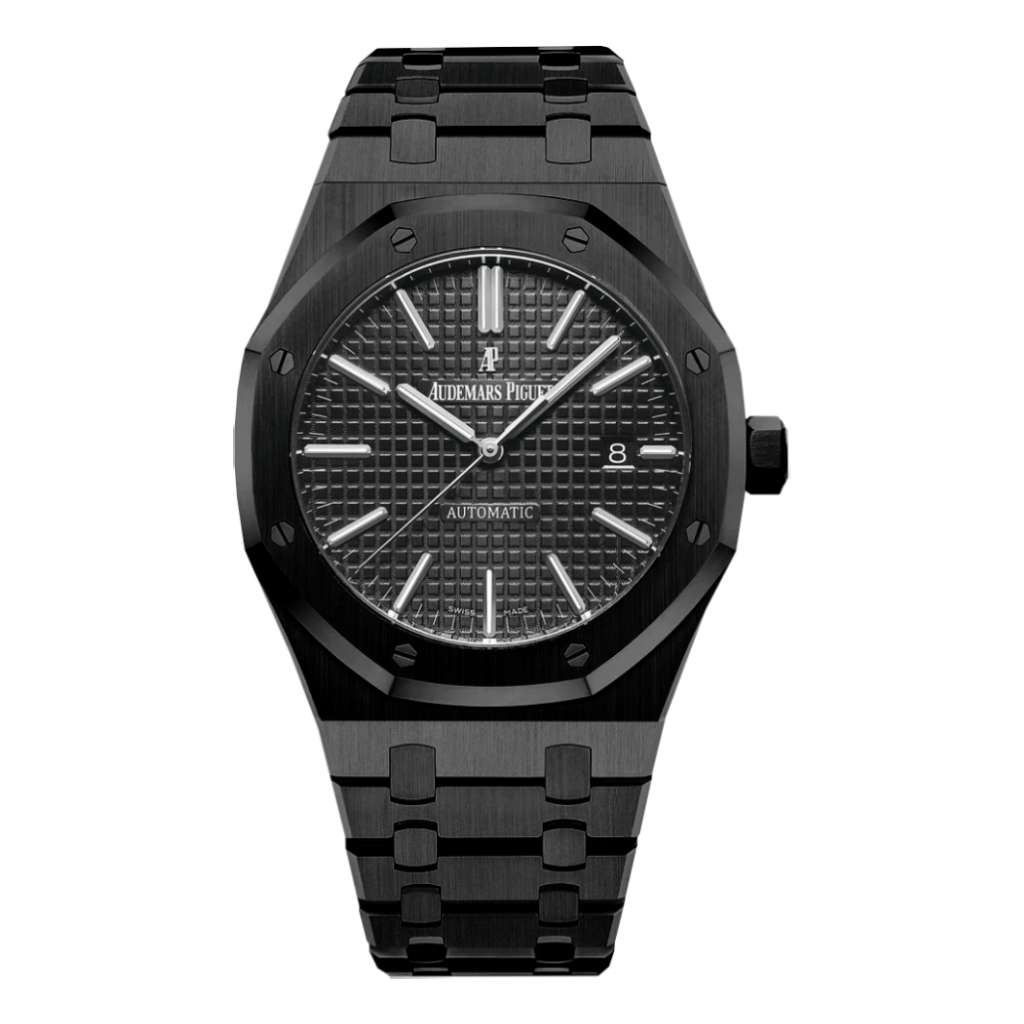
The black dial (15500ST.OO.1220ST.03) is the most versatile Royal Oak — the tapisserie adds texture to the black surface, creating depth that a plain black dial can’t match. ZF’s black dial reproduction is excellent, with the tapisserie pattern clearly visible but not overpowering. It’s the Royal Oak for people who want the design’s architectural impact with maximum daily wearability.
The white/silver dial (15500ST.OO.1220ST.04) is the most revealing — every detail of the tapisserie is visible on the light background, and any imperfection in the stamping stands out. ZF’s white dial is their most challenging production. Most units are very good, but this is the reference where careful QC photo review is most important. Look at the tapisserie uniformity across the entire dial — any area where the pattern appears inconsistent should trigger an RL.
The grey/slate dial (15500ST.OO.1220ST.02) offers a middle ground — the tapisserie is visible but the grey tone is forgiving of minor stamping variations. It’s the dial for people who want something less common than blue but less risky than white. The grey shifts between silver and dark grey depending on lighting, making it one of the most photogenically interesting dial options.
15202 “Jumbo” — The Ultra-Thin
The 15202ST is the Royal Oak “Jumbo” — the ultra-thin version that stays closest to Genta’s original 1972 design. At 39mm and just 8.1mm thick, it’s the Royal Oak for purists who value the original proportions. The genuine uses AP’s ultra-thin Cal. 2121 (now replaced by Cal. 7121 in the successor 16202).
ZF produces the 15202 with a modified Miyota 9015 movement that achieves approximately 8.5-8.7mm case thickness — slightly thicker than genuine’s 8.1mm. The difference is small but present in the side profile. For buyers who prioritize the slim aesthetic above all else, the Jumbo offers something the standard 15500 doesn’t — a watch that genuinely disappears under a shirt cuff.
The “Petite Tapisserie” pattern on the Jumbo (different from the Grande Tapisserie on the 15500) has smaller, more refined squares. ZF’s reproduction of this pattern is competent but slightly less precise than their Grande Tapisserie — the smaller scale makes manufacturing tolerances more critical.
Royal Oak Chronograph 26331
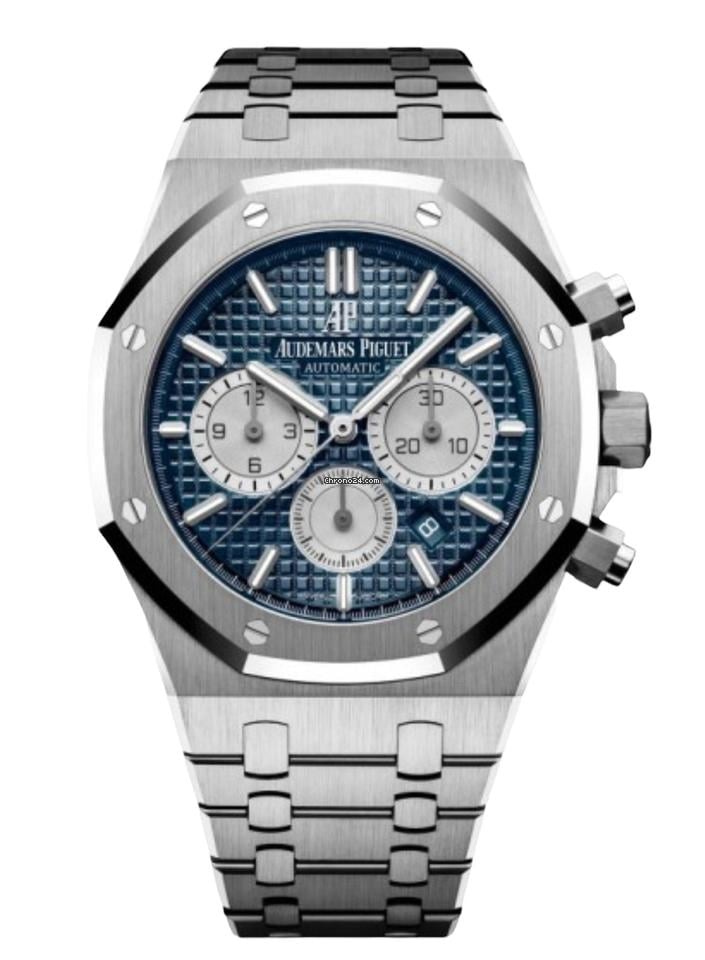
The Royal Oak Chronograph (ref. 26331ST) adds three subdials and pushers to the Royal Oak design, creating a more complex and visually busy watch. The “Panda” configuration — blue tapisserie main dial with silver subdials — is the most popular variant.
ZF uses a modified Asian chronograph movement (typically based on the Dandong 7750 or equivalent) that positions the subdials at 3, 6, and 9 o’clock — matching the genuine Cal. 2385’s layout. The chronograph functions work: start, stop, reset with the pushers at 2 and 4 o’clock. The case is thicker than the time-only 15500 — approximately 11.5mm versus 10.4mm — which is correct for a watch with a chronograph movement.
The chronograph Royal Oak is the more complex replica to produce. Additional subdials mean more printing, more tapisserie patterns (Petite Tapisserie on subdials), and more components to align. QC is correspondingly more important — check subdial hand alignment, chrono reset to zero, and pushers feel in addition to the standard Royal Oak checks.
ZF’s Movement Strategy
ZF takes a pragmatic approach to movements. Rather than developing a fully cloned AP caliber — which would be expensive and fragile — they use the Miyota 9015 as a base for time-only models. This Japanese automatic has been in production for over two decades, is available globally, and can be serviced by virtually any watchmaker. ZF modifies it with a decorated rotor and adapted date mechanism to match the genuine’s functionality.
The display caseback is worth discussing. The Royal Oak shows its movement through the sapphire back, which means ZF needs to make the movement look right. They add Geneva stripes (Cotes de Geneve) to the plates, perlage on the base plate, and a custom rotor with the AP logo. At arm’s length through the sapphire, the visual impression is correct. Under a loupe, a watchmaker would identify it as a Miyota derivative — but that’s an inspection scenario that doesn’t occur during normal wear.
Royal Oak QC Checklist
Royal Oak QC is more detailed than most Rolex models because of the complex finishing. In addition to the standard checks from our QC photos guide:
- All eight bezel screws — Each must be flush, polished, correctly aligned, and consistently sized. A single misaligned or dull screw is grounds for RL on a Royal Oak.
- Tapisserie uniformity — Check the entire dial for consistent pattern depth. Common issue: the tapisserie is slightly shallower near the date window cutout. Verify from edge to edge.
- Brushing direction — Horizontal brushing on case sides. Radial (circular) brushing on bezel flats. If any surface shows the wrong direction or inconsistent brushing, the watch’s visual harmony breaks.
- Chamfer lines — The transition between brushed and polished surfaces should be a clean, sharp line. Blurred or wavy chamfer lines indicate lower finishing quality.
- Bracelet integration — Where the bracelet meets the case should show no visible gap or misalignment. The integrated design means case and bracelet must flow as one piece.
- AP logo — The applied “AP” logo at 12 o’clock should be sharp, correctly sized, and centered. The crown at 3 should have a properly executed AP logo.
Royal Oak vs Offshore
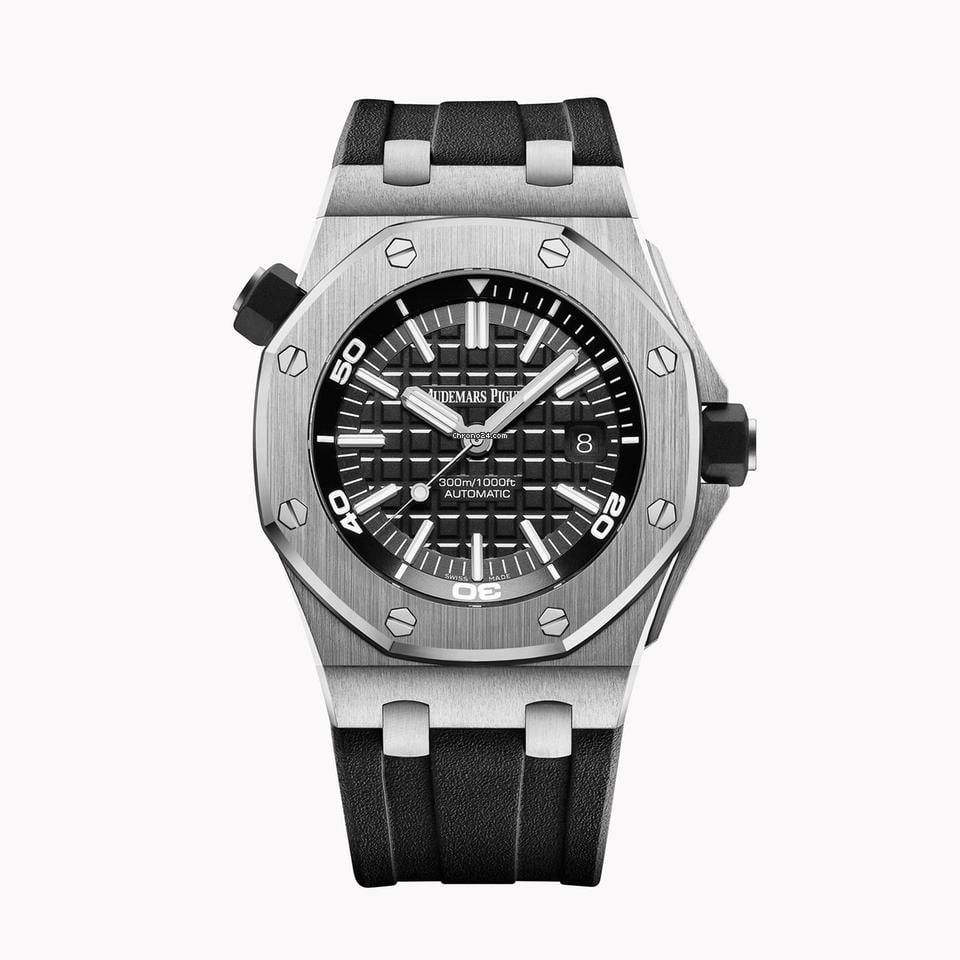
The Royal Oak Offshore is the Royal Oak’s bigger, bolder sibling — typically 42-44mm, thicker, with rubber strap options and more aggressive design elements. The Offshore was designed for people who want the AP DNA but in a sportier, more contemporary package.
In the replica world, ZF and JF both produce Offshore models. The Offshore Diver (ref. 15710ST) at 42mm is the most popular variant. The rubber strap eliminates the integrated bracelet challenge, which actually makes the Offshore easier to replicate accurately than the standard Royal Oak. The ceramic bezel on the Offshore Diver is well-executed by both factories.
Choose Royal Oak if: You want the original design language, the integrated bracelet, and a watch that works in both formal and casual settings. Choose Offshore if: You want a larger, sportier watch with rubber strap comfort and don’t mind sacrificing some of the Royal Oak’s dressed-up elegance.
Browse our complete Audemars Piguet collection to see all available Royal Oak and Offshore models.
FAQ — 15 Royal Oak Questions
How close is ZF’s tapisserie to genuine?
Approximately 95%. The pattern is correct in dimensions and layout. The remaining 5% is depth — ZF’s channels between squares are slightly shallower, producing less dramatic shadow play under direct light. Under normal viewing conditions (arm’s length, indoor lighting), the difference is invisible.
Is ZF the only option for Royal Oak?
ZF is the best for time-only models (15500, 15202). JF was the original Royal Oak clone leader and still produces acceptable versions. For the Offshore, both ZF and JF are viable. For the standard Royal Oak, ZF is the clear choice — better finishing, better tapisserie, more consistent QC.
Blue or black dial?
Blue is the iconic choice — the Royal Oak blue dial is one of the most recognized watch dials in the world. ZF’s blue reproduction is their best color. Black is more versatile and shows the tapisserie differently — texture without color change. For a first Royal Oak, blue is the recommendation. For daily versatility, black.
Can the Miyota 9015 be seen through the caseback?
Yes — the Royal Oak has a display caseback. ZF decorates the movement with Geneva stripes and a custom AP-engraved rotor. The visual impression at arm’s length is correct. A watchmaker would identify it under close inspection, but casual observers see an attractively decorated movement that matches the expected look.
What wrist size works best for the Royal Oak?
The 15500 at 41mm wears large due to its 50mm lug-to-lug span and angular design. Wrists 6.5″ and up carry it well. For smaller wrists, the 15202 “Jumbo” at 39mm is more proportionate. The Offshore at 42mm needs a 7″ wrist minimum to avoid looking oversized.
How does the brushing/polishing compare to genuine?
ZF’s alternating finish is the best in the market for AP replicas. The brushed surfaces have consistent directionality and grain. The polished chamfers are clean and reflective. The transition line between finishes is sharp. Genuine AP’s finishing is slightly more refined under magnification, but at normal viewing distances, ZF’s work is convincing.
Can I swim with the Royal Oak replica?
Genuine Royal Oak is rated to only 50m — it’s not designed for swimming despite being a “sports” watch. The replica provides basic splash resistance with the crown pushed in. Avoid submerging it. For water activities, use a Submariner or the Royal Oak Offshore Diver, which is designed for water exposure.
Are the screws actually functional on the replica?
On ZF’s version, the screws are decorative — they’re fixed in place and the bezel is secured differently than genuine. This has no practical impact on the watch’s function or durability. The screw heads are correctly shaped and positioned; they just don’t unscrew like genuine AP’s do.
Royal Oak or Nautilus replica?
The Royal Oak is bolder — its octagonal bezel and exposed screws demand attention. The Nautilus is more subtle — thin, smooth, understated. ZF’s Royal Oak is slightly more accurately replicated than 3KF’s Nautilus (95% vs 94%). The Royal Oak is for people who want their watch noticed. The Nautilus is for people who want their taste noticed. Read our icon comparison for the full breakdown.
How does the bracelet comfort compare to genuine?
ZF’s integrated bracelet is comfortable for daily wear — the links articulate smoothly and the butterfly clasp folds flat. Genuine AP’s bracelet has slightly more lateral flex between links, which some people prefer. The overall wearing experience is very similar — both are well-balanced watches that sit flat on the wrist.
What’s the biggest tell on a Royal Oak replica?
Tapisserie depth under strong direct light. In a well-lit environment with the light hitting the dial at a steep angle, the shallower channels on ZF’s version produce slightly less shadow contrast than genuine. Under normal indoor lighting or in photos, this is not detectable.
Does ZF make gold Royal Oaks?
Yes — ZF produces rose gold (15500OR) and yellow gold versions with their gold wrap technology. The rose gold Royal Oak is a stunning piece, but the same gold durability considerations from the Rolex Day-Date apply. For a first Royal Oak, the steel 15500ST is the strongest recommendation.
15500 or 15202 for a first Royal Oak?
The 15500. It’s ZF’s most refined Royal Oak production, offers more dial choices, and the 41mm size gives it presence on the wrist. The 15202 is for experienced collectors who specifically want the ultra-thin “Jumbo” proportions and don’t mind the slightly less precise tapisserie at that scale.
How long will the Miyota 9015 last?
With proper service every 3-5 years, the Miyota 9015 will run for a decade or more. It’s one of the most proven Japanese automatic movements in existence. Parts are cheap and abundantly available. Even if the movement fails completely, a replacement 9015 can be installed by any competent watchmaker for minimal cost.
What factory handles Royal Oak best overall?
ZF Factory, without question. For the standard Royal Oak, they produce the best tapisserie, the best bezel screw work, the best case finishing, and the most consistent overall quality. For a complete guide to all factories, see our factory guide. Browse our full AP collection.
Final Word
The Royal Oak is one of those watches that either clicks with you immediately or doesn’t. If the octagonal bezel, the tapisserie texture, and the industrial-luxury design language speak to you — ZF Factory produces a replica that captures approximately 95% of the genuine experience. The remaining 5% is in tapisserie depth and finishing refinement that only a direct side-by-side comparison under ideal conditions would reveal. For daily wear, the ZF Royal Oak delivers the presence, the wrist feel, and the visual impact that makes this watch one of the most desired timepieces in the world. The individual QC process is critical for this model — take your time reviewing the bezel screws, tapisserie uniformity, and brushing direction before you GL. See our complete 2026 guide for how the Royal Oak fits into the broader replica landscape.